49 works in this view — arrow keys or swipe to move between them.
Dance in Art
La promenade
Unknown artist
- Collection:
- Prints depicting dance
- Source:
- New York Public Library
- Rights:
- Public domain — free to use, share and adapt.
- Recorded as:
- Public Domain
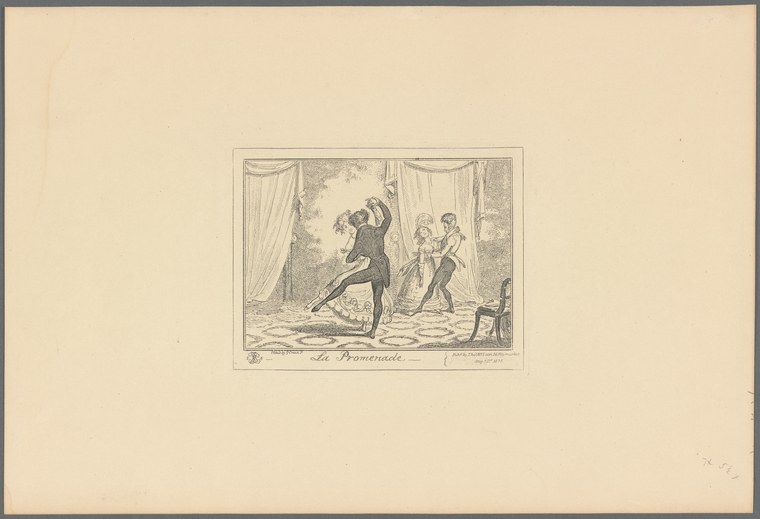
The promenade is invisible in most modern dance histories because it was never a named, independent form, yet it structured every ballroom evening and appears in dance notation from the Renaissance onward. This engraving makes visible the posture and bearing that dancers of the period would have spent hours perfecting, and it shows that the central work of ballroom dance was not virtuosity but the projection of refined, controlled presence.
What you are looking at
A fashionable couple promenade through an elegant interior, the woman in a flowing white gown and the man in dark coat and breeches, moving across a parquet floor toward two attendants by tall draped windows. The woman's posture is upright and composed, her arm linked or extended toward her partner as they progress in a stately, measured pace. The setting evokes a grand salon or ballroom of the late eighteenth century, with classical drapery and restrained neoclassical furnishings. The engraving technique renders fine detail in the fabrics and architectural elements, and the composition—with its leisurely forward motion and formal bearing—captures the ritualized, aristocratic character of promenade dancing as a social performance rather than a vigorous display.
The dancing
The lead figure moves with an extended leg in a walking stride, the body held erect in the classical posture demanded of courtly dance. The woman beside him is similarly upright, her arm and body alignment suggesting a connected but not tightly closed hold—consistent with the promenade as a parade or procession rather than a partner embrace. Their movement is unrushed and lateral across the floor, emphasizing elegance and decorum. A second couple, smaller in the background, echoes the same formal deportment.
The dance depicted
This depicts the promenade, a staple of late-eighteenth-century ballroom society and a structural element in court dances and cotillions. The promenade was less a distinct dance than a formal mode of processional movement between figures or at the opening and conclusion of a dance; partners walked together in a composed, measured manner as a display of mutual attention and social grace. The image captures the promenade in its essential function: a moment of quiet aristocratic restraint between more active dance phases, where the primary content was sartorial display and the demonstration of refined deportment.
How it was made
This is a copper or steel engraving, a commercial technique that allowed multiple impressions and wide circulation among the educated classes. The fine parallel lines and delicate cross-hatching typical of engraving create subtle tonal gradations and detailed rendering of cloth and interior surfaces. The small scale and linear precision suggest this was likely a print for a dance manual, illustration to a novel, or a satirical or instructional broadsheet—all common markets for such images in the late 1700s. The artist's hand is not attributed in the record, but the competent execution and refined subject matter indicate professional production for a literate audience.
About this work
La Promenade is a late-eighteenth-century engraving documenting a fundamental element of aristocratic social dance: the formal, composed walk that framed more complex choreography. It captures a dance that was as much about display and social ritual as about movement, showing a couple moving through an elegant interior in the prescribed upright posture and measured pace expected of the ballroom. The image is a record of dance as etiquette—the body as a vehicle for class performance.
How to look at it
Attend to the posture: the straight spine, the extended leg, the composed arm position. These are not accidental details but the visible markers of training and status. Note also the scale and pace implied by the figures' placement and the width of the floor: the artist has chosen to freeze not a moment of climactic movement but a quiet passage, suggesting that the promenade's significance lay in its steadiness and restraint rather than in spectacle. The background couple echoes the foreground pair, emphasizing that this was a codified, repeatable social form.
The period
In the late eighteenth century, ballroom dance was undergoing gradual but significant change. The rigid court etiquette of the Baroque was giving way to more fluid and varied forms—quadrilles, cotillions, and country dances—yet the promenade persisted as a dignified structural element that opened and closed these dances. Prints such as this one circulated among the middle and upper classes as instructional aids or satirical commentary on fashionable society. The neoclassical interior and the refined, elongated figures reflect the taste of the era; the promenade itself was understood as the embodiment of rational, civilized deportment—neither showy nor informal.
Where it lives
The work is held in the New York Public Library's collection of prints depicting dance. The record provides no date, artist, or medium attribution; the identification of the work as an engraving and its probable dating to the late eighteenth century are inferred from stylistic analysis of the image itself.
Dance in this work
Questions about this work
What is a promenade in ballroom dance?
A promenade is a formal, measured walk in which partners move together across the dance floor, typically in an upright posture and with composed, sideways-facing alignment. It was not a complete dance form but a structural element—often an opening, closing, or transitional passage—in court and ballroom dances from the sixteenth century onward. The promenade displayed the dancers' bearing and mutual attention rather than their technical virtuosity.
How do I tell this is eighteenth-century dance and not earlier or later?
The neoclassical interior, the cut of the woman's high-waisted gown, the man's tailcoat silhouette, and the refined but not stiff posture all point to the late 1700s. The promenade itself appears across centuries, but this particular rendering—the scale, the formal salon setting, the printed medium—situates it in the commercial dance culture of the late Enlightenment.
Is this a painting or a print?
This is an engraving, a printmaking technique in which an image is incised into a metal plate and then inked and printed. The fine parallel lines visible throughout the image are characteristic of engraving. Engravings allowed many copies to be made and distributed, making them common for instructional and documentary purposes in the eighteenth century.
More dance artwork





