49 works in this view — arrow keys or swipe to move between them.
Dance in Art
Breaking up
Unknown artist
- Collection:
- Prints depicting dance
- Source:
- New York Public Library
- Rights:
- Public domain — free to use, share and adapt.
- Recorded as:
- Public Domain
This image is valuable evidence of how Victorians themselves understood the ballroom: not as a site of romantic grace but as a crowded, fatiguing, socially fraught event. It shows the actual dress, setting, and physical comportment of the period in satirical detail, and it reveals how artists and printmakers of the era used dance as a vehicle for social commentary. For historians of dance, it is one of many popular prints that shaped (and mocked) how ballroom dancing was imagined in the 19th century.
What you are looking at
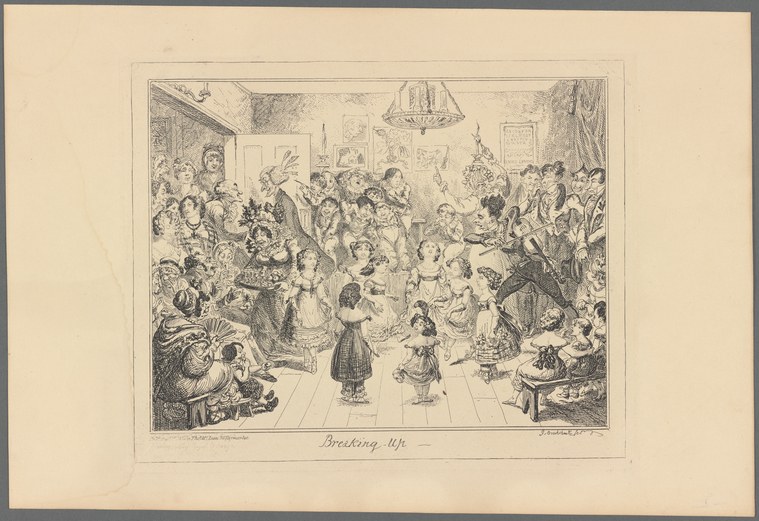
A crowded indoor social gathering, densely packed with figures in Victorian-era dress, occupies a parlor or ballroom lit by a hanging chandelier. The composition is deliberately chaotic: men in dark suits and women in elaborate dresses with full skirts and bonnets cluster in tight groups, some dancing, others conversing, eating, or simply standing. The title 'Breaking up' suggests this is the moment of dispersal—the end of a ball or party—captured mid-dissolution. The artist has layered the crowd so that figures overlap and recede, with the deepest space occupied by a doorway or exit. The engraving's fine hatching creates soft shadows and suggests movement through the density of line-work; the eye cannot rest on any single couple but is pulled across the whole agitated field.
The dancing
The figures are rendered in a theatrical shorthand typical of 19th-century social satire: exaggerated postures, turned-out toes, raised arms, and swaying torsos suggest the artifice and exhaustion of the ballroom. Couples appear in loose closed holds or arm-in-arm, some mid-pivot. The women's skirts splay and fold with the compression of the crowd. A child or small figure sits on the floor in the lower foreground, and the composition pulls the viewer's eye into the crush rather than offering a clear sightline to any individual pair. The bodies are animated but not uniformly graceful; some figures are slack or leaning.
The dance depicted
This is most likely a Regency or early Victorian social ball—a formal mixed-gender gathering of the gentry or merchant class where partner dancing (quadrilles, cotillions, waltzes, country dances) was the primary event. The 'breaking up' implies the final dances of the evening, when fatigue and disorder set in. The dress and setting point to the 1830s–1850s. The artist appears to satirise both the dancers and the ritual itself: the crowd is shown as exhausted, somewhat undignified, and caught in the act of losing formal composure. This is social satire, not a celebration of graceful technique.
How it was made
This is an engraving or etching, recognizable from the use of parallel and cross-hatched lines to build tone and shadow, the fine detail of the drapery and furnishings, and the consistent linear quality throughout. The technique allows for wide circulation as a print and suggests a middle-class audience—viewers with enough leisure and means to appreciate social satire. The density of line-work here is intentional: it mirrors the crowding of the scene and creates an almost frantic visual texture that conveys social confusion.
About this work
This print documents a formal Victorian social dance—the ball—at its moment of collapse. Rather than freezing a graceful moment, the artist has chosen the 'breaking up,' the end of the evening when order dissolves into fatigue and informality. It is a work of social observation and gentle mockery, using the dance floor as a stage for comment on class ritual, gender performance, and the gap between ideal (formal, composed, paired) and real (crowded, exhausted, chaotic). The engraving's circulation as a popular print suggests it resonated with viewers as recognisable satire of their own social world.
How to look at it
Look first at the composition as a whole: the artist has deliberately packed the frame to create visual and social congestion. Then move closer and attend to individual figures: notice the slack postures, the turned-away faces, the tangled skirts, the woman fanning herself in evident exhaustion. Look at the engraving technique itself—the heavy hatching that makes the image feel dense and almost nightmarish compared to the clean lines of formal dance prints. The title 'Breaking up' tells you this is not the opening minuet but the messy, human aftermath.
The period
The print belongs to a long tradition of 19th-century social satire in print form, when cheap engraved or lithographed illustrations were a major medium for comment on fashion, manners, and class. The Victorian ball was a rigid, codified ritual: formal dress was mandatory, steps were prescribed, partners were selected by rank and propriety, and the evening followed strict conventions. Yet it was also an occasion of real anxiety—eligible young people were on display, social hierarchies were reinforced, and physical fatigue was genuine. Satirists found rich material in the gap between the ideal of the refined ballroom and its actual experience.
Where it lives
This work is held in the New York Public Library's collection of dance-related prints, which suggests it was catalogued primarily for its depiction of social dance rather than as a major artistic or historical work. The catalogue record is minimal, which is typical for popular 19th-century prints that circulated widely and were often considered ephemeral.
Dance in this work
Questions about this work
What kind of dance is shown here?
This is a Victorian-era formal social ball, where guests danced quadrilles, cotillions, waltzes, and country dances in pairs. The 'breaking up' in the title refers to the final dances of the evening, when the rigid formality of earlier in the night has relaxed.
Is this a real scene or satirical?
It is social satire—a print made for amusement that exaggerates the chaos, exhaustion, and undignified moments of the ballroom. The artist is mocking both the dancers and the pretension of the ritual, not celebrating the elegance of formal dance.
When was this made?
The dress, furnishings, and style suggest the 1830s–1850s. The engraving technique and the social attitudes expressed are consistent with early Victorian popular print culture.
Why is the image so crowded and hard to read?
The density is deliberate: it conveys the actual crush of a ballroom, the difficulty of moving or dancing freely, and the visual and social chaos of the 'breaking up' moment. The engraver has used heavy line-work to reinforce this sense of disorder.
More dance artwork





