49 works in this view — arrow keys or swipe to move between them.
Dance in Art
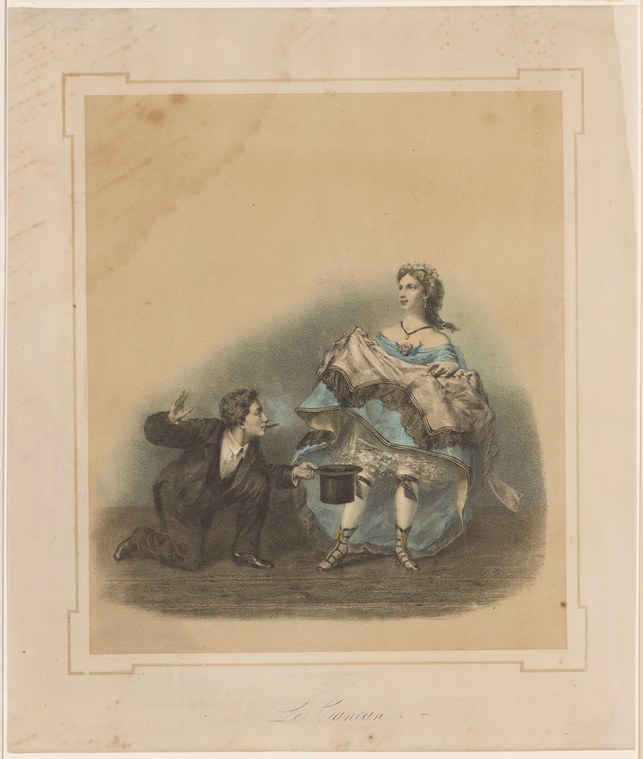
Le cancan
Unknown artist
- Collection:
- Prints depicting dance
- Source:
- New York Public Library
- Rights:
- Public domain — free to use, share and adapt.
- Recorded as:
- Public Domain
This print documents how the cancan was understood in the nineteenth century not as a specific dance technique but as a category of transgressive spectacle centered on the female leg and body. It reveals the gender dynamics and power relations embedded in how this dance was imagined and circulated in visual culture.
What you are looking at
A woman in theatrical dress reclines on a chair, her pale blue skirt voluminously gathered and lifted, one leg extended. A man in dark coat kneels or crouches beside her in an attitude of supplication or courtship. The woman gazes away with an air of disinterest or amusement; the man looks toward her with eager attention. The composition is intimate and playful, set against a neutral background with soft shading that creates depth. The woman wears what appears to be a corset or fitted bodice and heeled shoes; her hair is styled up. The print has a hand-colored quality, with tinted flesh tones and selective color in the costumes. The title "Le cancan" appears in script at the bottom of the page.
The dancing
The man's posture is one of exaggerated deference—knees bent, torso leaning forward in a posture of pursuit or pleading. The woman reclines passively, her body weight supported by the chair, one leg extended in a pointed or flexed position that shows off her leg and shoe. There is a studied asymmetry and imbalance in their poses: he is vertical and striving, she is horizontal and detached. The spatial relationship suggests a pantomimic moment of courtship or seduction rather than a step or figure executed by two people in concert.
The dance depicted
Despite the title, this does not depict the cancan as a stage dance. The cancan of the 1840s–1860s was a high-kicking group dance performed by women, often with skirts lifted to show legs and underpinnings—a spectacle valued for its energy and transgression. This print appears instead to document a moment of flirtation or seduction, possibly a scene from a theatrical or operatic work, in which the woman's lifted skirt serves as a prop of coquetry rather than the vigorous movement cancan requires. The artist may be using the title to invoke the cancan's reputation for scandal and licentiousness rather than to depict its actual choreography.
How it was made
This is a hand-colored engraving or lithograph, identifiable by the fine line work, the tonal modeling through parallel hatching and cross-hatching, and the selective application of watercolor or gouache to key areas—the woman's skirt, flesh tones, and the man's coat. The technique allowed for wide distribution as a print while retaining the finish and appeal of a drawing. The quality of line and the careful modeling of light suggest this was a work of some refinement, made for a middle-class market and likely issued in a series or album.
About this work
This print presents a theatrical or narrative moment labeled as the cancan, though it depicts not a dance but a staged scene of courtship or seduction. A woman reclines with her skirt lifted while a man kneels beside her in an attitude of pleading or devotion. The image trades on the cancan's reputation for transgression and display of the female body, but replaces the cancan's characteristic high kicks and collective energy with a more intimate and controlled pantomime of desire and resistance. The work belongs in a dance collection as an artifact of how the cancan was marketed, understood, and represented in the popular imagination of the nineteenth century—often more as a symbol of female sexuality and male pursuit than as a coherent choreographic form.
How to look at it
Attend to the theatrical framing and the moment chosen: this is not a dance in motion but a pause in a narrative of courtship, captured as if in a scene from a play or operetta. The woman's lifted skirt is the visual center, but her posture—reclining, looking away—transforms it from an active display (as in the cancan proper) into an object of masculine desire. Notice how the artist has used the print medium's capacity for fine line and tonal gradation to render fabric, flesh, and expression with theatrical precision. The work is about looking and being looked at, about the circulation of the female body as spectacle.
The artist
The artist is not recorded in the catalogue. The style and execution suggest a professional printmaker working in the mid-nineteenth century, likely in France or a French-influenced market, where the cancan was a subject of intense popular and satirical interest. The work's refinement and hand-coloring indicate it was made for a market that valued theatrical and narrative prints.
The period
The cancan emerged in Paris in the 1840s as a dance of working-class entertainers, scandalized critics, and fascinated audiences. By mid-century it had become a staple of music halls and operettas, and a subject of intense visual commentary in prints, caricatures, and lithographs. The 1850s–1860s saw an explosion of prints and images depicting or alluding to the cancan, many of them playing on its associations with female sexuality, disorder, and transgression rather than documenting the dance itself. This image sits within that broader visual culture of the cancan as a symbol and scandal.
Where it lives
This hand-colored engraving or lithograph is housed in the New York Public Library's Prints collection, which holds a broad range of nineteenth-century theatrical, satirical, and narrative prints. The work belongs to a category of reproductive prints made for popular circulation and consumption.
Dance in this work
Questions about this work
Is this a real depiction of the cancan dance?
Not in the technical sense. The cancan was a high-kicking, energetic group dance performed by women, often in a line or formation. This print shows a moment of courtship or seduction—a man kneeling beside a reclining woman—and uses the lifted skirt as a gesture of flirtation rather than as part of the vigorous kicking the cancan required. The artist appears to be trading on the cancan's reputation for scandal and display rather than documenting how it was actually danced.
Why is the woman's skirt lifted if she is not dancing?
In the nineteenth-century theatrical and narrative tradition, the lifted skirt was a visual code for coquetry, seduction, and the display of the female body. The print plays on the cancan's association with transgressive spectacle and the exposure of women's legs, but in a more controlled and intimate setting than a stage dance. It is an image about desire and power rather than about choreography.
What does this tell us about how the cancan was understood?
This print is evidence that the cancan was often understood in the popular imagination not as a specific dance form but as a category of transgressive female display and sexuality. The repeated appearance of such images in prints and satirical publications shows that the cancan's notoriety rested less on its actual technique than on its association with scandal, the body, and the complex power dynamics of performance and spectatorship.
More dance artwork





