49 works in this view — arrow keys or swipe to move between them.
Dance in Art
A country dance
Unknown artist
- Collection:
- Prints depicting dance
- Source:
- New York Public Library
- Rights:
- Public domain — free to use, share and adapt.
- Recorded as:
- Public Domain
This image documents a moment in one of history's most widespread and consequential dance forms—the country dance—at the height of its popularity. For historians and dancers, it provides visual evidence of how these dances were taught, demonstrated, and understood in the 18th century, showing the actual postures and groupings that written descriptions alone cannot convey.
What you are looking at
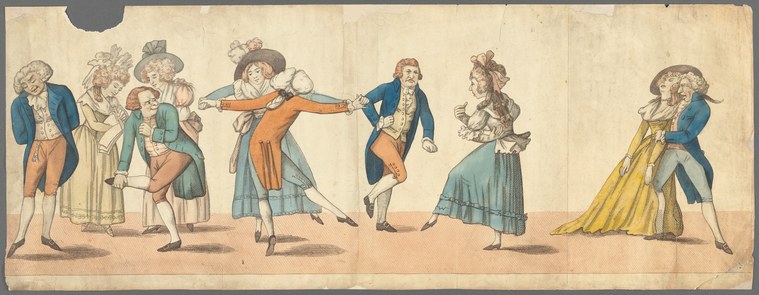
A hand-colored engraving depicts seven figures in 18th-century dress arranged across a shallow stage space, engaged in a country dance. The composition reads left to right as a narrative sequence: at far left, three figures (two women and a man) stand watching; next, a man in orange breeches and blue coat extends his arms in a wide gesture of invitation or demonstration; a man in dark coat and breeches stands to his right; a woman in a pale blue skirt and white bodice faces them; and at far right, a woman in a yellow-gold overdress and blue jacket completes the line. The figures are rendered in muted watercolor tones—ochre, blue, pale green, cream—against a plain background. The style is distinctly 18th century: the men wear breeches, coats, and hats; the women wear full skirts and fitted jackets. The scene has the character of an instructional or documentary image, capturing a moment of active dancing or demonstration rather than static formation.
The dancing
The central male figure dominates the composition through his open posture: both arms extended horizontally, one forward and one back, suggesting either an invitation to dance or an instruction to the group. His stance is upright and energetic, weight evenly distributed. The woman in pale blue faces him directly, her posture attentive. To the right, the woman in the yellow overdress raises one arm. The watching figures on the left stand in relaxed attitudes. The overall arrangement suggests a teaching moment or the opening of a dance figure where one dancer demonstrates and others prepare to join.
The dance depicted
This is almost certainly a country dance, as the title indicates. Country dances were the dominant social form in 18th-century Britain and were typically performed by multiple couples in a line or set. The composition suggests an instructional print showing how a dance began or a key figure within it—the active gesturing of the central male figure and the attentive positioning of the other dancers support this reading. The style of dress and the documentary character of the image are consistent with published dance instruction manuals or broadside prints of the period, which often illustrated the positions and sequences of popular dances.
How it was made
This is a hand-colored engraving, a common medium for dance instruction and entertainment prints in the 18th century. The image shows the characteristic fine lines of engraved plate work, with figures defined by thin parallel lines and cross-hatching for shading. Hand coloring in watercolor or gouache has been applied afterward—a labor-intensive process that made such prints relatively expensive. The technique allowed for clear documentation of costume and posture while reaching a wide audience through multiple prints from the same plate. The quality of both engraving and coloring suggests a professional workshop.
About this work
This engraved and hand-colored print captures a moment in an 18th-century country dance, likely from an instructional series or entertainment broadside. The scene shows seven figures in period dress arranged to demonstrate or participate in a dance figure, with a central male dancer extending both arms in a gesture that suggests either invitation or instruction. Country dances were the primary social dance form of the era, performed by multiple couples in sets and described in published manuals; images like this one served both as records of how dances were executed and as entertainment objects for a print-buying public. The print preserves not only the dance itself but the costumes, spatial arrangement, and social context of 18th-century dance practice.
How to look at it
Observe the central figure's open, inviting gesture and the responses of the other dancers—their posture and direction suggest they are watching, waiting, or about to join. The print captures a transitional moment, not a static pose, showing dance as a social and choreographed activity. Note the costume details: the precision of the breeches, coats, and women's skirts tells us about the physical constraints and possibilities of 18th-century dress in movement. The composition reads as a narrative, left to right, showing the social structure of the dance and the roles of different participants.
The period
Country dances emerged in England in the 16th century and became the dominant social dance form of the 18th century throughout Britain and continental Europe. They were performed at all social levels—from royal courts to country assemblies—and were codified in published dance manuals, most famously by John Playford (first published 1651) and later compilers. Engraved and hand-colored prints of dances were a thriving category of popular print in the 18th century, serving as both instruction and entertainment. Such prints documented costume, setting, and the social character of dance in the era. The rise of these prints parallels the professionalization of dance instruction and the standardization of country dance figures.
Where it lives
Held in the New York Public Library's collection of prints depicting dance. The work is part of a larger body of 18th-century dance imagery, mostly unattributed, that documents social and theatrical dance practice.
Dance in this work
Questions about this work
What is a country dance?
Country dances were social dances performed by multiple couples in lines or sets, with figures and sequences that were often described in published manuals. They dominated European social dancing from the 16th through 19th centuries and were performed at all social levels. The forms were relatively standardized, making them ideal subjects for instructional prints.
How were these prints made and used?
These images were engraved on metal plates and then hand-colored after printing, a labor-intensive but economical way to produce multiple copies. They served as instructional aids for dancers and dance teachers, as well as entertainment objects for collectors and the general public interested in fashion and social customs.
What can we learn about 18th-century dance from this image?
The print shows us the actual postures, gestures, and spatial relationships of country dancers; the precision of their costume; and the social character of the dance—the way dancers watched each other and responded to cues. It demonstrates that country dance was an active, choreographed, and socially structured activity, not a casual gathering.
More dance artwork





