49 works in this view — arrow keys or swipe to move between them.
Dance in Art
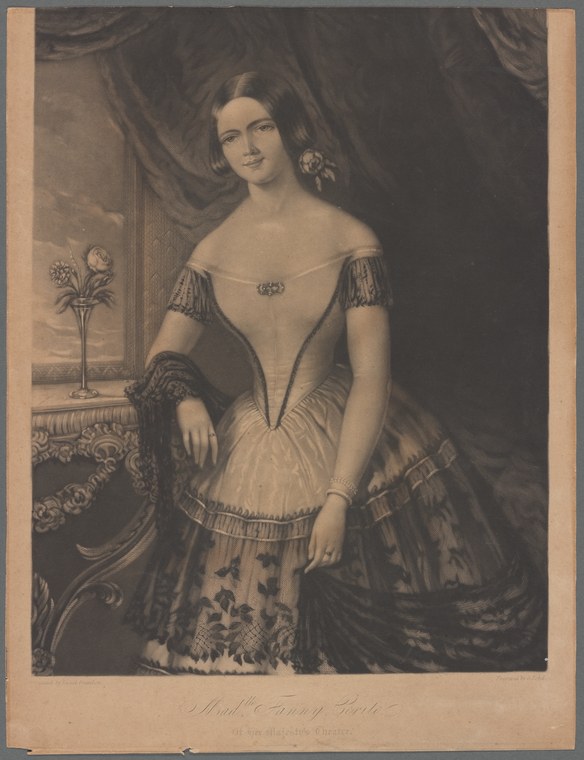
Madlle. Fanny Cerito of Her Majesty's Theatre
Unknown artist
- Collection:
- Prints depicting dance
- Source:
- New York Public Library
- Rights:
- Public domain — free to use, share and adapt.
- Recorded as:
- Public Domain
Cerito was one of the greatest ballerinas of the Romantic period, a creator and interpreter of roles that defined the era; this image preserves her likeness and documents the visual culture through which 19th-century theatrical celebrities were marketed and remembered. The print also reveals the gendered economics of ballet spectatorship: portraits of ballerinas vastly outnumber those of male dancers, and the emphasis on beauty and formal dress reflects the particular way women performers were commodified and consumed by the public.
What you are looking at
A three-quarter-length portrait of a woman in an elegant off-shoulder ball gown, posed in a refined interior setting. She stands in a controlled contrapposto, her weight settled on one leg, her gaze directed outward with the composed dignity expected of theatrical portraiture of the period. The gown features a deeply decolleté neckline with short fringe-trimmed sleeves, a fitted bodice adorned with an ornamental brooch, and a voluminous skirt with horizontal pleating and decorative embroidery at the hem. Her dark hair is parted centrally and adorned with what appears to be a jeweled ornament. To the left, a delicate vase with flowers sits on a draped table, establishing the fashionable interior. The background is rendered in soft tones with drapery suggested behind her, a convention of mid-19th-century portraiture. The overall composition emphasizes elegance and social status rather than motion or dance itself.
The dancing
The figure is a single woman in a standing pose that suggests readiness rather than active movement. Her posture is upright and dignified, with one arm resting naturally and the other positioned with hand to waist, a gesture that was conventional in formal portraiture of the period. Her silhouette, created by the architectural structure of the gown, conveys both poise and the physical control demanded of a professional dancer. There is no indication of a partner or ensemble; this is a solo portrait designed to showcase the subject's stage presence and formal beauty.
The dance depicted
This is a portrait of Fanny Cerito, a celebrated Italian-Danish ballerina of the Romantic era, depicted as she would have appeared in formal dress rather than in action on stage. Cerito was one of the leading ballerinas of the mid-19th century, known for technical brilliance and dramatic presence. The image does not depict her in a ballet pose or mid-performance; instead, it records her as a public figure and celebrity, the mode in which prints of theatrical performers were distributed to the public. Such portraits were often sold as engravings to fans and theatregoers, functioning as both souvenirs and advertisements.
How it was made
This is a hand-colored or tinted engraving, a reproductive print technique that allowed multiple copies to be produced and distributed widely. The fine line work visible in the rendering of fabric, the controlled use of tone, and the overall finish are consistent with steel-plate or copper-plate engraving. The subtle gradation in the background and the careful modeling of the face and fabric suggest the work of a skilled reproductive engraver. As an engraving, the work would have been affordable to theatregoers and collectors of theatrical prints, making Cerito's image accessible to a broad public audience.
About this work
This is a portrait engraving of Fanny Cerito, a principal ballerina of the Romantic ballet era, rendered not in performance but in the formal dress by which she would have been recognized in society. The work belongs to a vast 19th-century tradition of theatrical celebrity portraiture—prints that circulated in the thousands and defined how the public encountered performers they admired but could only see in person during theater seasons. Such images were as much about fame and social aspiration as about dance itself; they presented the performer as a fashionable, elegant, desirable figure. The engraving records not a moment of choreography but a moment of cultural presence, the still image through which a performer's fame was disseminated and endured.
How to look at it
Attend to the formality of the pose and the refinement of the dress: this is not a dance image but a celebrity image, and it records the cultural moment in which a ballet dancer's public identity was inseparable from her beauty and elegance as a fashionable woman. The print was made to be owned, displayed, and exchanged; look at it as a 19th-century fan or theater-goer would have—as a souvenir of an admired performer, proof of connection to the world of fashion and theater. The inscription below the image formally records her name and theater affiliation, turning the portrait into a document of her professional identity.
The artist
The artist is not recorded. The engraving was likely produced by a London reproductive engraver working for a print publisher; the inscription and the notation of "Her Majesty's Theatre" (the opera house on the Haymarket) suggest it was made for the British market. Such theatrical portraits were produced in volume by commercial print shops, and the engraver's skill was in translating a painted portrait or a stage appearance into a saleable print, often with little credit given to the engraver themselves.
The period
The Romantic ballet era (1830s–1850s) was dominated by ballerinas in a way never before seen; the ballerina displaced the male dancer as the primary focus of choreography and audience desire. Cerito was at the height of her fame in the 1840s and 1850s, and her celebrity was sustained and amplified through print culture. The engraved portrait became the primary way most people encountered the performers they idolized; the theater was expensive and performances infrequent, but prints were cheap and permanent. This image was made during a moment when ballet was becoming a commercial entertainment industry in which the performer's image—off-stage, fashionable, desirable—was as marketable as her technical or artistic skill.
Where it lives
The work is held in the New York Public Library's collection of prints depicting dance. It is a commercial theatrical engraving, one of thousands produced in London and Paris during the 19th century. The NYPL collection represents a significant archive of such prints, which together document both the visual history of dance and the economics of theatrical celebrity.
Dance in this work
Questions about this work
Is this Fanny Cerito dancing?
No. This is a formal portrait of Cerito in her street dress, the kind of image that was sold to the public as a theatrical souvenir. It records her as a celebrity and fashionable woman, not in performance. The pose is dignified and controlled, befitting a Romantic-era ballerina, but she is not shown executing any choreography or dance movement.
Who was Fanny Cerito?
Cerito (1817–1909) was an Italian-Danish ballerina and one of the greatest performers of the Romantic era. She was celebrated for her technical skill, dramatic presence, and beauty, and appeared in the major theaters of Europe, including London, Paris, and Milan. She created roles in works by leading choreographers and was a major star of mid-19th-century ballet.
What was Her Majesty's Theatre?
Her Majesty's Theatre (later known as the Opera House) was located on the Haymarket in London and was one of the principal venues for opera and ballet in the 19th century. It was where many of the greatest ballet performances of the era were seen, and where Cerito appeared during London seasons.
Why are there so many engraved portraits of ballerinas?
Ballet was expensive to attend, and performances were infrequent. Engraved portraits were cheap to produce and widely distributed; they allowed the public to own images of performers they admired and could not regularly see. The print trade in theatrical celebrity was enormous, and ballerinas in particular were the subject of thousands of such images.
More dance artwork





