49 works in this view — arrow keys or swipe to move between them.
Dance in Art
Segen
Unknown artist
- Collection:
- Prints depicting dance
- Source:
- New York Public Library
- Rights:
- Public domain — free to use, share and adapt.
- Recorded as:
- Public Domain
This image captures a crucial moment in European dance history: the standardization of court dance technique and the use of engraved prints as a medium for teaching and enforcing aristocratic norms of bodily comportment. It shows not just what a court dancer looked like, but what was considered the correct and beautiful way for a gentleman to stand, move, and occupy space—a visual language of class and social order rendered in line and shadow.
What you are looking at
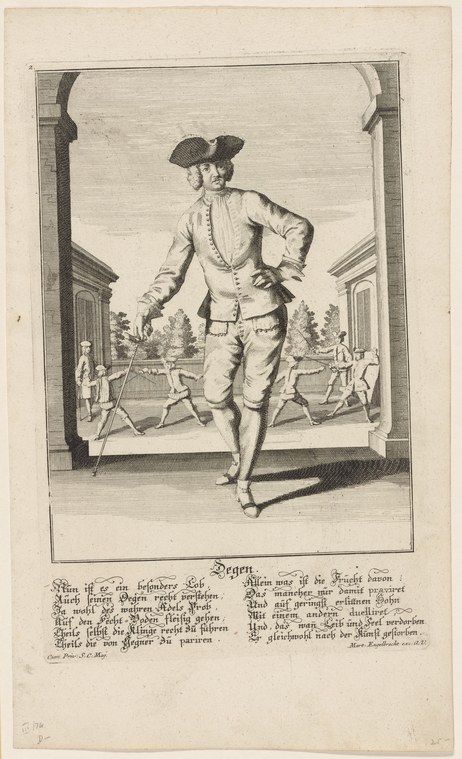
A single male dancer stands in a classical contrapposto pose within an architectural frame of rusticated stone columns and arches. He wears a fitted jacket with decorative buttons and embroidery, breeches, stockings, and a tricorn hat—the costume of 18th-century court dress. His left leg supports his weight while his right leg extends forward, knee slightly bent; his left arm rests at his side while his right arm is raised at the elbow. The pose is formal and self-contained, without a partner. Behind him, visible through the arch, is a garden or palace courtyard with symmetrical parterres and small figures of spectators or other dancers positioned at a distance. The ground is marked with a clear baseline suggesting a stage or performance space. The entire scene is rendered in the linear, high-contrast language of engraving, with careful attention to the play of light across fabric and flesh.
The dancing
The dancer's weight is clearly shifted to his left leg in a resting position; his right leg is lifted and extended, ready for movement. The arm positions are open and elevated rather than held in closed partnership—the raised right arm at mid-height, the left hanging freely. His torso is upright and his head held high, looking forward. The body demonstrates a command of vertical alignment and stillness appropriate to formal court dance. There is no partner visible, and the pose reads as a single figure study rather than a social or couple's dance.
The dance depicted
This is almost certainly a minuet or similar court dance of the 18th century, depicted as a single-figure study of the opening position and carriage required of a gentleman dancer. The engraving appears to be a dance instruction manual illustration or a record of court dancing practice, showing the idealized posture, leg position, and arm carriage expected in aristocratic ballroom dance. The garden setting and distant spectators suggest this is court entertainment rather than street performance, and the careful notation of every detail of costume and posture indicates this is an exemplary figure rather than a naturalistic moment.
How it was made
This is an engraving, identifiable by the uniform hatching, precise line work, and consistent tonal gradation achieved through parallel and crossing lines. The technique allowed for the production of multiple identical prints from a single plate, making it ideal for circulation among the dancing masters and aristocratic pupils who would study such instructional images. The medium's clarity and repeatability made it the standard vehicle for dance notation and instruction manuals throughout the 18th century. The careful architectural framing and the inclusion of title and text below suggests this is a single leaf from a larger instructional or allegorical series.
About this work
This engraving depicts an 18th-century gentleman in the formal dress and idealized posture of court dance, most likely a minuet or related baroque suite dance. It functions as both a portrait of aristocratic masculine elegance and an instructional image showing the correct carriage and leg position for formal ballroom dancing. The German text below and the allegorical or instructional framing suggest this is one plate from a dance manual or series of prints designed to teach court dancing to the nobility. Such prints were essential tools for spreading dance fashion and technique across Europe before the age of photography, making them primary documents of how dance was codified and transmitted.
How to look at it
Notice the careful balance between the two legs: one supporting the full weight, the other free and extended, creating the asymmetrical elegance that defines court dance posture. The raised arm and the open stance are not relaxed but rather a controlled, lifted carriage maintained through constant tension. The artist has frozen the moment of a restful position within the dance—not mid-leap or mid-turn, but in a posed attitude that a master would use to demonstrate correct form to a student. The architectural frame elevates this from a mere portrait to an exemplary or ideal image.
The period
This engraving dates to the 18th century, an era of unprecedented codification and systematization of court dance across Europe. The minuet and other baroque suite dances had become the dominant social practice among the aristocracy, and printed instructional manuals—many featuring engraved figures in positions of instruction—were essential tools for spreading technique and etiquette. The architectural setting and the isolated male figure reflect the era's interest in anatomy, proportion, and the ideal human form, influenced by both classical revival and Enlightenment empiricism. Dance was increasingly viewed as a teachable system of positions and movements, rather than pure improvisation.
Where it lives
This work is held in the New York Public Library as part of their collection of prints depicting dance. The inclusion of German text and the style suggest it is likely from a German or German-speaking print tradition of the 18th century.
Dance in this work
Questions about this work
Is this a portrait of a real person, or an idealized figure?
This is an idealized instructional figure, not a portrait. It shows the correct posture and positioning for court dance rather than depicting a specific dancer or moment. The formal pose, the architectural framing, and the inclusion of text all indicate this is from a manual or allegorical series designed to teach dance technique.
What dance is being shown?
This is most likely a minuet or a related court dance of the baroque suite, shown in one of the basic positions used in instruction. The open stance, the leg position, and the formal dress are all consistent with 18th-century court dancing. Without translation of the German text, the specific dance cannot be confirmed, but the posture and carriage are those of formal aristocratic ballroom dance.
Why is he alone? Where is his partner?
This is a single-figure study, designed to show the correct carriage and positioning for a male dancer independent of his partner. Such instructional prints often depicted individual figures to focus on correct posture, weight distribution, and arm position. In actual performance, a minuet dancer would have a partner, but this image is isolating the gentleman's form to make the teaching clear.
More dance artwork





