49 works in this view — arrow keys or swipe to move between them.
Dance in Art
Child dancers
Unknown artist
- Collection:
- Prints depicting dance
- Source:
- New York Public Library
- Rights:
- Public domain — free to use, share and adapt.
- Recorded as:
- Public Domain
This work documents the pedagogy of early 19th-century social dance and the role of dance in childhood education and socialization among the gentry and middle classes. It is rare visual evidence of how dance instruction was actually conceived and staged in the period, showing the relationship between teacher and pupil and the emphasis on formal, demonstrative teaching of ballroom forms. For historians of dance, dance pedagogy, and the social history of childhood, it is an economical and legible source.
What you are looking at
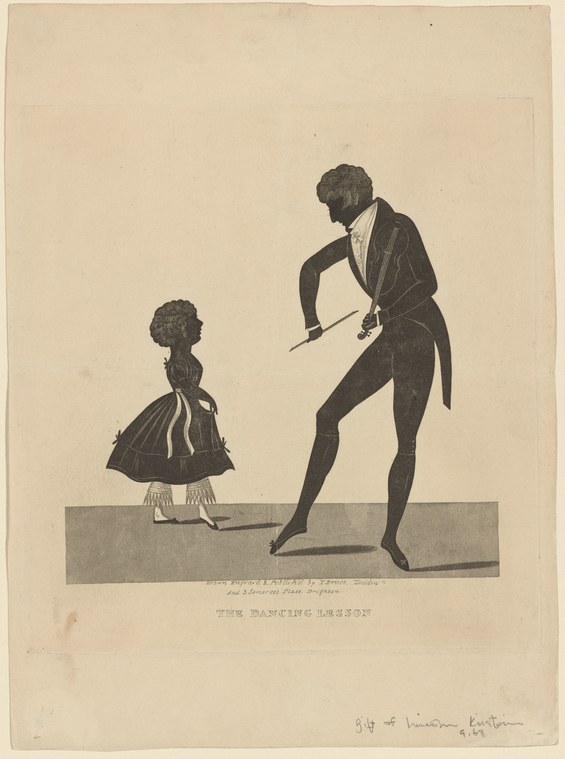
A silhouetted engraving shows two figures against a neutral ground: a taller adult man in formal dress—tailcoat, white shirt front, fitted breeches, and heeled shoes—and a much smaller child in a full-skirted dress with a fitted bodice. The man stands in a pronounced pose with one leg extended and bent, his torso leaning forward with one arm gesturing downward in instruction or demonstration. The child stands facing him, small and attentive. The title at the base reads "THE DANCING LESSON," and the engraving employs strong silhouette and shadow to create drama and clarity of line. The composition isolates the pair against blank space, focusing all attention on the geometry of their bodies and the relationship between instructor and pupil.
The dancing
The man's body language reads as actively teaching: his weight is shifted onto a bent supporting leg while the other extends, his torso inclines forward, and his arm reaches toward the child in a directing gesture. His posture suggests he is demonstrating a step or position. The child is much smaller in scale and stands in a more upright, attentive posture, watching the man's body. Their spatial relationship is intimate but formal—master and student—with no physical contact between them. The artist has rendered both figures in pure silhouette, which emphasizes the clarity and legibility of the instructional pose.
The dance depicted
This is a pedagogical image of early 19th-century ballroom dance instruction, most likely depicting the teaching of country dance, cotillion, or early regency-era ballroom forms. The man's extended leg and forward incline are characteristic of the demonstrative posture a master would adopt to show footwork or a step to a beginner. The child appears to be learning basic positions and movement from an adult (likely a parent, dance master, or family member). The formality of dress and the enclosed, staged quality of the scene suggests this is a teaching moment of some gentility—dance instruction in a domestic or academy setting rather than folk or recreational dance. The silhouette style and the period dress (early 19th-century men's fashion) place this securely in the regency or immediate post-regency era.
How it was made
This is a silhouette engraving or possibly an aquatint, executed in black and white with high contrast. The technique of silhouette was popular in the late 18th and early 19th centuries, particularly for satirical, instructional, and domestic subjects. The use of pure black figures against white ground allowed for rapid, economical production and circulation, making such prints affordable for middle-class audiences. The clarity of outline and the flattened perspective served both aesthetic and didactic purposes—the viewer immediately grasps the instructional moment without distraction from background or realistic detail. The technique was well suited to teaching images, where the legibility of body position was paramount.
About this work
"The Dancing Lesson" is a satirical or documentary silhouette engraving from the early 19th century depicting an adult teaching a child the elements of ballroom dance. The work belongs to a substantial genre of instructional and social-commentary prints about dance, deportment, and etiquette that flourished during the Regency and Romantic periods. These prints were both tools for teaching dance and materials for social satire—they could be read as earnest instruction or as gentle mockery of the affectations of polite society.
The image captures a moment of cultural transmission: the passing of refinement and social accomplishment from one generation to the next. The formal dress, the careful posture, and the staged isolation of the figures all underline that ballroom dancing was a marker of gentility and education. This small print circulated among educated, middle-class viewers and belonged to a broader visual culture of satirical social observation that includes Rowlandson, Gillray, and their successors.
How to look at it
Observe the angle and extension of the man's supporting leg and the forward pitch of his torso—these are the teacher's body at the moment of demonstration, showing a pupil how weight and line should work. Notice how his gesturing arm points downward, toward the child's feet or lower body, as if directing attention to footwork or a step. The child's smaller scale and upright stance convey readiness to learn and obedience. The complete silhouette means the artist has reduced the scene to pure geometry of posture and relationship, eliminating all distracting detail—the viewer sees only what matters for understanding the teaching moment.
The period
The Regency and early romantic period (c. 1810–1830) saw a boom in satirical and instructional prints about social behavior, manners, and accomplishments. Dance—particularly ballroom dance, country dance, and the quadrille—was central to courtship, sociability, and the performance of social status. Children of genteel families received formal instruction in dancing as part of their education in deportment; dance masters were established professionals, and instruction was often conducted in domestic settings or in academies. The silhouette technique, borrowed from 18th-century portrait practice, became a popular vehicle for satirical and observational prints about society. The period also saw the rise of the quadrille, the German, and other fashionable ballroom forms that required instruction and were frequently the subject of satirical commentary.
Where it lives
Held in the New York Public Library's collection of prints depicting dance. The work is catalogued as "Child dancers" but the inscription on the print itself reads "The Dancing Lesson," indicating its original title and instructional or satirical intent.
Dance in this work
Questions about this work
Is this a teaching manual or a satirical print?
It may be both. Early 19th-century prints of dance often occupied the space between earnest instruction and gentle social satire. The formal technique and clear silhouette suggest it could be used as teaching material, but the exaggerated posture and the juxtaposition of adult and child also allow for comic reading. Without an artist attribution or publisher's mark, the original intent cannot be definitively established, but the image works effectively either way.
What dance is being taught here?
Most likely a country dance, cotillion, or quadrille—the fashionable ballroom forms of the Regency period. The man's demonstrative posture with extended leg and forward lean is typical of how a dance master would show a step or weight transfer. The formal dress and domestic or academy setting confirm this is genteel ballroom instruction, not folk or recreational dance.
Why use silhouette for a dance image?
Silhouette was economical to produce and distribute, making it ideal for prints aimed at a broad middle-class audience. More importantly, the pure outline and stark contrast made the geometry of body position unmistakably clear—essential for an instructional or observational image where the viewer needs to read posture and movement at a glance. The technique also allowed for satirical exaggeration without realistic detail.
More dance artwork





