49 works in this view — arrow keys or swipe to move between them.
Dance in Art
Child dancers
Unknown artist
- Collection:
- Prints depicting dance
- Source:
- New York Public Library
- Rights:
- Public domain — free to use, share and adapt.
- Recorded as:
- Public Domain
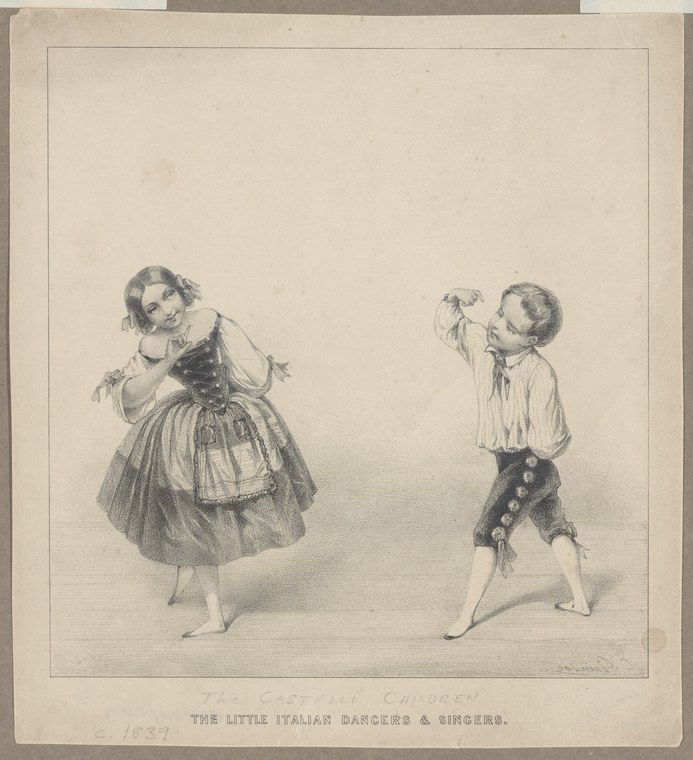
This image documents a specific theatrical tradition—the importation and performance of 'exotic' child performers—and how dance was packaged and promoted in nineteenth-century popular culture. It shows how performance imagery was used to create and sell celebrity and novelty, and how children's bodies were displayed in commercial theatrical contexts.
What you are looking at
A young girl in a full-skirted dress with horizontal stripes or bands stands in profile on the left, her body inclined slightly forward with arms extended, in a posture suggesting active performance. To her right stands a young boy in light shirt and dark breeches with decorative buttons, also in profile, looking toward the girl with one arm raised and fingers to his face in a gesture of attention or admiration. The composition is spare and intimate, set against a plain background with a ruled border frame. The figures appear to be posed mid-gesture rather than mid-movement, creating a moment of interaction or courtship. The engraving technique renders the scene with fine cross-hatching to suggest fabric texture and volume, particularly in the girl's skirt.
The dancing
Both figures are rendered with careful attention to posture and proportion befitting child dancers. The girl's stance is open and forward-leaning, with her skirt's weight and volume emphasized by the horizontal band pattern; her arms are extended in an expressive rather than balletic frame. The boy's posture is more restrained, his raised hand and turned head directed toward the girl in a gesture of courtship or admiration. Neither figure displays the rigid turnout or arm carriage of formal ballet technique; their movement is more naturalistic and gestural, consistent with theatrical pantomime or character dance of the period.
The dance depicted
This appears to be a scene from nineteenth-century theatrical dance, possibly a character piece or operatic interlude rather than classical ballet. The title 'The Little Italian Dancers & Singers' suggests a performance tradition of young Italian dancers imported to Europe as novelties, often appearing in mixed entertainments combining song, pantomime, and dance. The image captures a moment of theatrical interaction or courtship rather than displaying any specific codified technique. The girl's skirt and posture suggest popular or folk-influenced movement rather than the discipline of Romantic ballet, though the theatrical context and the printed circulation of the image indicate professional or semi-professional performance.
How it was made
This is a lithograph or engraving from the mid-to-late nineteenth century, executed with fine line work and cross-hatching to create tone and texture. The medium allowed for relatively affordable reproduction and wide circulation, suggesting this was a popular image—likely a print sold separately or in a series, or included in a theatrical publication or souvenir. The technique's capacity for fine detail and portraiture made it ideal for capturing the likenesses and costumes of celebrated performers or performance types. The ruled border and careful composition suggest a formal presentation typical of theatrical publicity prints of the era.
About this work
This is a theatrical publicity print depicting two child performers identified as 'Little Italian Dancers & Singers,' a category of imported entertainer that was popular in European theaters during the nineteenth century. The image shows a boy and girl in an intimate moment of staged courtship or flirtation, their costumes and gesture suggesting a character piece or pantomimic interlude rather than classical ballet. The print circulated as a souvenir or publicity material, reflecting the fascination with exotic and youthful performers that characterized nineteenth-century theatrical culture.
The work belongs to a broader tradition of dance imagery documenting theatrical types, fashions, and novelty performers rather than great classical choreography. It provides evidence of how dance was visualized and marketed to a popular audience, and of the role of children in commercial entertainment during this period.
How to look at it
Attend to the posture and costume of each figure, which tell different stories about how dance was performed and understood. The girl's forward lean, extended arms, and voluminous skirt suggest a style that valued expressiveness and visual spectacle over technical virtuosity; the boy's pose is more restrained but equally theatrical in its address to the viewer. The moment chosen is not a peak of physical action but a moment of social or romantic interaction, suggesting that theatrical dance of this type was as much about narrative and character as about movement vocabulary. The engraving technique allows you to see the careful rendering of fabrics and the subtlety of gesture that would have been visible to an audience in a theater lit by gaslight.
The period
The nineteenth century saw a flourishing market in theatrical prints and a corresponding appetite for images of celebrated performers and performance types. This coincided with the Romantic era in ballet and the rise of the ballet pantomime as a dominant theatrical form, yet the popularity of character dances, folk-influenced pieces, and 'exotic' performers suggests that academic ballet was only one part of a much broader dance culture. Italian singers and dancers, particularly children, were exported to other European centers as attractions, capitalizing on the association of Italy with musical and vocal tradition. The print medium allowed these images to circulate widely and serve as both publicity and souvenir.
Where it lives
This print is held in the New York Public Library's collection of prints depicting dance. It appears to be a nineteenth-century theatrical print, likely created for circulation as publicity or a souvenir, though its exact date and publisher are not currently recorded.
Dance in this work
Questions about this work
What are 'Little Italian Dancers'?
This refers to a category of child performers, usually Italian singers and dancers, who were imported to European theaters in the nineteenth century as exotic attractions. They typically performed in mixed entertainments combining song, dance, and pantomime, and were marketed to audiences as charming or novel performers. The title suggests this print documents a specific theatrical type rather than a single celebrated individual.
Is this ballet?
Not classical ballet. The posture, costume, and gesture suggest a theatrical character piece or pantomimic interlude, possibly influenced by folk or popular dance. While it dates from the era of Romantic ballet, it documents a different and probably more commercially oriented part of the theatrical dance world.
Why were child performers so common in nineteenth-century theater?
Children were valued as performers for their novelty, their perceived innocence, and their capacity to draw audiences. They were also cheaper to employ than adult performers and could be marketed on the basis of their rarity or exotic origin. The labor practices that made this possible would be considered exploitative by modern standards.
More dance artwork





