49 works in this view — arrow keys or swipe to move between them.
Dance in Art
Jim Crow!
Unknown artist
- Collection:
- Prints depicting dance
- Source:
- New York Public Library
- Rights:
- Public domain — free to use, share and adapt.
- Recorded as:
- Public Domain
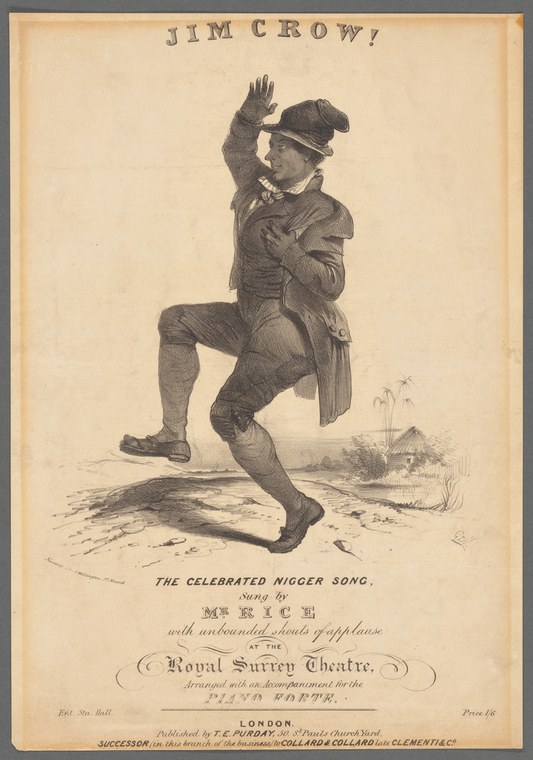
This image is essential historical documentation of minstrelsy—a performance tradition that shaped American popular dance, music, and comedy for over a century while systematizing the caricature and denigration of Black bodies and culture. Dancers and historians must understand minstrelsy's movement vocabulary and social function in order to recognize its ongoing influence in contemporary performance and to comprehend how racist entertainment was encoded into seemingly neutral physical technique. This print is not primarily a work of dance art to celebrate; it is a historical object that makes visible the formal and commercial apparatus of racial mockery.
What you are looking at
A single male figure dominates this engraved sheet music cover, captured mid-performance in an exuberant, high-stepping pose. He wears a fitted jacket, breeches, stockings, and a cap or hat, with one leg raised sharply and an arm extended upward in a gesture of celebratory movement. His body twists energetically, weight driven into his stance. The setting is minimal—a sparse ground line with a small distant building and reedy plants suggested in the background, typical of sheet music illustration. The figure's physique and posture suggest caricature: the proportions are exaggerated in ways common to satirical prints of the period. The title "JIM CROW!" appears in large letters above, and below the figure runs the subtitle "THE CELEBRATED NIGGER SONG." sung by Mr. T. D. Rice with additional verses gapplause at the Royal Surrey Theatre. This is a commercial music publication, as indicated by the publisher information at the base.
The dancing
The dancer is a solitary male figure captured in an explosive upward thrust, his raised leg bent at the knee and driven nearly to hip height. His weight appears driven onto the supporting leg, the body torqued and animated. One arm extends upward and back, the other held across the body. The proportions of the limbs and the caricatured features are pronounced and distorted. There is no partner or group; the energy is entirely individualistic and performative, directed outward toward an audience.
The dance depicted
This image documents the "Jim Crow" song-and-dance performance popularized by white performer Thomas D. Rice in blackface in the 1830s. The dance depicted here is a high-stepping, energetic style associated with minstrelsy—a form of entertainment in which white performers in blackface caricatured and mocked African American culture and bodies. The pose shown is characteristic of the exaggerated, physically expressive movement associated with early minstrel performance. This was not an authentic African American dance form but rather a dehumanizing parody marketed as entertainment. The dance style is theatrical and individualistic, with emphasis on high knee lifts, arm gestures, and overall comedic physicality designed to provoke laughter through caricature.
How it was made
This is a hand-colored engraving, printed from a copper plate with watercolor applied afterward—a common and economical method for disseminating illustrated sheet music in the 1830s–1840s. Engraving allowed fine linear detail in the figure's costume and facial features, and the technique's precision made it ideal for mass production and wide circulation. The coloring appears to be applied by hand in a simple palette, typical of the period. Such prints were affordable and intended for domestic or theatrical use, making this format crucial to the song's popularity and cultural reach.
About this work
This engraved sheet music cover documents one of the most harmful performance traditions in American entertainment history: the minstrel show, specifically the "Jim Crow" routine created and performed by white actor Thomas D. Rice in blackface in the 1830s. The image captures the exaggerated, high-stepping movement style associated with these performances—a style that caricatured and dehumanized African American bodies for white entertainment. The engraving shows the solitary performer in an energized upward-thrusting pose, legs and arms extended dynamically, a visual record of how minstrelsy codified racist caricature into a recognizable (and internationally popular) dance vocabulary. The print's survival in archives documents both the form's theatrical technique and its deep entanglement with American racism.
How to look at it
Observe the moment frozen here: the figure is captured not in repose but in explosive upward motion, the body twisted and extended, the weight committed to a single supporting leg. The artist has chosen a peak moment of energy and extension, making the performance look dynamic and entertaining to potential buyers of the sheet music. Note the distortion and caricature in the figure's proportions and features—this exaggeration was intentional and central to the minstrel aesthetic. The isolated figure against a minimal background emphasizes the individual performer and his physical display, the choreography of mockery.
The artist
The artist of this engraving is not recorded, but the print was published by T. E. Purday at St. Pauls Church Yard in London, indicating it was produced for British circulation during the height of Rice's international touring success. Such sheet music covers were typically executed by professional engravers working to deadline for publishers, not individually signed or preserved as fine art. The engraver's primary task was to create a recognizable, commercially legible image that would sell the song.
The period
The "Jim Crow" routine emerged in the early 1830s and became the most successful stage act of mid-nineteenth-century popular entertainment, influencing minstrel performance internationally. The print dates from the height of minstrelsy's popularity in Britain and America. At this time, minstrel shows were the dominant form of American theater, and the movement vocabulary they codified—high knee lifts, syncopated upper-body movement, and exaggerated physicality—became deeply embedded in American dance culture. Simultaneously, minstrelsy was being theorized (wrongly) as authentic or historically continuous with African American performance, when it was in fact a white-created caricature. This print circulated in a moment when minstrelsy was at peak cultural dominance and when its racist nature was not yet widely contested.
Where it lives
This print is held in the New York Public Library's collection of prints depicting dance. It is a commercial sheet music cover, one of thousands produced in this period, and its survival in an institutional collection reflects its historical significance rather than its rarity.
Dance in this work
Questions about this work
What is Jim Crow and why is it in a dance collection?
Jim Crow was a song-and-dance routine created and performed by white actor Thomas D. Rice in blackface starting in the 1830s. It became the most popular entertainment act of its era, exported internationally, and fundamentally shaped American popular dance vocabulary. It belongs in dance history collections because it is a foundational (and foundationally racist) form that influenced subsequent American dance, and because understanding minstrelsy's movement language is essential to recognizing how racism became embedded in American performance technique.
Is this dance form still performed?
Explicit minstrel performance has largely ended in mainstream entertainment, but the movement vocabulary and comedic tropes of minstrelsy persist in aspects of contemporary performance, often unrecognized. Historians and practitioners argue that recognizing minstrelsy's influence is necessary in order to identify and dismantle its legacy in modern dance, theater, and comedy.
Who was Thomas D. Rice?
Thomas D. Rice was a white American actor and entertainer who popularized the "Jim Crow" act in the early 1830s. He performed in blackface (darkening his skin with burnt cork) and created an exaggerated movement vocabulary meant to caricature Black people. His performances were enormously successful and toured internationally, making him one of the wealthiest and most famous entertainers of his era. The term "Jim Crow" later became the name for segregation laws throughout the American South.
More dance artwork





