49 works in this view — arrow keys or swipe to move between them.
Dance in Art
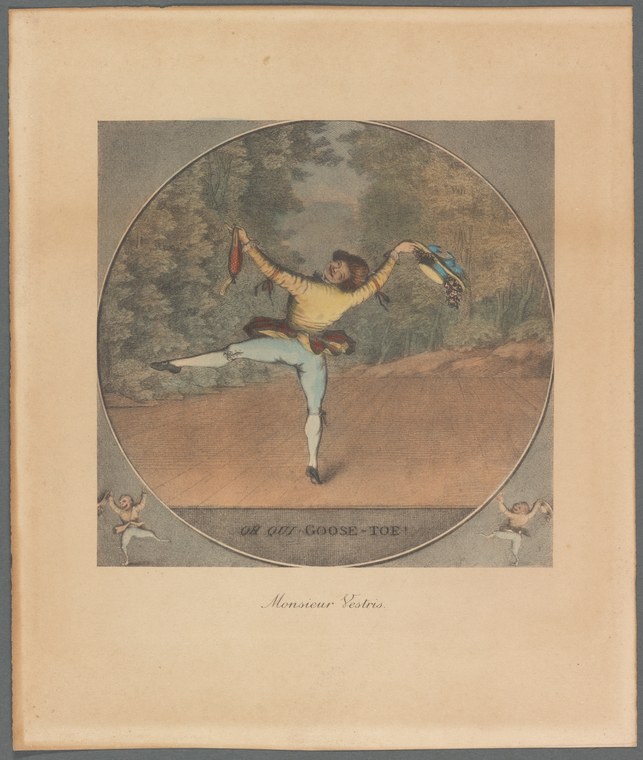
Oh qui goose-toe
Unknown artist
- Collection:
- Prints depicting dance
- Source:
- New York Public Library
- Rights:
- Public domain — free to use, share and adapt.
- Recorded as:
- Public Domain
This work documents the vocabulary and physical training of theatrical dance at a crucial moment in its history—the transition from Baroque to Classical ballet. For dancers and historians, it is a rare visual record of how a canonical step was understood and executed in the body, and it demonstrates that dance notation and teaching relied heavily on such printed images as well as written description.
What you are looking at
A male dancer in a yellow/cream-colored doublet and blue breeches executes a high, extended leg attitude on a warm ochre stage floor. The setting is minimal: a backdrop of muted greens and browns suggests a sylvan or theatrical space, with decorative putti (cherubs) flanking the circular composition at lower left and right. The dancer's pose is one of balletic elevation and extension—his body rises into the air with the supporting leg bent beneath him, his arms raised in a graceful upper-body frame. The circular framing device and the delicate figural ornaments create an emblematic or allegorical quality, as though this single moment has been lifted out of time to demonstrate a principle of movement or beauty. The pale cream background surrounding the composition gives it the character of a print or engraving mounted on a sheet.
The dancing
One male dancer, posed in a supported attitude or similar balletic extension—weight on one supporting leg (bent), the other leg extended at hip height, torso rising vertically. Both arms are elevated and extended; his frame is open and controlled. The musculature of his legs is articulated, and his posture shows the turnout and alignment expected of formal theatrical dance. This is a demonstration of a single step or position rather than narrative movement, and the artist has captured the hold and carriage of a trained dancer.
The dance depicted
This appears to be a depiction of formal theatrical dance from the late 18th century, most likely a step from the ballet or danse noble tradition. The pose—an attitude or similar elevated extension—was a fundamental position in the ballet vocabulary of this period. The yellow doublet and blue breeches are consistent with male theatrical dress of the Baroque and early Classical ballet era. The print's emblematic treatment (circular frame, allegorical ornament) suggests this is a didactic or illustrative work intended to codify and display a canonical step, rather than a scene from a specific ballet. The inscription 'Oh oui goose-toe' (or similar) may be a phonetic or corrupted transcription of a French dance term—possibly a variant of a known position name, though the exact reference remains unclear.
How it was made
This is a hand-colored engraving or etching, identifiable by the fine linear work visible in the background and the application of watercolor or gouache over a printed base. The technique allowed for precise articulation of the dancer's musculature and the delicate decorative elements (putti, framing circle), and it suggests a work of instructional or demonstration purpose meant for circulation among dance practitioners or the educated elite. The hand-coloring indicates this was a valuable object, not a mass-produced print, and the care taken with the composition suggests it was an important item in its original context.
About this work
This is a late 18th-century engraving depicting a male dancer executing a balletic attitude or elevated extension—a fundamental step in the formal dance vocabulary of the period. The dancer wears theatrical dress appropriate to ballet or danse noble: a yellow doublet, blue breeches, and heeled shoes. The circular framing and flanking putti give the image an emblematic or didactic quality, suggesting it was intended as an instructional illustration or a codification of proper form rather than a narrative scene. The work belongs to a tradition of dance instruction and representation that spans from the Renaissance through the Classical period, in which individual steps and positions were isolated and illustrated for study and reference.
How to look at it
Attend to the precision of the pose: the turnout of the legs, the carriage of the upper body, and the placement of the arms all reveal an artist who understood the formal requirements of ballet training. The isolation of a single figure against a neutral ground—a convention of dance instruction—invites the viewer to study the position without distraction. The raised circular frame and decorative elements, rather than obscuring the figure, emphasize its importance as a model or exemplar. The moment chosen is one of suspension and control, the moment of greatest extension and beauty, not a moment of transition or effort.
The period
This engraving dates to the late 18th century, a period when ballet was codifying its technique under figures like Jean-Georges Noverre (whose *Lettres sur la danse* appeared in 1760) and when the vocabulary of turnout, épaulement, and elevated positions was being systematized into the pedagogy still taught today. The use of prints to disseminate dance instruction was common in this era—choreographers and ballet masters published images of steps and positions to standardize training across Europe. The theatrical dress and the style of the engraving itself place this firmly in the Classical ballet moment, after the abandonment of the heavily ornamented Baroque court dress but before the Romantic tutu and ethereal aesthetic of the 1830s.
Where it lives
This work is held in the New York Public Library's collection of prints depicting dance, a major repository of such instructional and theatrical images. It is one of hundreds of European and American prints from the 18th and 19th centuries that document the physical forms and costumes of theatrical dance.
Dance in this work
Questions about this work
What does the title 'Oh oui goose-toe' mean?
The title is unclear and may represent a phonetic or corrupted transcription of a French dance term. It could be a variant spelling or colloquial reference to a named position in the ballet vocabulary of the period. Without further documentation, the exact meaning cannot be confirmed, but the image itself clearly depicts a balletic attitude or similar elevated extension.
Who would have used this print?
This was likely used by dance teachers, choreographers, and serious students of ballet as a reference for proper form and execution. Such prints were circulated in the studios and courts of Europe as part of the pedagogical apparatus for training dancers in the standardized technique of the period.
Is this from a specific ballet?
No. The isolated pose, emblematic framing, and instructional character indicate this is a demonstration of a canonical step or position, not a scene from a narrative ballet. It belongs to the tradition of dance instruction, in which individual movements were codified and illustrated.
More dance artwork





