49 works in this view — arrow keys or swipe to move between them.
Dance in Art
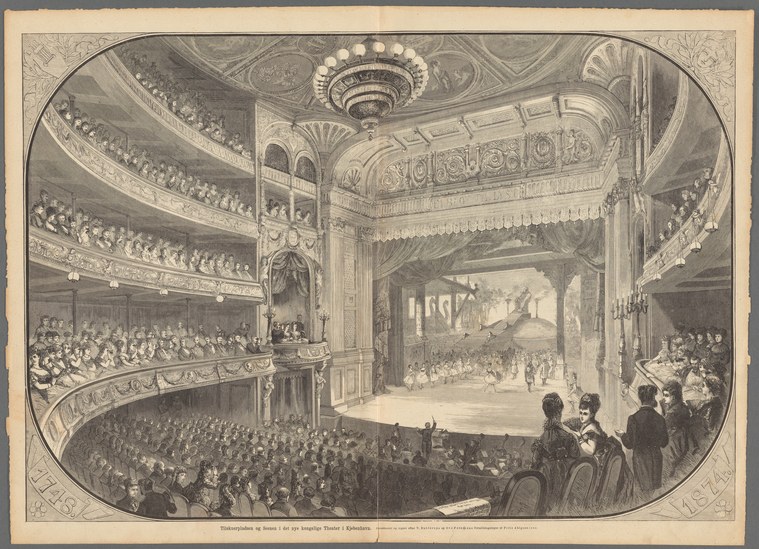
Interior of the Royal Theatre, Copenhagen
Unknown artist
- Collection:
- Prints depicting dance
- Source:
- New York Public Library
- Rights:
- Public domain — free to use, share and adapt.
- Recorded as:
- Public Domain
For dance historians, this image is invaluable evidence of the theatre infrastructure, audience size and composition, and lighting practices that governed 19th-century ballet and opera-ballet performance. It shows the physical and social conditions under which dancers worked—the scale of the house, the distance between stage and audience, the formal conventions of spectatorship—and documents a significant European theatre at a moment when ballet was a central attraction of urban cultural life.
What you are looking at
This engraving depicts the interior of a grand European theatre in the mid-19th century, viewed from the stage looking toward the audience. The house is a horseshoe or oval plan, rising in three tiers of galleries with box seating, every level packed with spectators in formal dress. The architecture is ornate: elaborate plasterwork, decorative relief panels between the boxes, a heavily decorated ceiling with a central rosette, and what appears to be a chandelier. On the stage itself, visible in the middle distance, a scene is being performed—the figures on stage are small but distinct, suggesting a full dramatic or dance production. The stage is framed by an ornamental proscenium arch. Foreground right shows audience members in the orchestra or pit area, their silhouettes dark against the brilliance of the stage lighting. The print technique—careful cross-hatching and fine line work—creates depth through perspective and tonal variation, making the receding galleries appear to rise into shadow.
The dancing
The performers on stage are too distant to read gesture in detail, but their grouping suggests a formal ensemble arrangement typical of 19th-century theatrical spectacle—figures distributed across the stage space rather than clustered. The audience figures in the foreground are seated or standing, heads turned toward the stage, depicted in dark silhouette. The composition emphasizes the architecture and the theatre as a social gathering space rather than isolating individual dancers or their technique.
The dance depicted
The work is a theatrical interior, not a dance depiction per se. The stage shows a performance in progress—likely a ballet or opera-ballet of the kind popular in Copenhagen in the mid-19th century—but the distance and the engraver's priority of capturing the building and crowd makes it impossible to read what specific dance or choreography is underway. The subject is the theatre event as a social phenomenon, the spectacle of the house and the audience, rather than a study of dance movement.
How it was made
This is an engraving, executed in line and cross-hatching on paper. The fine detail and precision of the technique indicate it was printed from an engraved copper plate, likely hand-colored after printing or left in monochrome as here. The medium allowed for wide circulation as a print—this would have been sold to the public as a view of a notable building, a souvenir of a prestigious venue, or a document of the theatre's interior design. The technique required skilled craftsmanship and suggests a publisher catering to an educated, urban audience interested in architecture and public spectacle.
About this work
This is a mid-19th-century engraving of the auditorium of the Royal Theatre in Copenhagen during a performance. It is a record of a specific building, its scale, its social function, and the conventions of theatrical presentation of the period—a full house, formal dress, tiered galleries allowing sight lines to all. The work treats the theatre as a social and architectural subject rather than focusing on the dancers or choreography. It is an important document of how dance and drama were presented and experienced in a major European capital, showing the architecture that shaped performance, the audience composition and behavior, and the elevation of theatre as a public institution.
How to look at it
Examine the depth and perspective: notice how the engraver has rendered the tiers of the auditorium to create a sense of recession from foreground audience toward the distant stage. The cross-hatching in shadow areas and the fine linear detail in ornament guide the eye upward and back. Look at the audience itself: every seat appears filled, formal dress is visible even at distance, and the social hierarchy of the house—pit, boxes, galleries—is clearly articulated by position and decoration. Finally, observe the stage: the performance happening there is rendered in miniature, deliberately distanced, inviting you to see the theatre as a whole rather than to read individual dancers.
The period
The Royal Theatre (Kongelige Teater) in Copenhagen was established in the early 18th century and underwent renovation and redesign throughout the 19th century. This engraving likely dates to the mid-1800s, when the theatre was a major venue for ballet, opera, and dramatic performance. Copenhagen was a center of Romantic ballet in Northern Europe, home to the dancer and choreographer Auguste Bournonville, whose works dominated the stage from the 1830s onward. The architecture shown here—the horseshoe auditorium, the elaborate decoration, the chandelier lighting—is characteristic of mid-Victorian theatre design, reflecting both technical advances in gas lighting and the aesthetic values of grandeur and order.
Where it lives
This work is held in the Prints collection of the New York Public Library, as a record labeled 'Prints depicting dance.' The engraving was likely published as a topographical or architectural print in the 19th century, documenting a notable public building rather than commissioned as dance documentation.
Dance in this work
Questions about this work
Can you identify the performance or choreography being shown?
No. The figures on stage are too distant and small for specific movement or costume detail to be legible. The engraver's purpose was to record the theatre building and the social event of a full house, not to document a particular ballet or dance. Context would be needed—a caption, a date, or knowledge of what premiered on a specific night—to identify it.
Why is the theatre shown from this angle, looking from stage to audience?
This viewpoint was conventional for theatre interior engravings in the 19th century. It allowed the artist to display the full auditorium, its architecture, and the spectacle of a full, formally dressed house—the entire social theatre, not just the performance. It emphasizes the building's grandeur and the audience experience.
What does this tell us about how ballet was presented in 1800s Copenhagen?
The image shows that ballet was performed in a major civic theatre with sophisticated architecture, gas lighting, and a large paying audience drawn from the educated and wealthy classes. The formal dress, the tiered seating, and the ornate decoration all indicate that ballet was a high-status cultural event. The distance of the stage from the audience and the size of the house suggest spectacle and ensemble effects were important—a different aesthetic from intimate chamber performance.
More dance artwork





