49 works in this view — arrow keys or swipe to move between them.
Dance in Art
A black ball
Unknown artist
- Collection:
- Prints depicting dance
- Source:
- New York Public Library
- Rights:
- Public domain — free to use, share and adapt.
- Recorded as:
- Public Domain
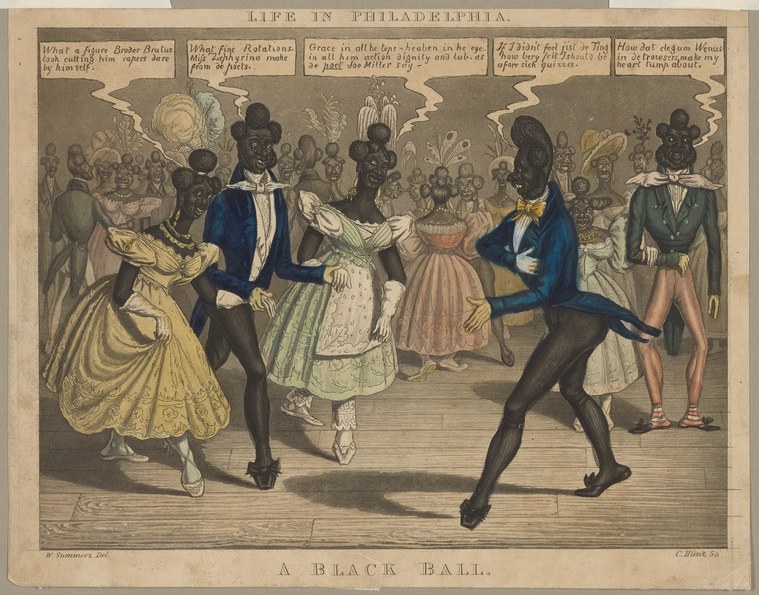
This print documents the moment when the waltz's close hold and rapid rotation became a flashpoint for anxieties about race, sexuality, and social mixing in America. For historians of ballroom dance, it is evidence that the waltz was understood as transgressive not only because of its physical proximity but because it could enable interracial intimacy. For historians of race and visual culture, it is a rare—and disturbing—artifact showing how that transgression was rendered and circulated in popular imagery.
What you are looking at
A crowded assembly gathers in an interior space—likely a ballroom or public hall—for what the title identifies as "A Black Ball." The composition is densely populated with figures of varying skin tones, arranged in a lively social scene. At center, a Black man and white woman dance together in an animated embrace, their bodies close and energetic. Around them, other couples and onlookers crowd the space in various states of engagement: some dancing, some conversing, some watching. The setting appears to be the 1820s–1830s judging by the women's high-waisted Empire silhouettes and the men's formal coats. Above the main scene, five quotations in speech bubbles float in the composition—crude and stereotypical remarks attributed to various observers—suggesting this is a satirical print mocking interracial social mixing. The light is even and warm, with a sepia tone characteristic of hand-colored engravings of the period.
The dancing
The central couple dances in a close, dynamic hold: the man's arm encircles the woman's waist, and both bodies lean into the movement with clear forward momentum. The woman's skirt, rendered in yellow ochre, swings with the turn of her body, suggesting rapid rotation. Other dancers behind them adopt similar close holds and animated postures. The surrounding figures—both male and female, of different races—are rendered with exaggerated facial features typical of racist caricature of the era. Several figures gesture expressively, their arms raised or extended, adding to the impression of vigorous, uninhibited movement.
The dance depicted
This is a social ballroom dance, most likely a waltz or contra dance adapted for the American context of the 1820s–1830s. The close hold, rapid rotation suggested by the woman's extended skirt, and the energetic body lean all point to the waltz, which was controversial in this period precisely because of its close contact between partners. The print is satirical rather than documentary: it uses the spectacle of interracial dancing—and interracial attraction—as the subject of ridicule. The quotations suggest the print is critiquing not the dance itself but the social transgression it depicts. This is social dancing in a moment of acute cultural anxiety.
How it was made
This is a hand-colored engraving or etching, identifiable from the fine line work, the composition's division into narrative zones (central action and surrounding response), and the characteristic pale, uniform application of watercolor wash. The technique allowed for rapid, relatively inexpensive reproduction and wide circulation among a middle-class audience. The satirical tone and crude caricature suggest this was popular printmaking—politically charged, socially transgressive material made for a mass market rather than for collectors or institutions.
About this work
This is a social satire depicting a ballroom scene in early 19th-century America, rendered as a hand-colored engraving. The title and the quotations framing the scene make clear that the "scandal" being mocked is interracial dancing and courtship. The image is valuable not as a neutral record of dance practice but as evidence of how ballroom dancing—particularly the waltz—was entangled with race, sexuality, and social hierarchy in the early American republic. It documents both the dance and the anxiety it provoked.
The work belongs in a dance history context because it shows how a specific dance form (the waltz) operated as a site of social transgression and contestation. It also illuminates the racist visual rhetoric through which such moments were framed for public consumption. The print is a primary source for understanding how dance, race, and respectability were negotiated in American popular culture.
How to look at it
Attend first to the central couple and the clarity with which the artist has rendered their physical connection and shared motion. The woman's swinging skirt and both figures' forward lean convey the momentum of the waltz. Then read the surrounding crowd: the quotations above the scene are not part of the dance itself but the artist's commentary on it, inviting the viewer to laugh at the discomfort or outrage of the onlookers. The tension between the vitality of the dance and the grotesque caricature of the dancers is the visual argument of the print.
The artist
The print is not attributed in the catalogue record. The style and composition suggest a commercial engraver working in the American satirical print tradition of the 1820s–1830s, possibly after a drawing by a named artist. The quotations and the overall framing suggest familiarity with the conventions of Regency-era English satirical prints (the tradition of Gillray and Rowlandson), adapted for an American audience and an American scandal.
The period
The waltz arrived in America in the early 1800s amid fierce moral and social opposition. Conservative commentators objected to the dance's speed, its close hold between partners, and its perceived licentiousness. By the 1820s, the waltz had become established among the fashionable elite, but anxieties about its morality persisted—and were compounded by anxieties about race. This print appears during a moment when ballroom dancing was becoming a site where racial boundaries were being tested and defended. The formal dress of the figures and the ballroom setting indicate that this is not a scene of working-class or enslaved people's dance, but rather a transgression within polite society.
Where it lives
The work is held in the New York Public Library's collection of prints depicting dance. It is catalogued only as "A Black Ball," with no artist, date, or medium attributed. The Library of Congress and similar institutions hold related American satirical prints from the same period.
Dance in this work
Questions about this work
What kind of dance is this?
The close hold, the speed suggested by the woman's swinging skirt, and the upright posture of the couple all point to the waltz, which was the most contested ballroom dance of the early 19th century. The rapid rotation was what alarmed moral critics about the waltz—it was faster and more dizzying than older contra dances.
Why is this called a 'Black Ball'?
In historical usage, a 'Black Ball' referred either to a ball held by or for Black people, or to a ball associated with scandal or disrepute. In this satirical print, the title appears to be ironic: the scandal being depicted is interracial intimacy on the dance floor. The print was made for white audiences as a vehicle for both entertainment and social commentary.
Is this a reliable record of what actually happened?
No. This is a political cartoon, not a documentary image. It was made to provoke, mock, and sell. It is valuable as evidence of what anxieties existed about interracial dancing, not as evidence that the scene depicted actually occurred. The exaggerated facial caricatures and the crude quotations signal the satirical intent.
Why was interracial dancing so controversial?
The waltz brought partners into an intimate hold in full view of society. In the context of slavery and rigid racial hierarchies, interracial touch—and the implicit equality it suggested—was perceived as a threat to social order. Dancing together was a form of social recognition that challenged racial boundaries.
More dance artwork





