49 works in this view — arrow keys or swipe to move between them.
Dance in Art
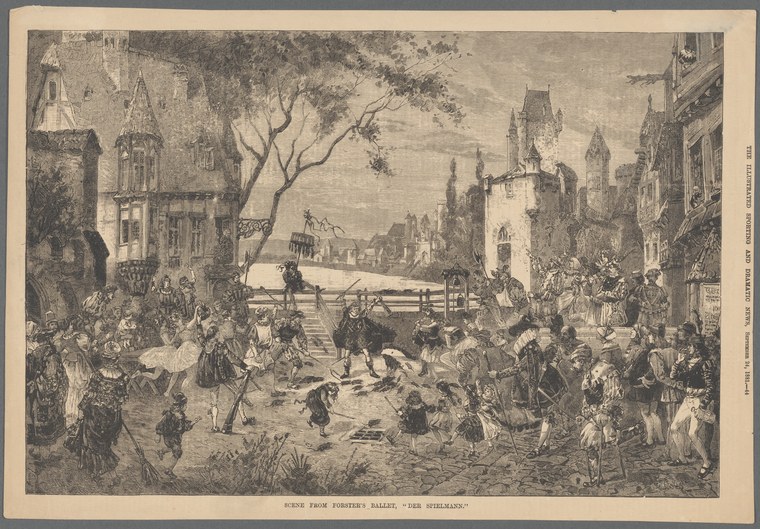
Scene from Forster's ballet, Der Spielmann
Unknown artist
- Collection:
- Prints depicting dance
- Source:
- New York Public Library
- Rights:
- Public domain — free to use, share and adapt.
- Recorded as:
- Public Domain
This print documents how ballet engaged with folk and popular culture in the late 19th or early 20th century, using a subject (the minstrel, the marketplace, the carnival) from outside the aristocratic court. It shows that even as classical ballet technique hardened into academic forms, choreographers were still drawing on street performance, popular gathering, and medieval imagery—a tension central to modern dance history.
What you are looking at
A crowded medieval or Renaissance town square erupts in celebration around a central performance space. The setting is dense with architecture—crenellated towers, Gothic spires, half-timbered buildings—rendered in fine engraving lines that create atmospheric depth through careful cross-hatching. Hundreds of figures pack the square: spectators line the edges, cluster on steps and platforms, lean from windows. At the center, a raised wooden stage or platform hosts a smaller group engaged in active movement. The composition draws the eye inward through converging lines of architecture and outward-facing crowds. A large tree with spreading branches dominates the middle distance, its foliage rendered in fine stipple. The light is cool and even, characteristic of engraving technique, with drama created through density of line rather than chiaroscuro.
The dancing
The central performers occupy an elevated stage, distinguishing them from the crowd. Figures on the platform display varied postures—some upright, some bent or twisted, suggesting vigorous movement rather than static poses. The surrounding crowd gestures actively: arms raised, bodies leaning forward, creating a sense of engagement and excitement. Dress is mixed—some figures wear long robes or period costume, others simpler garb. The density of bodies and the variety of poses suggest this is a popular spectacle rather than a courtly performance, with spectators as important to the composition as the dancers themselves.
The dance depicted
The title links this to Forster's ballet 'Der Spielmann' (The Minstrel or The Player), a work of the late 19th or early 20th century, though the print's artistic style and the medieval setting suggest it may represent a scene of peasant or folk celebration rather than classical ballet. The image depicts what appears to be a street or village festival with popular dancing, not the formal geometry of staged classical ballet. Without being able to verify Forster's ballet against this image, it is unclear whether this represents the ballet's own aesthetic, a scene it choreographed, or an illustration drawing on a different tradition of minstrel or carnival imagery.
How it was made
This is an engraving, identifiable from the uniform parallel line work (hatching and cross-hatching), the precise tonal gradations built from density of line, and the lack of tonal wash or color. The technique allows fine detail and great clarity of form even at small scale, and the regularity of line creates a sense of order despite the chaotic subject matter. Engravings of this quality were expensive to produce and typically distributed as fine prints to educated audiences, though wood-engraving could also be used for cheaper mass production. The style and finish suggest a professional reproductive engraving, likely made to document or publicize a theatrical production.
About this work
This engraving illustrates a scene from a ballet or theatrical work titled 'Der Spielmann' (attributed to a choreographer or composer named Forster), depicting a medieval festival or carnival with vigorous popular dancing. The image captures the anarchic energy of street celebration—crowds, raised platform, varied figures in motion—rendered with the precision and tonal sophistication of fine engraving. It belongs to a tradition of theatrical prints that documented and advertised stage productions to audiences who could not attend live performance, and to a broader 19th-century European fascination with peasant and folk material as subject matter for the ballet stage.
How to look at it
Attend to the composition: the central elevated stage creates a frame within the frame, separating performers from spectators but also binding them together through the density of looking and gesture. The medieval or Renaissance architecture is not merely setting but the body of the image—towers, spires, and buildings are drawn with as much care as the figures. Notice how the engraver has used line density to suggest both the chaos of the crowd and the formality of the occasion; no figure is fully isolated. The large tree is a compositional anchor, dividing the scene and suggesting both pastoral and urban registers.
The artist
The artist is not recorded. The engraving is of professional quality and likely produced by a reproductive printmaker working from a drawing or design by another hand—possibly documenting a stage design, costume sketch, or theatrical scene. The style and technique place it in the European tradition of theatrical and narrative engraving, common in the 19th century for publicizing opera, ballet, and theater.
The period
The late 19th and early 20th centuries saw a major shift in ballet subject matter. The Romantic ballet had used folk material and exotic settings; the Russian Imperial Ballet under Sergei Diaghilev and later choreographers began systematically drawing on European and non-European folk dance, medieval imagery, and popular celebration. Simultaneously, engraving as a medium was being displaced by lithography and photography, making this image a record of a transitional moment in both dance and print culture. Forster's 'Der Spielmann' fits into this context of choreographic interest in minstrelsy and popular performance.
Where it lives
Held by the New York Public Library in its collection of prints depicting dance. It is catalogued as illustrating a scene from Forster's ballet 'Der Spielmann,' but the artist of the engraving is not recorded.
Dance in this work
Questions about this work
Is this a scene from a real ballet performance?
The title attributes it to a work by Forster, likely 'Der Spielmann,' though Forster may have been a composer, choreographer, or librettist. The print appears to be a theatrical illustration—a common way to publicize and document stage works before photography. Whether it depicts a scene choreographed by Forster or draws on folk and medieval imagery Forster used is not clear from the image alone.
What is the setting?
A medieval or Renaissance town square, crowded with festival-goers and presided over by Gothic architecture. The setting is partly real observation and partly romantic convention—19th-century artists often used medieval imagery to suggest authenticity, antiquity, and folk authenticity even when depicting contemporary performances or imagined scenes.
Why is this an engraving and not a painting?
Engraving was the standard medium for theatrical prints in the 19th century. It was cheaper than oil painting to reproduce and distribute widely, allowed for fine detail, and created an impression of seriousness and permanence. A colored lithograph or photograph would have been more economical by the early 20th century, so this image likely dates to the later 19th century.
More dance artwork





