49 works in this view — arrow keys or swipe to move between them.
Dance in Art
La fête des fleurs
Unknown artist
- Collection:
- Prints depicting dance
- Source:
- New York Public Library
- Rights:
- Public domain — free to use, share and adapt.
- Recorded as:
- Public Domain
This work is a primary document of how dance was visualized and valued in the 18th century—not as a technical demonstration but as an essential element of courtship, pleasure, and aristocratic leisure. The engraving's wide distribution means it shaped how non-dancers understood ballroom culture and social dance; what people *saw* when they imagined dancing shaped what they actually danced. For art historians, the work exemplifies the fête galante tradition at the moment when it was being made accessible to broader audiences through the print market.
What you are looking at
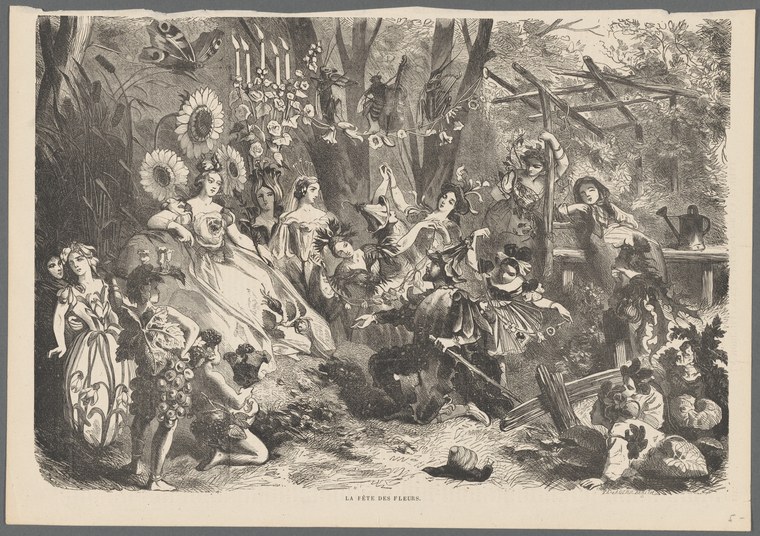
A festive outdoor gathering in a wooded setting, where elegantly dressed figures celebrate among garlands of flowers and foliage. The composition centers on a cluster of dancers and revelers arranged in loose groupings across a forest floor, with large sunflowers suspended overhead and floral decorations adorning the trees. The lighting suggests dappled woodland shade, with the figures arranged in a theatrical tableau that reads as both intimate performance and public celebration. In the foreground, pairs and small groups engage in dance and courtship gestures; the background recedes into trees and architectural elements including what appears to be a small structure or pavilion. The dress is uniformly elaborate—women in full skirts and corseted bodies, men in period coats and hose—suggesting the 18th or early 19th century.
The dancing
The bodies are disposed in a mix of partnered and social formations, predominantly in three-quarter view to best display the silhouettes and movement. Several pairs stand in loose proximity rather than closed hold, with arms extended in gestures of invitation or display. The women's skirts dominate the visual mass, their full volume suggesting movement or the moment just before or after a turn. Posture is upright and formal, with the characteristic S-curve of the period's corseting evident throughout. The composition includes approximately twenty figures, arranged not as a coordinated group but as individuals and couples in social arrangement—some gazing at partners, others turning away, creating narrative depth.
The dance depicted
This appears to be a fête or garden party scene in the tradition of 18th-century aristocratic outdoor entertainments, where dance and courtship were intertwined. The title *La fête des fleurs* (Flower Festival) and the ornamental floral setting suggest a work from the romantic tradition of French art, possibly depicting the kinds of pastoral celebrations that popular opera and ballet represented to urban audiences. The dancers are not executing a specific codified dance form visible in their postures, but rather performing the social roles of the privileged classes at leisure. The scene conflates courtship, display, and the ceremonial aspects of ballroom culture with an idealized natural setting—a common theme in theater and decorative arts of this period.
How it was made
This is an engraving or etching, identifiable from the fine linear hatching, the tonal modeling through line density, and the tonal range achieved through crosshatching. The medium's tonal subtlety is evident in the way the foliage is rendered and in the modeling of fabric volume. The technique allows considerable narrative detail and social observation—the faces remain individualized, the costume ornament legible, and the spatial relationships clear despite the crowded composition. This is a medium suited to wide circulation, suggesting the work was created for a relatively affluent print market, likely in France given the subject and style. The technical control and ambitious composition suggest a work by an experienced printmaker rather than a minor or amateur artist.
About this work
This engraving depicts an idealized aristocratic garden celebration in which dance and courtship are central to the gathering's pleasure and meaning. The work belongs to the tradition of theatrical or literary celebration of Enlightenment leisure—the kinds of scenes that appeared in contemporary opera, ballet, and the decorative arts. The outdoor setting, the abundance of flowers, and the costumes all place it firmly in the 18th-century French tradition of fête galante imagery, though executed in a popular print format rather than as an oil painting. For dance historians, it documents the spatial and postural conventions of social dancing at leisure, the relationship between pairs in courtship, and the visual logic by which a crowded celebration maintains dramatic coherence.
How to look at it
Attend first to the composition's multiple centers: the artist has avoided a single focal point, instead distributing attention across clusters of dancers and revelers. Notice how the floral and architectural elements frame and contain the human figures without overwhelming them, and how the full skirts create a rhythmic visual pattern that reads as movement even in stillness. Look at the spacing between pairs—there is a studied informality to these groupings that suggests the spontaneity of pleasure while maintaining strict compositional control. The engraving technique allows the artist to show both the texture of fabric and the individuality of faces, making the figures simultaneously types (aristocrats at play) and individuals (with particular expressions and gestures).
The period
This work belongs to the mid-to-late 18th century, when French print culture was at its height and when the aristocratic pastoral tradition was reaching a broad middle-class audience. The fête galante—the idealized celebration of leisure, nature, courtship, and music—had been a major subject in French painting since Watteau; the translation of such subjects into engraved prints made them available to people who would never own paintings. This was also the period when ballet was being reformed and professionalized, when the distinction between social dance and theatrical dance was becoming clearer, and when women's participation in public performance was expanding. The print's subject—dance as social pleasure rather than spectacle—reflects contemporary values about leisure and gender roles.
Where it lives
The work is held in the New York Public Library's Prints collection, catalogued as depicting dance. It is part of a broader tradition of French popular prints documenting leisure and social life, likely created for distribution to the educated and affluent classes who would recognize the fête galante tradition.
Dance in this work
Questions about this work
Is this a painting or a print?
This is an engraving—a print made by incising an image into a metal plate and using ink to reproduce it on paper. The fine lines visible throughout are the hallmark of the engraving technique. Because it is a print, multiple copies would have been made and sold, making it far more widely available than a painting could be.
What dance is being shown here?
No single dance form is identifiable from the dancers' postures. Rather, this depicts the social world of 18th-century ballroom culture—courtship, display, and leisure—during which various dances would have taken place. The scene is theatrical rather than documentary: it idealizes and aestheticizes social dancing rather than recording actual steps or techniques.
Why are there so many flowers?
The floral abundance is both literal and symbolic. The outdoor garden setting removes the dance from the ballroom (the actual site of aristocratic social dancing) and relocates it to an idealized natural world where pleasure, beauty, and leisure could flourish without constraint. Flowers signify both season and sensuality, making them essential to the fête galante tradition.
What does this tell us about 18th-century dance?
This image shows that social dancing was understood as an art form in which bearing, display, and courtship mattered as much as technical skill. The loose groupings and the emphasis on the dancers' appearance and relationship to each other (rather than their footwork) reflects how 18th-century culture valued dance as a social and erotic practice. The gender difference in costume volume also documents how women's full skirts created a distinct visual spectacle.
More dance artwork





