49 works in this view — arrow keys or swipe to move between them.
Dance in Art
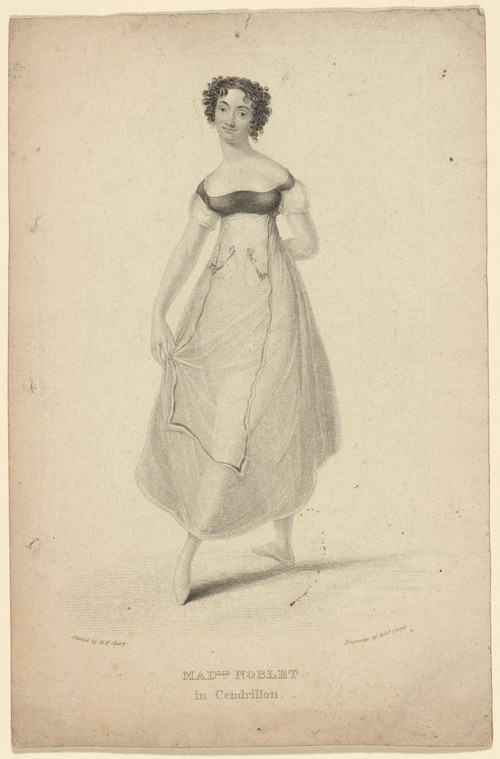
Madlle. Noblet in Cendrillon
Unknown artist
- Collection:
- Prints depicting dance
- Source:
- New York Public Library
- Rights:
- Public domain — free to use, share and adapt.
- Recorded as:
- Public Domain
Mademoiselle Noblet was a significant figure in early 19th-century French theatre and an influence on the development of Romantic ballet; this print is documentary evidence of her fame and the visual conventions by which dancers were remembered and circulated in the public imagination. It demonstrates that in the Romantic era, a dancer's image was as valuable as her movement — the print preserves not a choreographed step but a character, a costume, and a famous body in a moment of theatrical presence.
What you are looking at
A young woman stands alone against a plain background, posed as if mid-movement in a theatrical gesture. She wears the costume of a pantomime or operatic character: a white muslin gown with a dark velvet or satin band across the bodice, high-waisted in the Regency style, with the skirt billowing and caught to one side as if she has just turned or stepped. Her dark hair is arranged in loose curls pinned atop her head. Her left arm extends gently at her side while her right arm moves across her body; her pose suggests a moment of hesitation, entreaty, or theatrical emotion rather than active dancing. The figure is rendered in a soft drawing technique with careful attention to the play of light on fabric, creating volume in the skirt and definition in her form. The image is a finished study rather than a quick sketch, signed or initialed at the lower left.
The dancing
A single standing figure, not in active dance position but in a theatrical attitude. The body weight appears to rest on the back foot, with the front leg slightly advanced; the posture is upright and dignified rather than dynamic. The arms are in a soft, expressive frame typical of pantomime or early Romantic-era gesture — neither a ballroom hold nor ballet port de bras, but something between acting and dancing. The skirt is manipulated in the composition to suggest movement or turning, though the body itself is relatively still.
The dance depicted
This is not a depiction of dance in the strict sense, but rather of a character in a theatrical role — here, Cendrillon (Cinderella) — as might appear in a pantomime, opéra comique, or ballet. Mademoiselle Noblet was a celebrated French dancer and mime of the early 19th century, known for roles in the nascent Romantic ballet. The image captures her in character rather than in the midst of a choreographed step; it is a costume study or character portrait intended to preserve a famous performer's appearance in a specific role. The pose and handling of the skirt suggest the aesthetic of theatrical movement — the expressiveness and narrative focus — rather than the technical vocabulary of any particular dance form.
How it was made
This is an engraving or etching, rendered in black ink on paper, with fine linear hatching and cross-hatching to suggest volume, shadow, and the texture of fabric. The technique is precise and controlled, allowing for the soft, almost luminous quality of the white muslin against darker tones. Such prints were the standard medium for circulating images of celebrated performers in the early 19th century; they were affordable, reproducible, and distributed widely through print sellers, theatrical publications, and the collections of theatre-goers. The signature or initials visible at lower left indicate this was an authorized and professional work, likely sold as a theatrical souvenir or included in a series of dancer portraits.
About this work
This is a character portrait of a celebrated early 19th-century dancer, Mademoiselle Noblet, in the role of Cendrillon from a theatrical production — likely a pantomime or ballet. Rather than capturing a moment of dancing, the print preserves the costume, bearing, and theatrical presence of the performer in character. It belongs in a gallery of dance in art because it documents the material culture and visual identity of a major figure in the emergence of Romantic ballet, and because it shows how dance and theatre were inseparable in this era — the body's meaning lay in the marriage of movement, costume, narrative, and the performer's celebrity.
How to look at it
Attend to the handling of the skirt — caught and gathered to suggest motion even though the body is relatively still — and to the quality of the gesture in the arms and hands, which conveys emotion and character rather than technical display. Notice how the artist has chosen a moment of pause or reflection rather than active dance; this was a common convention in theatrical portraiture, allowing the costume and the actor's bearing to be fully legible to the viewer. The soft, careful rendering of the face and the delicate linework on the fabric show the care devoted to making the image a faithful record of a famous performer's presence.
The artist
The artist is not recorded in the catalogue; the engraving bears a signature or initials at the lower left that may identify them, but these are not legible in reproduction. The work is characteristic of the commercial theatre print industry that flourished in Paris in the 1820s–1840s, when prints of celebrated dancers and singers were produced in quantity and sold as theatrical souvenirs. Such prints were often made after drawings or paintings and distributed through print shops and theatrical venues.
The period
This print dates from the era of early Romantic ballet, when the French stage was beginning to shift toward the ethereal, otherworldly aesthetic associated with ballets such as *La Sylphide* (1832) and *Giselle* (1841). Cendrillon, the Cinderella story, was a popular subject for pantomime and musical theatre throughout the 19th century; the costume and pose here reflect the sentimental, narrative-driven aesthetic of the period. The engraving technique was still the dominant medium for theatrical portraiture, though lithography was beginning to compete by the 1830s.
Where it lives
This print is held in the New York Public Library's collection of prints depicting dance. Such prints were typically produced and sold independently through theatrical print shops and collected by theatre enthusiasts in bound portfolios or framed for display.
Dance in this work
Questions about this work
Who was Mademoiselle Noblet?
Mademoiselle Noblet (first name Marie-Eugénie or similar; dates uncertain but active c. 1815–1840s) was a celebrated French dancer and mime performer in Paris, known for roles in pantomime, opéra comique, and early ballet. She was among the generation of performers working at the threshold of Romantic ballet, and her name appears frequently in theatrical reviews and prints of the period.
Is this a picture of dancing?
Not exactly. This is a character portrait, showing the performer in costume and in a posed attitude that suggests theatrical presence rather than capturing active dancing. It is typical of theatrical portraiture of the era, which privileged the performer's image and narrative character over the documentation of specific steps.
Why would someone keep a print like this?
Theatre-goers in the 19th century collected prints of famous performers as souvenirs and as a way of preserving their memory. These prints were sold in theatres and print shops and were sometimes bound into albums. They served much the same function as photographs, playbills, and autographs do today.
What does the Regency-style dress tell us about the production?
The high-waisted white muslin gown is characteristic of early 19th-century theatrical costume and reflects both current fashion and the sentimental, ethereal aesthetic of Romantic-era theatre. The dark velvet band emphasizes the waist and adds visual drama; such costumes were designed to flatter the performer while also conveying character and narrative meaning through color and silhouette.
More dance artwork





