49 works in this view — arrow keys or swipe to move between them.
Dance in Art
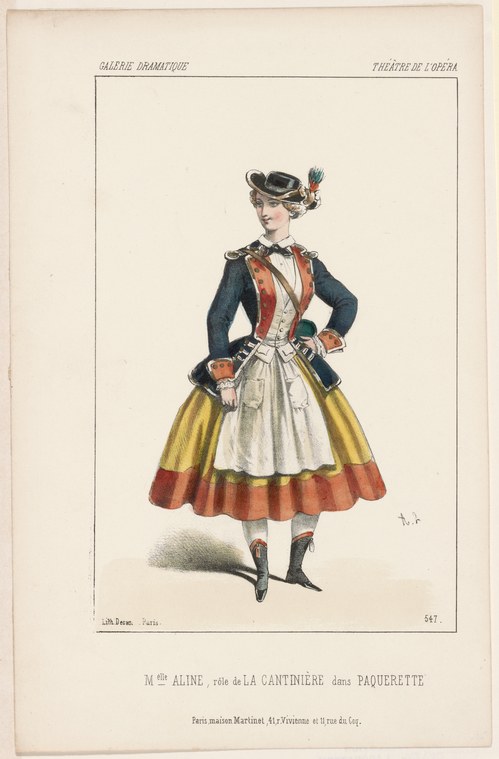
Melle Aline, rôle de La cantinière dans Paquerette
Unknown artist
- Collection:
- Prints depicting dance
- Source:
- New York Public Library
- Rights:
- Public domain — free to use, share and adapt.
- Recorded as:
- Public Domain
This work preserves the visual record of a specific theatrical role and its costume from the late 19th-century stage. For historians of musical theatre and stage costume, it is primary evidence of how character roles were designed and presented to audiences. For dance historians, it represents the extensive popular theatrical culture outside classical ballet that employed dance and movement as part of character comedy.
What you are looking at
A young woman stands alone in three-quarter view against a blank background, dressed in an elaborate stage costume of the late 19th century. She wears a dark navy or black jacket with ornate military-style frogging and red-orange trim across the front and cuffs, fitted tightly at the waist. Below this jacket is a full skirt composed of three deep horizontal bands: a cream or white central section, topped by a broad yellow panel, and finished at the hem with a deep red or rust-colored band. The skirt has the voluminous silhouette characteristic of 1880s–1890s theatrical costume. She stands with one hand on her hip in a confident pose, the other at her side, wearing dark stockings and black heeled shoes. Her hat is a dark military-style bicorne or similar headpiece trimmed with feathers or plumes. The costume is clearly designed for a specific named role—the inscription below identifies her as Mlle Aline in the role of La Cantinière (the vivandière or canteen attendant) in the operetta or comedy-ballet *Paquerette*.
The dancing
The figure stands in a relaxed, presentational pose rather than mid-dance: weight is evenly distributed, with a slight contrapposto. The hand-on-hip gesture is a conventional stage attitude suggesting confidence and character rather than active dancing. There is no visible evidence of pointe work, turnout, or the balletic frame typical of ballet dancers of the period. The pose and costume suggest a comic or character role rather than a principal lyrical dance.
The dance depicted
This is a theatrical costume study for a named character role in a stage work, almost certainly an operetta or comic musical-theatre piece rather than ballet. The role of *Cantinière* (vivandière) was a stock character in 19th-century musical theatre—a camp follower, traditionally a woman who sold provisions to soldiers. These roles frequently featured comic or character dancing rather than classical ballet, and the military-inspired costume with its bright striped skirt is consistent with such a comedic portrayal. The print documents the performer Mlle Aline in this specific role, likely for circulation to theatregoers or the theatrical press. Without access to information about the operetta *Paquerette* itself, we cannot determine whether significant dancing was a feature of the role.
How it was made
This is a hand-colored lithographic print, as indicated by the soft color wash and the printing characteristics visible in the background tone. The artist's signature (a small monogram) appears at lower right. Lithography allowed for both the precision of line work in the jacket and accessories and the soft modeling of the fabric and figure. Hand-coloring was applied after printing, allowing the bright theatrical colors—particularly the yellow and red skirt bands—to be rendered vividly. This production method was typical of theatrical costume documentation and publicity in the late 19th century, and such prints circulated to theatre patrons, critics, and collectors interested in stage fashion.
About this work
This is a theatrical costume portrait documenting a named performance by Mlle Aline in the character role of La Cantinière (canteen attendant) in the operetta or musical comedy *Paquerette*. The work is a piece of theatrical ephemera—publicity or documentation of stage dress—rather than documentation of dance in action. It belongs in a gallery of dance in art because such costume studies were a significant part of 19th-century theatrical culture and circulation, and because the role and its associated dance (if any) are part of the material history of stage performance.
The print captures the visual language of character roles in popular musical theatre of the period: bright, legible costume with military associations, a confident stage attitude, and a visual identity designed to be readable from the auditorium. It documents not a choreographed moment but a performer's standard appearance in a named role.
How to look at it
The print should be read as a costume document and character portrait rather than as a representation of movement or dance. Note the military styling of the jacket, which establishes the character's association with soldiery and camp life. The bold horizontal striping of the skirt in three contrasting colors is both visually striking and functionally designed for theatrical legibility from a distance. The confident hand-on-hip pose and direct gaze establish character rather than represent a choreographed moment. The high level of finish and detail in the lithograph suggests this was a professional costume study, possibly produced for publicity or as a record of the role as performed by this particular dancer.
The artist
The artist is not recorded in the catalogue. The print is credited to Imprimerie Lemercier of Paris (visible at the lower left), a major lithographic printer of theatrical and fashionable subjects in the second half of the 19th century. The monogram signature at lower right belongs to the artist (possibly the costume designer or the lithographer who drew the design). Theatrical costume prints were a significant commercial genre in Paris during this period, and Lemercier was among the leading publishers of such work for the music-hall, operetta, and theatrical market.
The period
This print dates from the era of operetta's dominance in Parisian entertainment (1860s–1890s). Operetta and musical comedy were enormously popular, and unlike classical ballet (which was more exclusive), these theatrical forms engaged broad audiences and featured comic character roles alongside sung numbers and dance. The vivandière was a familiar stock character in comic opera, particularly in French and light European operatic tradition. Stage costume prints of this kind were mass-produced and circulated as publicity, reviews, and collectibles, making them a significant form of visual culture and a primary source for understanding theatrical fashion and character types of the period.
Where it lives
The print is held in the New York Public Library as part of its collection of theatrical prints depicting dance (as noted in the catalogue record). The source information indicates it came from the Library's holdings of theatrical ephemera and prints related to performance history. Lemercier's imprint as printer-publisher is visible at lower left.
Dance in this work
Questions about this work
What is a vivandière or cantinière?
A vivandière or cantinière was originally a woman who followed military camps and sold provisions (food, drink) to soldiers. In 19th-century operetta and comic theatre, the character became a stock role—a comic or flirtatious woman associated with military settings. The character typically wore a military-inspired costume, as seen here.
Is Mlle Aline a famous dancer?
The catalogue record does not identify Mlle Aline beyond her appearance in this role in *Paquerette*. She may have been a performer in operetta or musical theatre in late 19th-century Paris, but without additional sources, her broader career and prominence cannot be established.
What is operetta?
Operetta is a theatrical form combining spoken dialogue, sung numbers, and dance in a comic or light-hearted narrative. It was distinct from ballet and grand opera, and was immensely popular in Paris, Vienna, and across Europe from the mid-19th century onward. Operetta roles often featured character dancing and comedy rather than classical ballet technique.
Why does this print matter for dance history?
This print documents the material culture of 19th-century theatrical performance—the costume, character type, and visual presentation of a named stage role. It is evidence of the extensive popular dance and musical theatre world outside classical ballet, and of how character and narrative were communicated through costume design.
More dance artwork





