49 works in this view — arrow keys or swipe to move between them.
Dance in Art
Der Stern des Nordens: Polka-Mazurka für Pianoforte
Unknown artist
- Collection:
- Prints depicting dance
- Source:
- New York Public Library
- Rights:
- Public domain — free to use, share and adapt.
- Recorded as:
- Public Domain
The image documents what ballroom dancing meant in mid-nineteenth-century European society: not primarily the choreography, but the social roles, gender dynamics, and aesthetic presentation that surrounded it. The costume detail—particularly the elaborate folk-inspired dress of the woman on the left—also suggests the exoticizing fascination with Eastern European folk dances that drove the polka and mazurka crazes. For historians of social dance and nineteenth-century visual culture, this cover represents a moment when dance entered the home as a commercial product consumed through sheet music.
What you are looking at
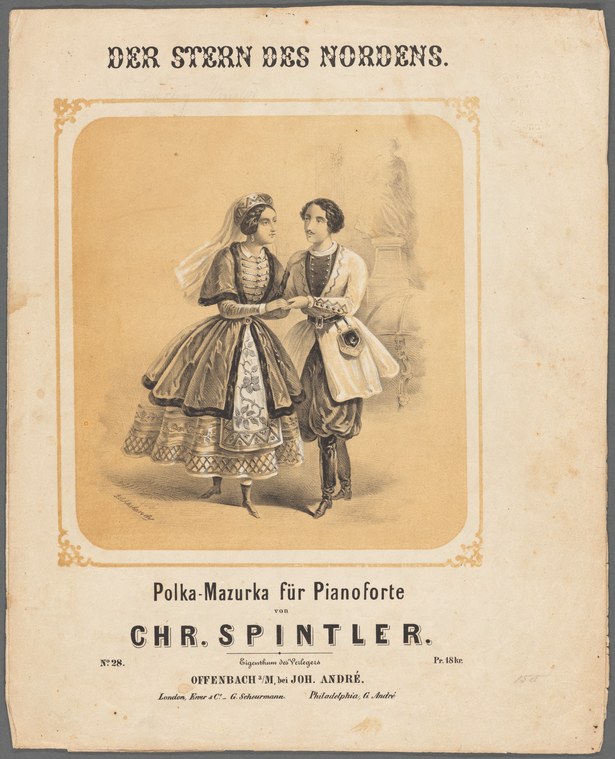
This is the cover sheet for a polka-mazurka piano composition, printed in the mid-nineteenth century. Two young women occupy the center of the composition, rendered in fine pen and ink with hand-applied yellow-tan wash. The figure on the left wears a dark dress with white lace inset at the bodice and a full skirt decorated with elaborate geometric embroidered or woven patterns; her long dark hair is partially bound with a light-colored ribbon or headpiece that trails down her back. The figure on the right, dressed in a lighter cream or white day dress with dark trim, gestures toward her companion—their interaction suggests courtship or social flirtation. Both women wear the fashionable silhouette of the 1850s-1860s: narrow waists, full skirts, and modest necklines. The setting is undefined, with only a faint architectural element (possibly a pilaster or doorframe) sketched in the background. The composition is framed by an ornamental border with florid corner flourishes typical of mid-Victorian printed ornament.
The dancing
The two figures are not in a dance frame; instead, they stand at an angle to one another in a moment of social interaction. The woman on the left faces rightward, while the woman on the right turns slightly toward her companion, one arm extended in a gesture that suggests pointing, directing attention, or the opening of a conversation. Their bodies are upright and composed, not captured mid-movement. The spatial relationship between them—close but not touching—suggests the formality of social dancing or courtship display rather than active choreographic motion.
The dance depicted
The composition is titled 'Polka-Mazurka für Pianoforte' and served as the cover for a piano transcription of this dance form. The polka-mazurka was a hybrid social dance that combined the energetic hopping step of the polka with the three-beat metre and folk character of the mazurka; it was fashionable in European ballrooms during the mid-nineteenth century. The image, however, does not depict the dance in motion. Instead, it presents two women in the formal dress of the period—suggesting the social context in which polka-mazurkas were performed—and emphasizes the courtship dimension of ballroom dance. The artist has chosen a moment of introduction or negotiation rather than the actual dancing.
How it was made
This is a printed sheet-music cover executed in lithography with hand-applied colour wash. The fine linear work of the figures, the delicate pen-work of the border, and the selective application of yellow-tan wash are characteristic of mid-Victorian chromolithographic or hand-coloured lithographic practice. This technique was standard for music covers of the period, allowing for relatively inexpensive reproduction in modest quantities while maintaining the elegance expected by middle-class piano students and amateurs. The printed text ('Der Stern des Nordens' [The Star of the North], 'Polka-Mazurka für Pianoforte', 'von CHR. SPINTLER', publisher and location information) indicates this was a commercial product aimed at the domestic music market.
About this work
This is a mid-nineteenth-century lithographic cover for a published polka-mazurka piano piece by the composer Chr. Spintler. It exemplifies the genre of music-cover illustration that flourished during the Victorian era, when the piano was the dominant domestic musical instrument and social dancing was central to courtship and entertainment. Rather than showing the dance itself—which would have been difficult to capture convincingly in a static image—the artist has chosen to represent the social and romantic context that gave these dances meaning: two fashionably dressed young women meeting in a moment of courtship negotiation. The work belongs to the broader visual culture of nineteenth-century ballroom dance, in which images reinforced the association between music, fashion, courtship, and feminine accomplishment.
How to look at it
Notice the asymmetrical placement of the figures and the gesture of the woman on the right, which creates a narrative moment rather than a static pose—this was a common strategy in nineteenth-century narrative illustration, inviting the viewer to imagine what comes next. Observe the careful rendering of the textures of the fabrics: the geometric patterns on the left figure's skirt suggest either embroidery or woven folk costume, marking her dress as distinctly Eastern European, while the smooth lines of the right figure's dress mark her as conventionally fashionable. The artist has used costume to tell a story about encounter and difference. The ornamental border, with its floral flourishes, was a standard convention of the period, signaling that this object was a refined product for the drawing room.
The artist
The artist is not recorded. The composer, Chr. Spintler, was an active publisher and composer of salon and dance music during the mid-nineteenth century, but little is known of his biography. The cover was printed by the London firm Joh. André (with additional printing in Philadelphia), suggesting a transatlantic market for this type of music and illustration.
The period
The polka-mazurka emerged during the 1850s-1860s as European ballroom culture was at its height, and social dances became increasingly commercialized through printed music and instruction manuals. The polka itself had arrived in Western Europe from Bohemia in the 1840s and quickly became a craze; the mazurka, a Polish folk dance with aristocratic associations, had been a ballroom staple since the early nineteenth century. The hybrid polka-mazurka represented both the appetite for novelty in dance and the practice of combining regional dance elements. During this same period, women's fashion emphasized the full skirt, achieved through the crinoline cage, which became the defining visual emblem of respectable femininity. The cover illustration, with its emphasis on fashionable dress and courtship scenario, reflects the centrality of dance to middle-class social life and the link between dancing ability and marriageability.
Where it lives
This object is held in the New York Public Library's collection of prints depicting dance. It is a lithographically printed music cover with hand-applied wash, a common artifact of mid-nineteenth-century domestic music culture.
Dance in this work
Questions about this work
What is a polka-mazurka?
A hybrid social dance combining the quick, bouncing hop of the polka with the three-beat metre and folk character of the Polish mazurka. It was fashionable in ballrooms during the 1850s-1860s. The polka-mazurka represented the Victorian appetite for exotic or 'national' dances and the practice of mixing them for novelty.
Why does this cover not show people actually dancing?
This is typical of music-cover illustration of the period. Rather than attempting to show choreographic action—which is difficult to depict convincingly in a static image—the artist focused on the social context: the moment of courtship and introduction that preceded and framed the dance. The cover sold the romance and glamour of ballroom culture, not the technical steps.
What do the different styles of dress tell us?
The woman on the left wears a dark dress with elaborate geometric embroidered or woven patterns that mark it as folk costume—likely meant to evoke the Eastern European (possibly Polish or Bohemian) origins of these dance forms. The woman on the right wears fashionable Western European dress of the period. This contrast may suggest an encounter between tradition and modernity, or simply the artist's desire to make the image visually varied and interesting.
Who was Chr. Spintler?
A mid-nineteenth-century composer and music publisher active in creating salon and dance music for the amateur market. Little biographical information survives, but his output includes numerous transcriptions and original compositions for piano—the instrument at the center of domestic middle-class musical life.
More dance artwork





