49 works in this view — arrow keys or swipe to move between them.
Dance in Art
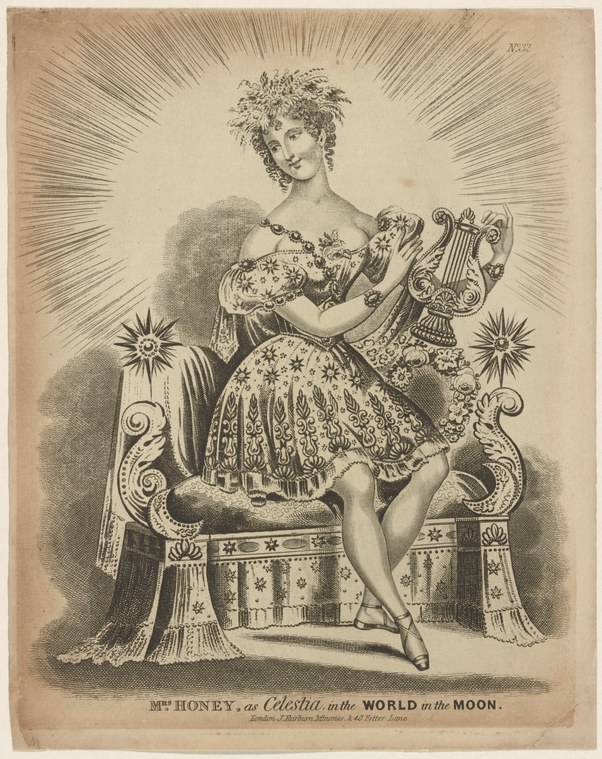
Mrs. Honey as Celestia, in The world in the moon
Unknown artist
- Collection:
- Prints depicting dance
- Source:
- New York Public Library
- Rights:
- Public domain — free to use, share and adapt.
- Recorded as:
- Public Domain
This print is valuable evidence of who performed in London theatres in this period, how female performers were costumed and presented to audiences, and what kinds of theatrical entertainment—pantomime, musical comedy, dance-heavy spectacle—drew crowds. It documents a named performer in a named role, anchoring the history of dance and theatre to specific people and moments rather than abstract forms.
What you are looking at
A woman in elaborate theatrical dress sits in a ornate chair against a radiating background of fine parallel lines that creates a halo effect around her figure. She wears a richly patterned skirt with dense floral or geometric embroidery, a fitted bodice, and a draped shawl or cape falling from her shoulders. Her hair is styled up with a decorative wreath or headdress. She holds a lyre in her right hand and gestures gracefully with her left. Two starburst motifs flank the chair. The woman's pose is contemplative yet theatrical, with one leg extended in a relaxed attitude. The engraving style and the mythological reference in the title suggest this depicts a character from an 18th-century pantomime or theatrical performance rather than social dancing.
The dancing
A single seated female figure dominates the composition. Her posture is upright but relaxed, with the weight settled into the chair. Her left arm extends outward in an open, expressive gesture; her right hand holds a lyre. The extended leg and the angle of her torso suggest a moment of theatrical repose or preparation rather than active dancing. The overall frame is one of grace and decorative display rather than kinetic momentum.
The dance depicted
This is most likely a representation of a character from a pantomime or theatrical entertainment rather than a depiction of social or ballroom dance. The title names 'Mrs. Honey as Celestia,' suggesting this is a portrait of a named performer in a specific role—possibly from a comic opera, pantomime, or satirical stage piece. The lyre identifies Celestia as a celestial or mythological character, and the theatrical costume and statuesque pose indicate this is a star vehicle for a performer rather than a record of how people actually danced. The work belongs more to theatrical portraiture than to dance documentation.
How it was made
This is an engraving, identifiable from the fine parallel lines that create tone and shadow, the precision of the line work, and the delicate handling of texture across the fabric and skin. The radiating background lines are a hallmark of hand-engraved work. Engravings of this type were typically distributed as prints for audiences and theatre-goers, making them valuable records of contemporary costume and character interpretation. The technique allowed for fine detail in the costume and face while maintaining the crisp, repeatable quality necessary for commercial distribution.
About this work
This engraving documents a performer and role from 18th-century English theatre, likely from a pantomime or comic opera. The inscription identifies the subject as Mrs. Honey in the character of Celestia from a work titled 'The World in the Moon.' Rather than a record of dance technique or ballroom custom, it is a theatrical portrait—a star vehicle frozen in a moment of character display. Such engravings circulated as mementos of popular entertainments and as promotional images of celebrated performers. The work sits at the intersection of dance history, theatre history, and visual culture: it shows us how a performer of this era was costumed, promoted, and imagined by her audience.
How to look at it
Look at the pose and the props: the lyre identifies the character as Celestia, a celestial or mythological figure. The extended leg and the open gesture of the left arm are theatrical poses—designed to be seen from a distance by an audience, not naturalistic movement. The engraver has frozen a moment of display and character presentation. The radiating background is not a stage effect but a convention of portraiture in this period, used to dignify and isolate the figure. Notice the density of surface detail—the patterned fabrics, the jewellery, the hair ornament—all markers of expense and spectacle.
The artist
The artist is not recorded in the catalogue. The engraving bears an accession number (N275) but no signature is legible in the image. The work appears to be a commercial theatrical print, likely produced for sale to theatre-goers; such prints were often unsigned or signed only with a publisher's mark. The style and execution suggest a competent London engraver working in the mid-to-late 18th century.
The period
The 18th century saw the rise of pantomime and comic opera as popular entertainment in London theatres. These forms blended music, dance, spectacle, and comedy; they featured named star performers whose likenesses circulated as engravings. Female performers were prominent in these entertainments, often in roles that combined singing, dancing, and character acting. The costume shown here—the ornate embroidered skirt, the fitted bodice, the decorative wreath—reflects fashionable dress of the period adapted for the stage. The theatrical print became a major medium for promoting performers and capturing the visual memory of ephemeral performances.
Where it lives
The print is held in the New York Public Library's collection of prints depicting dance. It was catalogued under the broad category 'dance' but lacks specific dating, artist attribution, or medium identification in the current record. It appears to be an 18th-century commercial theatrical engraving.
Dance in this work
Questions about this work
Was Mrs. Honey a real performer?
Yes, the inscription names a specific performer in a specific role. Theatre-goers of the period would have known this print as a memento of a performance they had seen or heard about. However, detailed biographical information about Mrs. Honey is not supplied by this image alone.
What is 'The World in the Moon'?
The title suggests a pantomime, comic opera, or satirical musical entertainment—likely a London stage production. The work combined mythological or celestial themes with comedy and spectacle, which were popular in the 18th-century theatre. The 'world in the moon' motif appears in several period entertainments.
How is this a dance image if she's sitting down?
This is a theatrical portrait of a performer, not a record of an actual dance in progress. It documents costume, character, and how performers were presented to audiences. Theatrical entertainments of this period always included dancing, and this print preserves the visual memory of a performer in a dance-centric medium, even if this particular moment is one of repose.
What does the lyre mean?
The lyre identifies Celestia as a mythological or celestial character—possibly associated with music or Apollo. It is a stage property that signals the character's role and status within the theatrical narrative.
More dance artwork





