49 works in this view — arrow keys or swipe to move between them.
Dance in Art
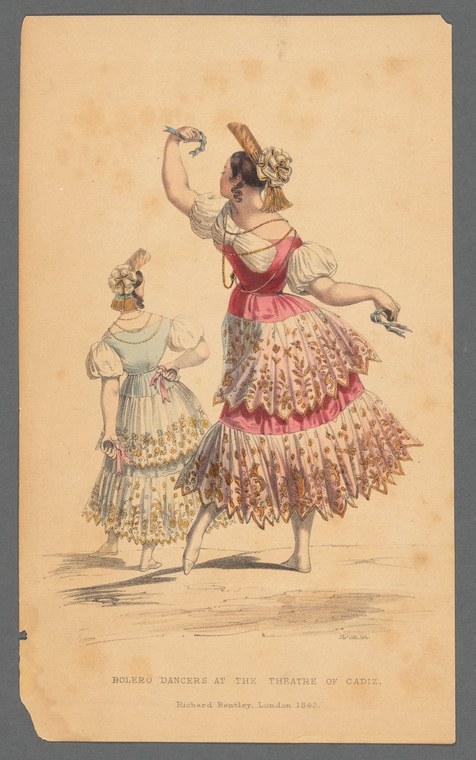
Bolero dancers at the theatre of Cadiz
Unknown artist
- Collection:
- Prints depicting dance
- Source:
- New York Public Library
- Rights:
- Public domain — free to use, share and adapt.
- Recorded as:
- Public Domain
This is one of the few visual records of how the Spanish Bolero was actually staged and costumed in the early 19th century, a period of significant popularity across Europe. For dancers and historians studying the historical bolero, theatrical Spanish dance, or the relationship between costume and identity in early modern dance, the specificity of the textile work, the headdress, and the staged posture is invaluable evidence. The print demonstrates the Bolero's status as a prestige theatrical export and reveals the aesthetics—elegance, display, ornament—that defined its appeal to Regency audiences.
What you are looking at
Two female dancers in theatrical dress occupy a shallow stage space, rendered in hand-colored engraving. The taller, rear figure wears a rose-red velvet bodice with a tiered skirt of whitework (possibly lace or cutwork) layered over rose silk, and holds her raised right arm aloft with fingers splayed in a gesture of display or flourish. Her head is crowned with flowers. The smaller figure downstage left, rendered in three-quarter profile facing right, wears a similar white worked skirt with rose silk underdress and a white bodice; she too wears a flowered headdress and gazes upward. Both figures stand on a bare stage floor with minimal shadow, and the composition emphasizes theatrical presentation rather than narrative—a moment frozen in performance. The engraving style and hand-coloring are consistent with early 19th-century theatrical prints.
The dancing
Both dancers are upright, with the weight distributed through the legs in an open stance. The rear dancer's raised arm and open hand position suggest a display or salute to the audience, a gesture of presentation rather than partnered interaction. The forward dancer's gaze is directed upward and away, creating a sense of reverie or theatrical abstraction rather than mutual engagement. There is no closed or social hold; the two figures occupy the stage space separately, each oriented toward the viewer in different sight lines. The silhouette is columnar rather than curved, consistent with early 19th-century deportment.
The dance depicted
The title identifies this as Bolero dancers at the Theatre of Cadiz, which places the work within the Spanish bolero tradition as performed in theatrical contexts in the early 19th century. The bolero was a Spanish theatrical dance gaining popularity across Europe in this period, often performed as a solo or display piece rather than a social partner dance. The costume—elaborate and ornamental, with hand-worked textiles and floral crown—and the theatrical setting support its identification as a staged version of the bolero. However, the absence of clear footwork, the static arm positions, and the vertical silhouettes make it difficult to determine the specific style or regional variant being performed. The image captures presentation and costume convention rather than the characteristic hip articulation or rhythmic weight shifts of the dance itself.
How it was made
This is a hand-colored engraving, likely from a theatrical print series. The engraved line is fine and precise, defining the figures clearly against the pale ground. Hand-coloring in rose, cream, and flesh tones has been applied over the printed plate—a labor-intensive process that indicates the work was intended for a paying audience of theatre-goers, print collectors, or dance enthusiasts. The technique allowed for mass production while retaining the prestige of hand-finishing. Theatrical prints in this format were widely circulated and collected as souvenirs and records of celebrated performances and dancers, making them important documents of early 19th-century performance practice.
About this work
This hand-colored engraving records the appearance and costume of the Bolero as performed on the Spanish theatrical stage in the early 19th century. The work is part of a tradition of theatrical prints documenting notable dancers and dances for a European audience. The composition prioritizes visual elegance and costume display—the ornamental work, the floral crowns, the rich silks—suggesting that the Bolero at this moment in its history was valued as much for its aesthetic presentation as for its kinetic content. The work belongs in a dance gallery because it is evidence of how a major European dance was visualized, performed, and consumed in the theater and the print market of the Regency era.
How to look at it
Attend to the costume detail first: the hand-worked skirt, the rose silk underdress, the flowered crown, and the refined fabrics reveal what the early 19th-century theatrical audience valued in the Bolero—visual richness and exotic elegance. Then observe the posture and gesture: the upright frame, the raised arm, the gaze directed away from the partner or audience, all suggest a style of dance that emphasized presentation and individual presence rather than partnered interaction or rapid footwork. The stillness of the image—this is not a moment of violent action or intricate footwork—tells you that the artist was interested in recording costume and theatrical image rather than kinetic content.
The artist
The engraver and hand-colorist are not recorded. The print is attributed to the London publisher Richard Bentley (active 1820s–1840s), who specialized in hand-colored theatrical and literary prints aimed at the middle-class drawing room and print cabinet market. Bentley's prints often documented celebrated theatrical moments and celebrated performers; this work would have been part of a broader cultural appetite for souvenirs of London theatre and touring European performers.
The period
The early 19th century saw a surge of interest in Spanish and Mediterranean dance across European theaters. The Bolero, originating in Andalusia, became fashionable in London, Paris, and Vienna as an exotic, rhythmic alternative to the stately minuet and the emerging waltz. Theatrical prints in this period were a primary means of documenting and circulating images of celebrated dancers and performances; Regency collectors valued them as records of taste and theatrical fashion. The hand-colored engraving was the dominant medium for this market before lithography became dominant in the 1830s–1840s. The costume—high-waisted empire silhouette with heavy textile ornamentation—dates the work to the 1820s or 1830s.
Where it lives
The print is held in the New York Public Library's print collection, part of a broader holdings of 19th-century theatrical and dance imagery. It is labeled as part of the 'Prints depicting dance' collection and carries the publisher attribution to Richard Bentley, London, circa 1820s–1830s.
Dance in this work
Questions about this work
What is a Bolero and where did it come from?
The Bolero is a Spanish theatrical dance that originated in Andalusia in the 18th century. It is characterized by rhythmic footwork, hip articulation, and arm styling, often performed to guitar accompaniment. In the early 19th century, it became fashionable across Europe as a concert and theatre dance, often performed by celebrated Spanish and international dancers. It influenced later Spanish dance forms and contributed to the development of flamenco theatrical styles.
Why were prints like this made and who bought them?
Theatrical prints served as souvenirs and records of celebrated performances and dancers. They were purchased by theatre-goers, print collectors, and society patrons as mementos of an evening's entertainment and as records of fashion and theatrical taste. Hand-colored engravings were expensive and labor-intensive, so they were aimed at affluent buyers. They also served as promotional tools, circulating the images of celebrated dancers and encouraging attendance at future performances.
Can you tell how the Bolero was danced from this image?
Only partially. The stillness of the figures, the upright posture, and the absence of visible footwork make it difficult to discern the characteristic weight shifts, rhythms, or hip movement that define the dance. The image prioritizes costume and theatrical presentation over kinetic detail. For a fuller understanding of early 19th-century Bolero technique, one would need to consult written descriptions, musical notation, or performance reviews from the period.
Why is the Theatre of Cadiz specified in the title?
Cadiz is a major port city in Andalusia, Spain, and had a celebrated theatre and cultural life in the early 19th century. Specifying the venue lends authenticity and prestige to the image—it suggests these are actual Spanish dancers performing in their native tradition, not European imitations. The Theatre of Cadiz would have been a center of Spanish dance culture and a source of celebrated performers who then toured Europe.
More dance artwork





