49 works in this view — arrow keys or swipe to move between them.
Dance in Art
Dance on music covers
Unknown artist
- Collection:
- Prints depicting dance
- Source:
- New York Public Library
- Rights:
- Public domain — free to use, share and adapt.
- Recorded as:
- Public Domain
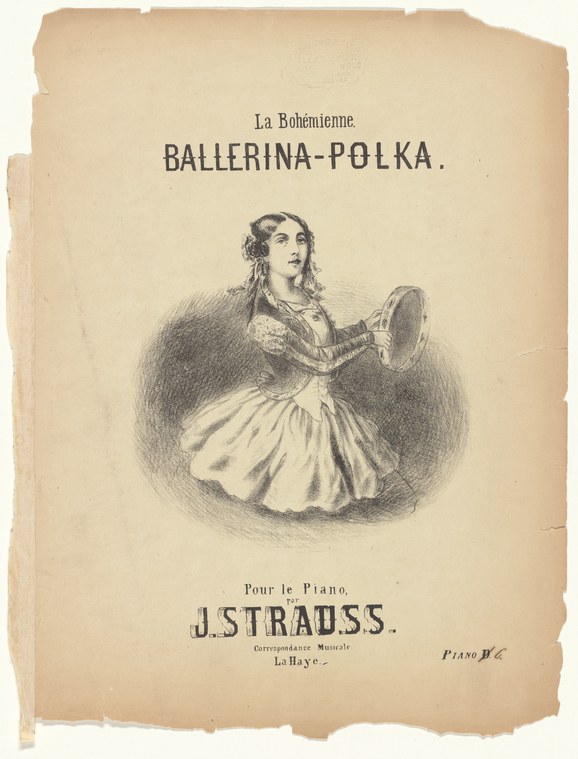
This image preserves a crucial moment in the history of social dance: the moment when the polka crossed from ballroom into theatrical performance, and the evidence of how that transition was marketed and imagined. The precision with which the engraver has captured the technical demands of the pose—the balance, the extension, the controlled velocity—tells us that by this date, audiences expected theatrical dancers to execute social dances with the skill of trained ballet dancers, and that the costume and decorum of the stage performance were understood as essential to the dance itself.
What you are looking at
A young woman in a voluminous white skirt and dark corseted bodice is caught mid-twirl, her body angled dynamically and her long hair and skirt lifted by the motion of the turn. She holds a large decorative fan outward with her left hand, her right arm extended for balance. The figure is rendered in fine-line engraving against a plain cream background, with delicate cross-hatching to suggest the volume of her skirt and the shadows of her corsage. The composition isolates the dancer against the void, emphasizing the moment of weightless rotation. At the top of the sheet is printed text identifying this as "La Bohémienne. BALLERINA-POLKA" and crediting it as "Pour le Piano" by "J.STRAUSS", with "Correspondance Musicale" and "La Haye" (The Hague) printed below.
The dancing
The dancer's weight is carried on a single leg, the supporting foot presumably en pointe given the athletic verticality of the pose, while her free leg extends in the direction of the turn. Her upper body is held upright but angled slightly backward by the rotational force, with her head lifted and face turned outward. The fan is held high and extended, suggesting a theatrical flourish or perhaps a signal—it is part of the movement, not incidental. The posture and port de bras (arm carriage) are precise and controlled despite the apparent velocity of the turn, indicating trained technique.
The dance depicted
This is a polka, the title "Ballerina-Polka" making that explicit, and the engraving advertises a piano composition by Johann Strauss (likely the younger) published by the Hague. The polka was a fashionable social and theatrical dance of the mid-to-late nineteenth century, danced both in ballrooms and on stage. This particular image presents it as a theatrical or concert piece: the isolated figure, the refined costume, and the technical execution all mark this as a performance rather than a social dance. The polka was characterized by quick hopping steps and energetic turning, which the frozen moment of spin captures well. The fan suggests this may be a solo performance or a woman's variation within a larger piece.
How it was made
This is a fine-line engraving, likely a steel or wood engraving, printed on cream paper. The crisp parallel hatching and precise line work are characteristic of mid-nineteenth-century commercial music-cover engraving, a technique that allowed for sharp detail and multiple impressions from a single plate. The fineness of the line and the delicate rendering of the dancer's face and the fabric texture indicate skilled hand-engraving. As a music cover, this sheet was designed to be mass-produced and distributed, making it an accessible form of advertisement and documentation of choreography and fashion simultaneously.
About this work
This is a music-cover engraving advertising a polka composition for piano by Johann Strauss, published in The Hague in the nineteenth century. The cover image depicts a solo female dancer in mid-turn, her body angled and her skirt and fan animated by motion. As a promotional image, it documents both the fashionable costume and the technical expectations of the polka as a theatrical piece—neither a court dance nor a folk form, but a popular ballroom dance elevated to the concert stage. The work combines commercial music publishing, dance promotion, and fine engraving technique into a single object that circulated widely as a cultural commodity.
How to look at it
Attend to the precise moment the engraver has chosen: the dancer is neither at the beginning of her turn nor at its conclusion, but suspended at the height of the rotation, her body still rising and her skirt still lifting. This is the moment of maximum visual drama and technical difficulty. Notice how the artist has used the outline of her body and the spray of her skirt to communicate motion without blur—the fine engraving line is itself unchanging, but the composition conveys speed and weightlessness through the angle and extension of the figure. The fan is key: held high and extended, it is not a prop but an active part of the choreography, a signal of the theatrical presentation of the dance.
The period
The polka emerged in the 1840s and spread rapidly throughout Europe as both a ballroom dance and a popular theatrical entertainment. By the 1860s–1880s (the likely date of this engraving), the polka was established as a staple of concert programs and opera divertissements, performed by ballerinas in tulle and pointe shoes. Johann Strauss the Younger was one of the major composers of polka music, and his works were published and performed across Europe. The theatrical polka maintained the characteristic fast hopping steps and turning figures of the social dance but was staged with the spectacle and technical display of ballet. Music-cover engravings such as this one served both as sheet-music packaging and as advertisement for performers and composers—they circulated in drawing rooms, concert halls, and music shops, shaping public expectations of what polka dancing should look like.
Where it lives
This engraving is held by the New York Public Library as part of its collection of prints depicting dance. It is a music-cover engraving, one of thousands produced in Europe and circulated as commercial sheet music, making it a common object that was nonetheless subject to loss and decay. The survival of examples in institutional collections is crucial to understanding the visual culture of nineteenth-century dance.
Dance in this work
Questions about this work
Was the polka considered a serious dance form?
Yes, by the mid-nineteenth century. While it began as a popular Czech social dance, it was quickly adopted by professional ballet companies and appeared on concert and opera programs throughout Europe. Ballerinas performed polka variations as show-stoppers, and composers like Strauss elevated the music to concert status. This engraving shows the polka in its theatrical guise, performed with the technical precision and costume standards of ballet.
What is the fan doing in the choreography?
The fan is clearly part of the movement: it is held high and extended, not simply carried. This suggests the choreography of this particular polka included deliberate fan work, which was common in theatrical dances of the period. The fan added visual interest, elegance, and often signaled character or mood—in this case, a touch of exoticism implied by the title "La Bohémienne" (The Bohemian Woman).
Who was Johann Strauss?
Johann Strauss II (1825–1899), known as "the Waltz King," was an Austrian composer who dominated European popular and concert music in the mid-to-late nineteenth century. Though famous for waltzes, he also composed many polkas, quadrilles, and other dance forms, all of which were published as sheet music and performed across Europe. His works were essential to the concert and ballroom culture of his era.
More dance artwork





