49 works in this view — arrow keys or swipe to move between them.
Dance in Art
Der Pfingsttanz
Unknown artist
- Collection:
- Prints depicting dance
- Source:
- New York Public Library
- Rights:
- Public domain — free to use, share and adapt.
- Recorded as:
- Public Domain
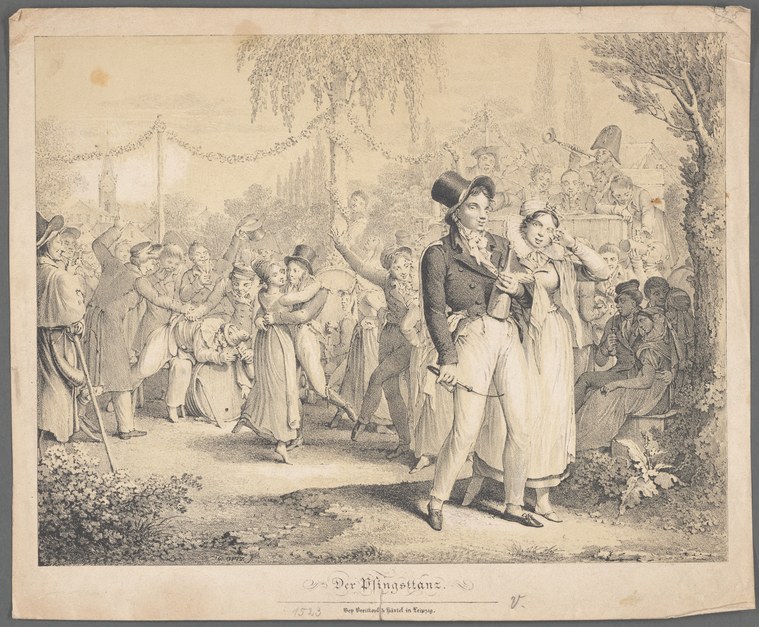
The image provides rare visual evidence of how the waltz and other Regency ballroom dances were actually performed in public—their posture, frame, and social context—at a moment when the waltz was revolutionizing European dance but when documentation was scarce. For historians of dance and of Regency society, this print offers what written accounts and dry dancing manuals cannot: the lived texture of the ballroom, the gender relations it encoded, and the visual experience of participants.
What you are looking at
A festive outdoor gathering, likely a Whitsuntide celebration, fills an enclosed garden or park space. In the foreground, couples and groups of figures in early 19th-century dress occupy a sunlit clearing ringed by trees and classical architectural elements—draped garlands slung between posts frame the scene. The central focus shows multiple pairs engaged in dance or courtship, with women in high-waisted Empire silhouettes and men in tailcoats and breeches. The composition draws the eye from a prominent dancing couple at center-right—the woman in white, the man in dark coat and hat—outward to clusters of spectators, musicians, and other dancers arranged in loose groupings across the space. The light falls warmly across the scene, creating strong shadows and a sense of summer afternoon pleasure. Beyond the immediate dance ground, figures rest on benches or stand at the margins, establishing the social hierarchy typical of Regency-era public entertainments.
The dancing
The primary dancing couple holds a close social frame: the man's arm supports the woman's waist, and both face forward with upright posture. Their leg positions suggest a walking or gliding motion rather than high lifts or kicks. Other couples throughout the scene maintain similar closed holds or stand at arm's length in conversational attitudes. The women's posture is characteristically high-waisted and elegant, with arms held gracefully; the men stand more stiffly upright. No footwork detail is visible at this scale and medium, but the overall carriage—the controlled, almost ceremonial formality of the upper body—distinguishes this from country or folk dance. Spectators cluster in small groups, some seated, some standing, creating a leisurely social atmosphere rather than the intensity of performance.
The dance depicted
This is almost certainly a Regency-era ballroom dance, most likely a waltz or country dance such as the Cotillion, given the title *Der Pfingsttanz* (Whitsun Dance) and the social setting. The Whitsun festival (Pentecost) was a traditional occasion for public balls and garden entertainments across Germanic lands in the early 19th century. The closed couples and upright frame align with Regency waltz conventions of around 1810–1830, when the waltz was still scandalous in Britain but widely embraced in Austria and Germany. The formal dress, the garden setting with its ordered decorum, and the mixture of dancing and spectating all point to a genteel social dance of the Regency period rather than a folk tradition. The image documents how this dance was performed in public space—outdoors, in mixed company, with clear gender pairings and social hierarchy.
How it was made
This is a hand-colored engraving or aquatint, as evidenced by the fine line work forming the composition, the tonal modeling achieved through parallel lines and hatching, and the watercolor wash applied to the figures and landscape. The technique allowed for mass reproduction and distribution, suggesting this was a popular print for sale to the middle-class audience who consumed images of fashionable life. The careful detail in dress and architectural setting, combined with the warm atmospheric effect, indicates a skilled printmaker working in the tradition of social documentation. Hand coloring, applied after printing, accounts for the subtle variation in hues and the somewhat uneven coverage visible at the edges. This is the kind of print that would have been framed in a parlor or album as a record of contemporary manners.
About this work
This engraving documents a Whitsuntide ball in the Regency era, capturing the forms and social rituals of early 19th-century German or Austrian ballroom dance. The title *Der Pfingsttanz* confirms the seasonal celebration, and the visual evidence—the Empire silhouettes, the closed couple holds, the garden setting with formal ceremony—places it squarely in the Regency period of the 1810s–1820s. It belongs in a gallery of dance art because it is precise social history: it shows not just that people danced at such gatherings, but how they held their bodies, how they arranged themselves in space, and how the act of dancing was integrated into a broader ritual of courtship, display, and community. The print is neither performance documentation nor individual portraiture; it is a ethnographic record of a moment in dance's social life.
How to look at it
Attend first to the central dancing pair: the artist has frozen them at the moment of forward motion, with the man's posture erect and protective, the woman's weight balanced and composed. This is not a moment of spectacular display—no leap, no spin—but rather the quotidian elegance of social dance. Notice how the artist contrasts this focused pair with the leisure of the spectators: some sit, some stroll, some gesture in conversation. This visual hierarchy—the dancing pair as the scene's center but not its only focus—is itself a historical document: it tells us that watching and being watched were as much part of the pleasure as dancing itself. The garden setting, with its formal geometry and its framing devices, emphasizes that this was a controlled, civilized spectacle, not a wild revel.
The period
The Regency era (1811–1820, though culturally extending to c. 1830) was a moment of transformation in ballroom dance. The waltz, originating in Austria and southern Germany, had only recently entered polite society and was still considered daring in Britain for its close couple contact and the woman's exposure of her legs in motion. Germany and Austria embraced it far more readily. Whitsun festivals (held in late spring) were traditional occasions for public balls and garden entertainments throughout the German-speaking lands, and they often featured the newest fashions in dress and dance. Social printing—engravings and watercolored prints documenting fashionable life—was a booming industry; middle-class collectors bought these images as records of how one should look and behave. *Der Pfingsttanz* sits in this tradition of social reportage.
Where it lives
Held in the New York Public Library's collection of prints depicting dance. This is the kind of popular social print that was published in quantity during the Regency era and widely distributed across Europe; many copies are held in public collections, though individual provenance is often lost.
Dance in this work
Questions about this work
Why is this a Whitsun dance specifically?
The title *Der Pfingsttanz* identifies it as such. Pfingsten is the German word for Whitsunday (Pentecost), a spring festival traditionally associated with public balls and garden entertainments throughout German-speaking lands. The garden setting, the formal dress, and the sunny outdoor atmosphere are all consistent with a Whitsun celebration, which typically took place in May or June.
Is this a waltz or a country dance?
The closed couple frame and upright posture are consistent with the Regency waltz, which by the 1810s–1820s was becoming the dominant fashion in Austria and Germany, though still shocking to some in Britain. However, the garden setting and the mixture of dancing and socializing could also suggest a Cotillion or other Regency country dance. The image alone cannot determine which with certainty, but the Regency waltz is the most likely candidate given the period and region.
What does the dress tell us about dating this print?
The women's Empire silhouettes—high waistlines, straight skirts, minimal ornamentation—and the men's tailcoats and breeches are hallmarks of Regency fashion, dating the print to roughly 1810–1830. This dating aligns with the title and the style of the engraving itself.
Who would have owned or seen a print like this?
Hand-colored engravings like this were affordable prints for the middle and upper-middle classes—not expensive fine art, but not cheap ephemera either. They were bought by people who wanted to display fashionable life in their homes, to learn what was in vogue, and to admire representations of refined leisure. They circulated widely across Europe, often published in series on social and fashionable topics.
More dance artwork





