49 works in this view — arrow keys or swipe to move between them.
Dance in Art
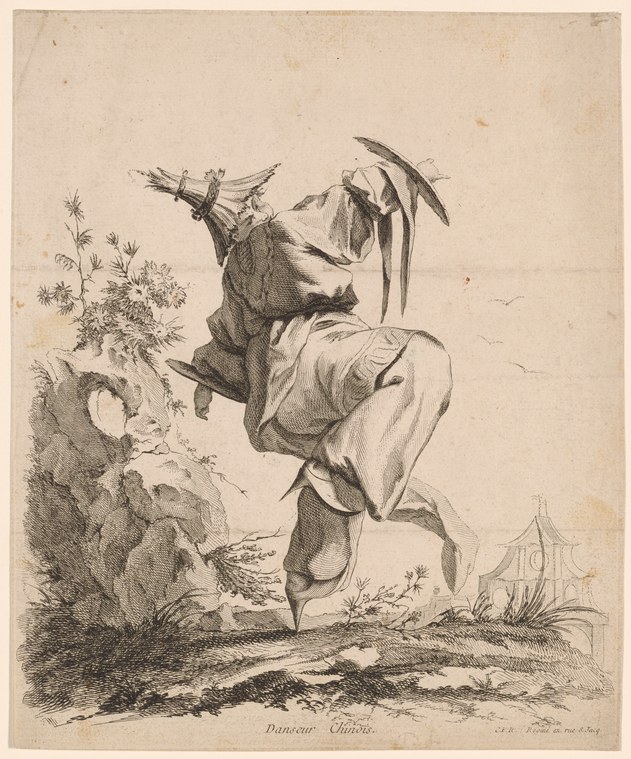
Danseur chinois
Unknown artist
- Collection:
- Prints depicting dance
- Source:
- New York Public Library
- Rights:
- Public domain — free to use, share and adapt.
- Recorded as:
- Public Domain
This image is one of relatively few surviving European visual documents of Chinese dance from the 18th century, and it captures both a real performance tradition and the aesthetic framework through which Europeans encountered it. For dance historians, it offers concrete evidence of how Chinese dance movement was understood and portrayed in the West during this period; for art historians, it demonstrates the role of prints in creating and distributing images of cultural difference.
What you are looking at
An engraved figure of a dancer in Chinese dress occupies the center of the composition, set against a spare landscape with rocky outcrops and sparse vegetation. The dancer wears a long-sleeved robe with voluminous sleeves and what appears to be a long skirt or lower garment, rendered in fine cross-hatching that suggests fabric weight and drape. The figure is captured in a dynamic pose: the body is twisted, one arm raised high with the sleeve billowing, the other extended lower, and the legs appear to bend at the knees in a position suggesting either descent or a turning moment. The dancer holds or brandishes what may be a curved implement—possibly a sword or similar object—in the raised hand. The setting includes a small pavilion or structure in the background at right, and the ground plane is established with scattered rocks and low vegetation. The print is executed in a European printmaking style with fine parallel lines building tone and shadow, creating a sense of three-dimensional form across the figure's body and costume.
The dancing
The single figure demonstrates considerable flexibility and articulation through the torso. The pose shows the body sharply twisted, with the weight appearing to shift through the legs as they bend. The raised arm extends overhead with the sleeve creating a dramatic line, while the lower arm angles across the body. The head is tilted to follow the line of the upper body. The costume—particularly the long, voluminous sleeves—creates visual extension of the limbs and amplifies the sense of motion. The execution suggests the artist understood that costume and fabric movement are inseparable from the body's line in this dance tradition.
The dance depicted
This appears to document a form of Chinese theatrical or court dance, most likely from the 18th century based on the style and subject matter. The title *Danseur Chinois* identifies it as a representation of a Chinese male dancer for a European audience. The twisted torso, bent knees, and elevated arm position suggest a vocabulary involving axial rotation and extension through the upper body—consistent with classical Chinese dance forms. The curved implement in the hand may indicate a prop-based dance, possibly related to sword or fan dancing traditions. Without documentary evidence, the specific form cannot be definitively named, but the image captures both the physical vocabulary and the exoticist lens through which 18th-century European artists viewed Asian performance.
How it was made
This is an engraving, identifiable by the fine parallel hatching lines used to build form, shadow, and texture across the entire composition. The technique allowed for precise reproduction and wide distribution through the printing press, making such images affordable for collectors and circulating images of distant performance cultures across Europe. Engraving was the dominant medium for reproducing artwork in the 17th and 18th centuries, implying this work was created for a European market with curiosity about non-Western dance practices. The signature mark at the bottom, though not fully legible in reproduction, confirms it as a formal, published print rather than a sketch.
About this work
This engraving documents a Chinese dancer in the exoticist tradition of 18th-century European visual culture. It presents a single figure captured mid-movement in a pose demonstrating considerable bodily flexibility and the integration of costume—particularly the voluminous sleeves—into the kinetic line. The artist has rendered the twisted torso, bent knees, and extended arms with enough specificity to suggest genuine observation or engagement with descriptions of Asian performance, rather than pure invention. Yet the image is unquestionably made for a European audience discovering and aestheticizing distant dance traditions through the medium of the print.
The work exemplifies how dance images functioned as vehicles for cultural curiosity and often cultural fantasy during the Age of Enlightenment. Chinese dance appears here alongside other non-European subjects in European print collections, documenting both actual performance vocabularies and the European appetite for the exotic. For historians of dance and image-making alike, this print is valuable evidence of how movement from other cultures was seen, recorded, and circulated in early modern Europe—often transformed in the act of translation into European artistic media.
How to look at it
Attend to the pose itself: the artist has chosen a moment of considerable torsion and extension, with the body twisted along its central axis and the limbs reaching outward. This is not a static position but a captured instant within movement. Note how the costume—especially the long sleeves—becomes part of the choreography: the sleeve lines extend the arm and create visual momentum beyond the body's own contours. The curved implement held aloft adds another line of extension and suggests this may be a prop-based form. The sparse setting keeps the focus on the body and its vocabulary, allowing the viewer to read the movement uninhibited by narrative or elaborate decor.
The artist
The artist is not recorded in the catalogue. The style, technique, and subject matter place it firmly in the 18th-century European print tradition. The print may be French, Dutch, or German based on stylistic conventions and the continental fashion for prints depicting distant lands and peoples. The signature or mark at the bottom remains unverified in available records.
The period
This engraving belongs to the 18th-century European fascination with chinoiserie and the visual representation of non-European performance. During this period, European artists and collectors were eager to document and aestheticize Asian cultures, and prints became the primary medium for circulating such images across the continent. Chinese dance, along with other "exotic" performance forms, was both a real tradition and a projection of European fantasy—often romanticized and reinterpreted through European artistic conventions. The refinement of the engraving technique in the 17th and 18th centuries made such documentation and distribution possible at unprecedented scale.
Within European dance history, this period saw the dominance of ballet and court dance, but the circulation of images of non-European dance also reflects growing cosmopolitanism and the gradual inclusion of "foreign" movement vocabularies into European theatrical practice—a process that would accelerate through the 19th century with the Romantic ballet's embrace of exotic subjects and characters.
Where it lives
The work is held in the New York Public Library's collection of prints depicting dance, catalogued without attribution or date. It is one of many 18th-century European prints documenting non-Western performance traditions, reflecting the print collection's focus on visual documentation of dance across cultures and periods.
Dance in this work
Questions about this work
Is this depicting a real Chinese dance form?
Most likely, yes—in part. The pose and movement vocabulary show enough specificity to suggest the artist had access to descriptions or possibly visual models of Chinese dance. However, the image is also filtered through European artistic conventions and the aesthetic expectations of a European audience. It captures a real tradition but as interpreted and translated into European visual language.
What is the dancer holding?
It appears to be a curved implement, possibly a sword, fan, or other prop used in Chinese dance forms. Without additional documentation, the specific object cannot be identified with certainty, but the raised position and curved line suggest it is integral to the choreography rather than merely decorative.
Why was this printed and circulated in Europe?
Prints of exotic and distant cultures were highly fashionable among 18th-century European collectors and educated audiences. Such images satisfied curiosity about non-European lands and peoples and reflected the aesthetic movement of chinoiserie—the European fascination with (and stylization of) Asian art and culture.
How do I know this is an engraving and not some other print technique?
The fine parallel hatching lines used to build shadow and form are characteristic of engraving, where lines are incised into a metal plate. This technique creates a particular visual texture and precision that distinguishes it from etching, lithography, or woodcut.
More dance artwork





