49 works in this view — arrow keys or swipe to move between them.
Dance in Art
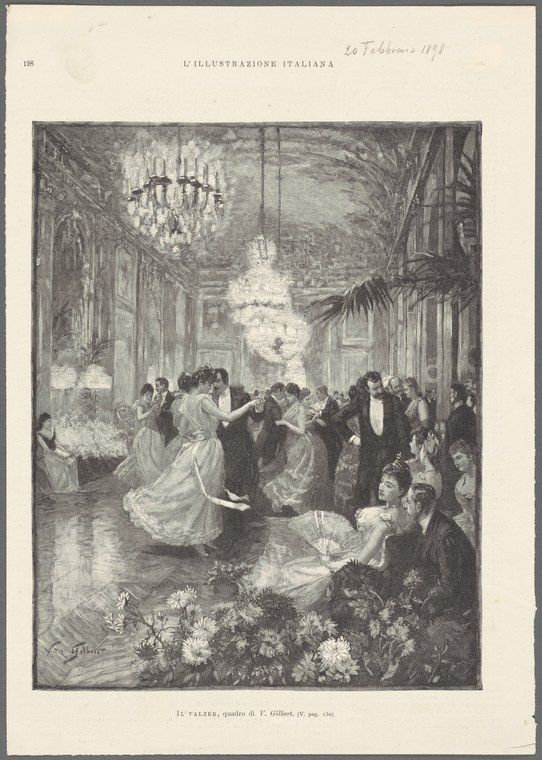
Il valzer
Unknown artist
- Collection:
- Prints depicting dance
- Source:
- New York Public Library
- Rights:
- Public domain — free to use, share and adapt.
- Recorded as:
- Public Domain
This is a high-quality contemporary image of the waltz at the moment of its social apotheosis, rendered by an artist who clearly understood ballroom technique and the formal hold. It captures not just the dance step but the entire ecosystem of ballroom culture—the dress code, the setting, the partnering ethos, and the choreography of social movement—making it an unusually rich visual document of late 19th-century dance practice.
What you are looking at
An elegant ballroom fills with couples dancing under elaborate chandeliers in an ornate neoclassical interior. The scene captures a moment of social movement: couples in closed position rotate across a polished floor, their bodies angled into the characteristic rise-and-fall of a formal dance. The women wear full-length gowns—many pale and ethereal, some darker—while the men are in dark evening dress with white shirts. In the foreground, flowers (chrysanthemums or similar blooms) are scattered across the floor or arranged in vases, suggesting a special occasion. The artist has rendered the candlelit interior with dramatic chiaroscuro: the chandeliers glow brightly, casting the dancers into a luminous scene while the architectural details—columns, arches, ornate ceiling—recede into shadow. The composition suggests movement and grace without frenzy; the dancers are distributed across the space in a leisurely, aristocratic manner that evokes the formal balls of the late 19th century.
The dancing
The couples hold the closed ballroom position standard to European formal dancing of the period: the man's right hand at the woman's back, her left on his shoulder, their outside arms extended, bodies in a slight S-curve frame. The dancers' postures show the upright carriage and restrained elegance expected in ballroom etiquette—no wild abandonment, but a composed, sustained rise through the body. The nearest couple in the foreground shows clear weight transfer and rotation; their torsos are aligned and rotated as a unit, feet moving in the small, precise steps typical of waltz or related salon dances. Several couples can be counted across the floor, all maintaining the same formal hold and axis.
The dance depicted
This is a waltz, almost certainly a Viennese or classical European waltz of the period the dress and setting suggest (late 1800s). The title *Il valzer* (The Waltz in Italian) confirms this. The waltz was the supreme ballroom dance of the 19th century, and this scene captures its social meaning as much as its technique: a public exhibition of refined partnership, suitable for the formal soirées of aristocratic and upper-middle-class society. The image shows the waltz not as a rural or folk origin, but as it had become in the gilded age—the presiding dance of urban, cosmopolitan leisure. The closed hold, the three-beat rotation, and the rise of the body through the frame are all waltz signatures, and the artist has understood them.
How it was made
This is a fine-line engraving or etching—likely an etching given the fluid, detailed linework and the soft gradation of tone through cross-hatching. The technique allows the artist to render both the precise architecture of the ballroom and the gentler modeling of fabric and flesh; the contrast between the hard linear definition of the chandeliers and columns and the softer, more gestural rendering of the dancers' bodies shows the medium's range. The quality of line and the refined tonal control suggest this was a work of some ambition, intended for a cultivated audience—likely a print for a periodical or a collector's portfolio. The signature (apparent in the lower left) confirms authorship, though the artist's name is not recorded in the holding record.
About this work
This engraving documents the waltz at its height as a marker of civilized leisure and urban sophistication. It is a dance-specific image that understands both the technical hold and the social role of its subject: the waltz as the dance that defined 19th-century ballroom culture. The scene is neither a caricature nor a narrative—it is a record of a moment of refined pleasure, captured with enough anatomical and compositional skill to convey the actual movement and posture of the dancers. For a historian of ballroom dance, this image is valuable because it shows the waltz not in instruction or notation, but as it was performed in its native context, among its native audience, in the midst of the architectural grandeur that ballroom culture inhabited.
How to look at it
Notice how the artist has frozen the waltz at a moment of rotation, with couples distributed across the floor at different phases of the three-beat cycle—some beginning to rise, others at the height of their frame. The composition is not static; even in stillness, the engraving conveys the continuous, circling motion that defines the waltz. Attend to the closed hold: the geometry of the embrace, the alignment of the torsos, the extension of the outside arms. This hold is not loose or casual but precise and sustained—it is the technology that makes the dance possible. The setting—the grandeur of the ballroom, the wealth of the candles, the formality of the dress—tells you that this is not folk dancing or popular entertainment, but the dance of an elite asserting its grace and refinement through movement.
The period
The waltz rose to dominance in European ballrooms in the early 19th century and remained the supreme social dance through the Victorian era and into the early 20th century. By the time this engraving was made (date unknown, but likely 1880s–1900s based on the style of dress and interior design), the waltz had been established for nearly a century as the foundation of ballroom culture. The formal closed hold had become codified, and the dance had spread from Vienna to Paris, London, and every major city where the urban elite gathered for social display. This image sits within a rich tradition of ballroom imagery in fine and decorative arts, from Hogarth through the great 19th-century dance prints—a genre devoted to capturing the elegance, sociability, and visual spectacle of formal dance.
Where it lives
The work is held in the New York Public Library's Prints Collection, catalogued as depicting dance. It is a fine-art engraving or etching, likely from a 19th-century periodical or artists' portfolio, circulated among educated collectors and institutions.
Dance in this work
Questions about this work
Is this the Viennese waltz or the English (Slow) waltz?
The image alone cannot definitively distinguish between them; both employ the closed hold and three-beat rotation. The Viennese waltz is faster and turns more sharply; the English waltz incorporates rise-and-fall and is more restrained. This artist has captured the fundamental frame that both share, and the elegant, upright carriage suggests the English interpretation, but the engraving's detail is not fine enough to confirm footwork or tempo distinctions.
Why are there flowers on the floor?
The flowers suggest a special occasion—a formal ball or gala. Flowers were often used to decorate ballrooms for important social events, and the detail underscores that this is not ordinary social dancing but a ceremonial display of elegance and leisure.
Could this be a different dance, like a quadrille or cotillion?
No. The closed hold and continuous rotation are unmistakable signatures of the waltz. Quadrilles and cotillions use a different hold (often hands-across or side-by-side) and different formations (sets of four or eight). This is unambiguously a waltz.
What can we learn about 19th-century ballroom etiquette from this image?
The image shows that ballroom dancing was highly formal and partnered; dancers maintained an upright, composed posture; the closed hold was the standard embrace; and dancing took place in grand architectural settings designed to showcase refinement and wealth. The segregation of dress (dark men, pale women) and the careful spacing of couples also reflect the era's social codes.
More dance artwork





