49 works in this view — arrow keys or swipe to move between them.
Dance in Art
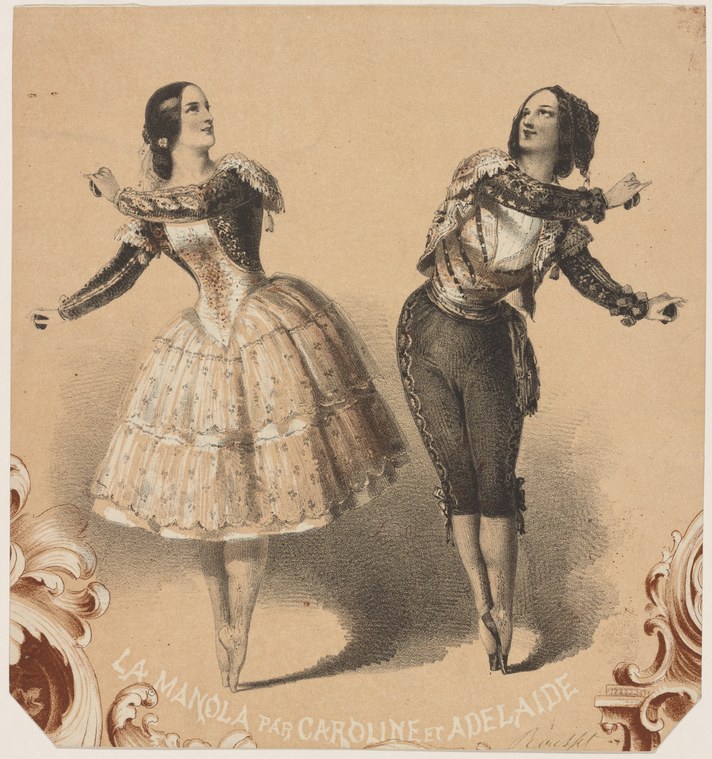
La manola par Caroline et Adelaide
Unknown artist
- Collection:
- Prints depicting dance
- Source:
- New York Public Library
- Rights:
- Public domain — free to use, share and adapt.
- Recorded as:
- Public Domain
This work documents the specific practice of performing Spanish regional dance in a European theatrical and ballroom context, naming the performers and preserving a record of a celebrated specialty act. It shows how non-European dance forms were adapted, aestheticized, and presented to European audiences through costume, gesture, and the authority of named celebrity performers.
What you are looking at
Two female dancers in theatrical costume face the viewer in a three-quarter pose against a plain background, each looking upward and outward with a gesture of appeal or presentation. Both wear ornate shoulder capes or shawls with decorative patterns and fringe, fitted bodices, and voluminous skirts. The dancer on the left wears a pale, possibly white skirt with horizontal pleating or gathering; the one on the right wears a darker, more opaque skirt. Both have their arms extended in a graceful, expressive manner—one arm raised, the other lowered—suggesting a moment of emotional intensity or dramatic declaration. Their hair is dark and arranged in the period style. Decorative rococo cartouches frame the lower corners of the composition in brown and gold tones. The image is rendered in a monochromatic style typical of prints, with subtle tonal gradation creating depth in the fabric and shadow.
The dancing
Both figures stand in an upright, frontal pose with weight evenly distributed, suggesting a pause in movement rather than action. Their arm positions are symmetrical in shape but opposite in direction—one arm held high and extended, the other lower—creating a sense of balance and theatrical presentation. The bodies show no flexion in the knees; the posture is formal and composed. The expressive reach of the arms and the upward gaze suggest emotional intensity or a moment of supplication rather than technical footwork display.
The dance depicted
This appears to be a theatrical representation of *la manola*, a Spanish dance of the lower classes that became fashionable in European theater during the 19th century, particularly in Paris. The costume—especially the decorative mantilla-like cape and the full skirt—aligns with the dress associated with Spanish regional character dances. The formal pose, emotional gesture, and theatrical framing suggest this is a staged interpretation for the ballroom or theatrical stage rather than documentation of vernacular practice. The dancers named Caroline and Adelaide were likely performers known for this specialty; the duet format and symmetrical composition suggest a set piece designed for effect.
How it was made
This is an engraving or lithograph, rendered in black ink on paper with monochromatic toning and hand-coloring or careful tonal work to suggest fabric texture and three-dimensionality. The rococo ornamental frames indicate a print designed for circulation and collection, likely from a theatrical or dance publication of the 19th century. The technique allows careful attention to costume detail and gesture while maintaining the formal clarity needed for widespread reproduction and viewing at a distance.
About this work
This is a print documentation of a theatrical dance moment featuring two named performers in Spanish character dress, identified as performing *la manola*. The work belongs to the 19th-century tradition of theatrical dance prints that recorded and circulated images of celebrated dancers and fashionable choreographies. It sits at the intersection of Spanish regional dance, European ballroom exoticism, and theatrical performance—a mode in which Spanish, Italian, and exotic dances became drawing-room and stage spectacles for bourgeois audiences. The careful rendering of costume and the symmetrical, emotional presentation of the two figures emphasizes the theatrical and social status of the performers as much as the dance itself.
How to look at it
Attend to the symmetry and mirror-image quality of the two figures and how that creates a sense of duet or ensemble rather than solo display. Notice the costume detail—the decorative fringe, the cut of the skirt, the style of the cape—which identifies the dance tradition and its theatrical presentation. The upward gaze and extended arm gesture are the emotional and narrative center; the pose is not about footwork or technical display but about theatrical presence and expressive appeal. The rococo framing emphasizes that this is a designed, curated image for collection and display, not documentary.
The artist
The artist is not recorded. The work was issued as a print, likely by a Parisian publisher given the French inscription and the circulation style. The aesthetic and decorative approach are consistent with mid-19th-century theatrical and dance prints, a genre that often presented unsigned or loosely credited work, especially where the focus was on the performer and the dance rather than the artist.
The period
The 19th century saw the rise of romantic ballet and the expansion of theatrical dance into both elite and popular spheres. Spanish and other 'exotic' dances became fashionable on European stages and in ballrooms, reflecting both colonial interest and a taste for character and regional costume in an era of industrialization. The naming of Caroline and Adelaide suggests these were known performers with a following, part of the celebrity dance culture that developed around touring and theatrical performance. This print likely served both as a souvenir and as an advertisement for future performances.
Where it lives
This work is held in the New York Public Library's collection of prints depicting dance. It is a theatrical print, likely issued in the mid-19th century as a promotional or commemorative image for circulation among audiences interested in dance and performance.
Dance in this work
Questions about this work
Who were Caroline and Adelaide?
The record does not identify them beyond their names, but they were likely performers known for specializing in Spanish character dances, particularly *la manola*. The fact that a print was issued bearing their names indicates they had a reputation and a following sufficiently large to merit such publication. They may have performed in Paris or another major European theater center.
What is la manola?
*La manola* is a Spanish dance associated with the lower classes and regional character of Madrid and Andalusia. In the 19th century it became popular on European stages and in ballrooms as an exotic, flirtatious character dance, performed by actresses and dancers in costume. The theatrical version performed by Caroline and Adelaide was likely very different from any vernacular practice.
Is this a ballet or a ballroom dance?
The evidence suggests a theatrical character dance performed in a staged or ballroom context rather than classical ballet. The Spanish costume, the emotional gesture, and the lack of pointe shoes or classical ballet framing point to a specialty performance—the kind of 'national' or 'character' dance that became a feature of ballroom performances and theatrical evenings in 19th-century Europe.
More dance artwork





