49 works in this view — arrow keys or swipe to move between them.
Dance in Art
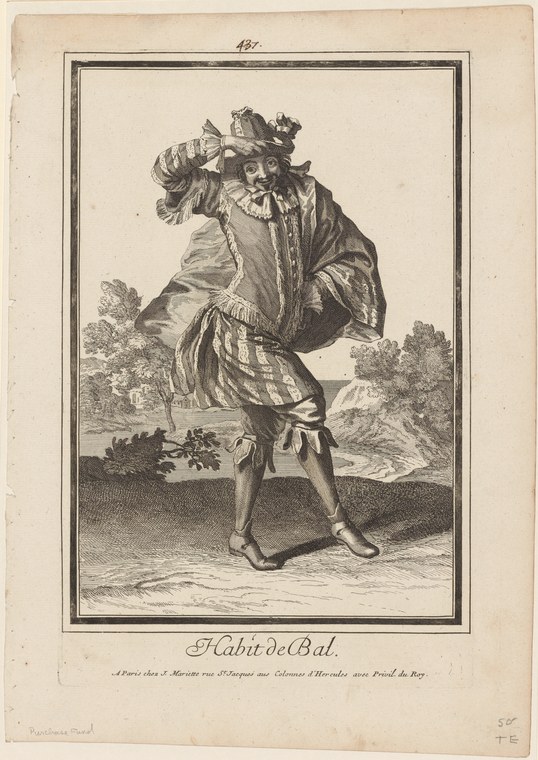
Habit de bal
Unknown artist
- Collection:
- Prints depicting dance
- Source:
- New York Public Library
- Rights:
- Public domain — free to use, share and adapt.
- Recorded as:
- Public Domain
This engraving is primary visual evidence of how baroque courtiers understood their bodies and dress as unified expressions of rank, taste, and accomplishment. For historians of dance, fashion, and court culture, it demonstrates the inseparability of costume and movement in the baroque aesthetic, and the role of engraved fashion plates in standardizing and disseminating courtly behavior across Europe.
What you are looking at
A single figure dominates this engraving, depicted in three-quarter view against a sparse landscape of rocky outcrops and distant trees. The dancer wears elaborate court dress: a richly patterned coat with long skirts and full sleeves, topped with an ornate feathered hat or plume. The body is caught in a striking pose—weight shifted to one leg, the other raised and bent, arms gesturing expressively with one raised high and the other extended. The costume's heavy fabric suggests the garment is held away from the body by the momentum of the movement. The figure stands on bare ground with minimal shadow, against an uncluttered background that throws the elaborate dress and animated posture into sharp relief. The overall composition isolates the dancer as a specimen of courtly movement and fashion.
The dancing
A single dancer, posed in an active, asymmetrical stance with clear weight distribution onto the supporting leg while the other leg bends at the knee. The arms are positioned in a dynamic, expressive frame—one raised and the other extended outward—characteristic of formal courtly gesture. The torso twists slightly, and the head is turned toward the raised arm, following the movement line. The dancer appears to be mid-gesture rather than mid-step, suggesting a moment of ornamental display or a formal pose within a choreographed sequence.
The dance depicted
This appears to document a figure from the court dances of the baroque period, most likely a participant in a minuet, bourée, or similar formal court dance. The inscription 'Habit de Bal' (Ball Dress) suggests this is a costume study—a record of what a fashionable courtier wore to a formal dance occasion—rather than a depiction of a specific dance step or movement. The pose demonstrates courtly bearing and the theatrical use of the body and costume as ornament, typical of 17th- or early-18th-century aristocratic dance practice. The image functions as a fashion plate as much as a dance document.
How it was made
This is an engraving, established by the fine line work, the absence of tone, and the formal border frame typical of print production. The technique allows precise delineation of costume detail—the coat's pattern, the plume, the stockings—while capturing movement through the exaggerated tilt and twist of the body. The engraving's portability and reproducibility meant such images circulated widely among European courts and educated audiences, serving as records of courtly fashion and propriety. The formal frame and inscription suggest this is a page from a larger series documenting court dress or dance manners.
About this work
This engraving documents a moment in the visual culture of European courtly dance, capturing both the fashion and the formal bearing required of a dancer in a baroque court. The figure represents not a specific named dancer but rather a type—the fashionable courtier at a ball—whose elaborate costume and refined posture embodied the ideals of courtly behavior. The work sits between costume history, dance documentation, and fashion illustration, serving multiple purposes within the material and visual culture of baroque aristocracy.
The image's survival in a collection of dance-related prints indicates its historical value as evidence of how court dances were performed and what dancers wore. It belongs in a dance archive not as a technical guide to steps but as a record of the social context and visual practice of one of Europe's most influential dance traditions.
How to look at it
Attend to the deliberate artificiality of the pose: this is not a frozen moment from dancing, but a composed statement of courtly deportment and dress. The artist has chosen a posture that displays the costume's detail—the coat's pattern, the plume's movement—while demonstrating the dancer's control of the body and its line. The sparse background ensures nothing distracts from the figure itself. Notice how the twist of the torso and the placement of the limbs create a sense of refined movement even in stillness, and how the costume's weight and bulk are managed by the body's stance. This is fashion and bearing as a unified visual language.
The artist
The artist is unrecorded in the catalogue. The inscription attributes the work to a tradition of costume and dance documentation rather than to a named individual creator. Such engravings were often produced by print workshops rather than individual artists, and were frequently copied, reissued, and circulated across borders. The style and technique suggest a French or Franco-Flemish origin, consistent with the French inscription and the dominance of French court culture in setting standards for aristocratic behavior across Europe.
The period
This work dates from the era of formal court ballet and social dance in the late 17th or early 18th century, when the minuet dominated European court life and dancing was a required accomplishment of any person of rank. Dance was inseparable from fashion, manners, and the theater of courtly display. Engraved costume plates and dance manuals were produced in large numbers to record and disseminate the conventions of courtly behavior, making them instruments of cultural standardization as the old aristocratic order consolidated its visual practices. The work reflects the moment when dance was becoming codified, documented, and transmitted through print.
Where it lives
This engraving is held in the New York Public Library's collection of prints depicting dance, catalogued as part of their broader holdings in dance history and material culture. The collection context suggests it was acquired as a historical document of dance practice and costume rather than as a work of fine art by a named master.
Dance in this work
Questions about this work
Is this a specific dancer or a generic figure?
This appears to be a generic type—a fashionable courtier at a ball—rather than a portrait of an individual dancer. The inscription 'Habit de Bal' (Ball Dress) indicates the work is a costume study documenting what one wore to dance, not a record of a particular person's performance. Such engravings served as fashion and behavior guides for courtly society.
What dance is being shown?
The pose and costume are consistent with baroque court dances such as the minuet, but the work is not a dance instruction or depiction of a specific step. It is a costume and deportment study—a record of how a courtier should appear and carry themselves at a formal dance occasion. The emphasis is on dress and bearing rather than choreography.
Why would this image have been made?
Such engravings served multiple purposes: as fashion plates for circulation among the European aristocracy, as records of courtly manners and propriety, and as teaching aids. They standardized and disseminated the visual practices of court culture, allowing courtiers across different regions to understand and adopt the behaviors and fashions of the leading courts, particularly the French court.
What does the costume tell us about baroque dance?
The heavy, ornate coat, the full skirts, the feathered hat, and the stockings were all standard courtly dress. They constrained the body in specific ways—requiring an upright carriage, limiting stride length, and making the dance's elegance and restraint visible. The costume was not separate from the dance; it was integral to how the dance was performed and how dancers understood their bodies.
More dance artwork





