49 works in this view — arrow keys or swipe to move between them.
Dance in Art
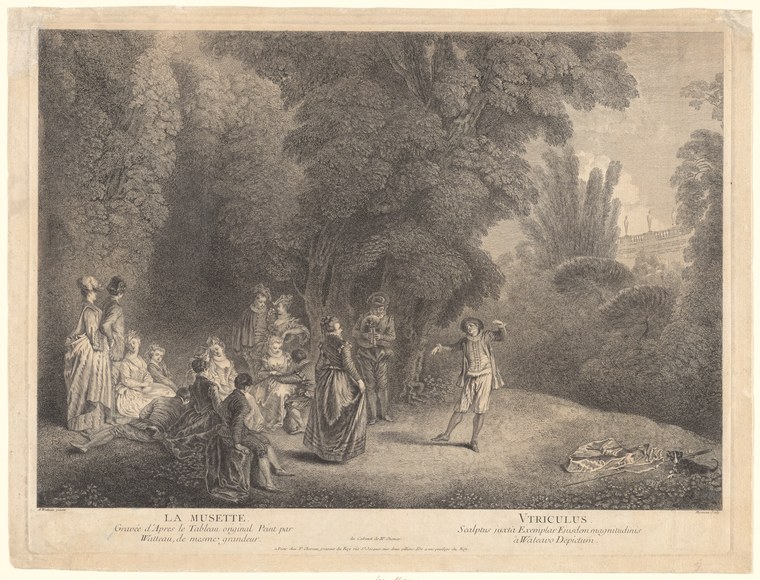
La musette: gravée d'apres le tableau original peint par Watteau, de mesme grandeur
Unknown artist
- Collection:
- Prints depicting dance
- Source:
- New York Public Library
- Rights:
- Public domain — free to use, share and adapt.
- Recorded as:
- Public Domain
Watteau's *Musette* documents the musette not as a step sequence but as a cultural phenomenon—how the dance existed in aristocratic imagination as an ideal of pastoral elegance and courtly leisure. For dance historians, it is evidence of how a specific dance became a social and aesthetic category, depicted not to teach steps but to evoke a mood and a moment of class identity.
What you are looking at
A garden assembly in the early eighteenth century, depicted in soft gray tones typical of engraved reproduction. A group of aristocratic figures in elaborate dress occupies a tree-lined path; the nearest figures sit or recline on the ground in the left foreground, while others stand or converse in the middle distance. The setting is deeply wooded with tall, feathery trees creating a theatrical backdrop, and a distant château or garden structure visible through the foliage on the right. The lighting is diffuse and atmospheric, suggesting afternoon leisure. A bagpiper stands at right, identifiable by his instrument, and the scattered arrangement of the group suggests a moment of rest and conversation rather than formal dancing, though the title invokes the musette—a popular courtly dance of the period.
The dancing
The bodies are relaxed and naturalistic rather than in formal dance posture. Those seated lean and recline with easy grace; standing figures adopt conversational attitudes, some turned toward one another. There is no visible partnering in a closed or open ballroom hold. The overall frame is one of repose and social intimacy—bodies arranged for visual composition rather than choreographic clarity. The presence of the bagpiper (who plays the musette's most common accompaniment) anchors the scene as a social music moment, but the stillness and grouping suggest observation rather than active dancing.
The dance depicted
The musette was a fashionable French country dance (or more precisely, a stylized pastoral reimagining of one) popular in aristocratic circles in the early 1700s, typically danced in couples with a simple, walking gait in duple time. The picture is titled after the dance, yet what is depicted appears to be a gathering *prompted by* musette music rather than a depiction of the dance in action. The bagpiper supplies the traditional instrument; the aristocratic costumes and garden setting match the genre's pastoral convention. This image likely represents the musette as a social and musical phenomenon—the kind of elegant leisure activity that attracted the attention of painters and engravers—rather than choreographic instruction.
How it was made
This is an engraving after a painting by Watteau (the title states 'gravée d'apres le tableau original peint par Watteau, de mesme grandeur'—engraved after the original painting by Watteau, of the same size). The technique is line engraving, visible in the fine parallel lines (hatching and cross-hatching) that build tone and shadow. This reproductive method allowed Watteau's composition to reach a much wider audience than the original oil painting; engravings were the primary means of disseminating images before lithography and photography. The delicate, tonal quality possible in engraving—softer and more painterly than earlier woodcut or etching—suited the atmospheric, intimate mood Watteau created.
About this work
This is a reproductive engraving of a painting by Jean-Antoine Watteau, the French Rococo master most celebrated for scenes of aristocratic leisure and fête galante. The subject is a garden gathering of elegantly dressed figures accompanied by a bagpiper, titled *La Musette* after the country dance and its characteristic instrument. Rather than capturing a dance in motion, Watteau presents the social and musical context—the garden, the dress, the instrument, the relaxed grouping—that made the musette a marker of refined, pastoral taste in early eighteenth-century France. The engraving's soft tonal range and precise detail record Watteau's composition for a print market that could not access the original painting.
How to look at it
Attend to what Watteau omits: there is no clear moment of choreography, no visible step or figure, no demonstration of technique. Instead, look at the composition—how the figures are arranged, how the bagpiper anchors the scene on the right, how the dense foliage and soft light create an atmosphere of ease and seclusion. The engraver's technique mirrors this: the soft hatching and absence of harsh line create a mood rather than clarity. The viewer is positioned as an observer of aristocratic leisure, not as a student of dance steps. This is a work about the social meaning of dance, not its execution.
The artist
Jean-Antoine Watteau (1684–1721) was the leading painter of the French Rococo, celebrated for his fêtes galantes—scenes of aristocratic figures in parks and gardens, often engaged in music, conversation, or theatrical performance. His work synthesized Flemish landscape tradition with Italian comedy and French court culture. Watteau's paintings were highly sought and frequently engraved for reproduction; reproductive engravings after his work were a major vehicle for the dissemination of Rococo aesthetics across Europe. His influence on the taste and visual culture of the early eighteenth century cannot be overstated.
The period
The early 1700s saw the musette rise from a rustic French folk dance to a fashionable court entertainment, a trajectory that mirrors the Rococo's broader appetite for pastoral and 'natural' themes as aesthetic ideals. The dance appeared in ballet-pantomime and in social dancing; composers wrote musettes for both theatrical and ballroom contexts. In painting, Watteau and his contemporaries made the garden gathering and the musical party central to their vision of aristocratic culture. The engraving and wide circulation of Watteau's work helped establish the musette—and the garden fête more broadly—as a defining image of early eighteenth-century luxury and taste.
Where it lives
The work is held in the NYPL's collection of prints depicting dance. It is catalogued as a reproductive engraving after Watteau's original painting, noted as being of the same dimensions as the oil ('de mesme grandeur'), suggesting it may have been a formal, high-quality reproduction intended for the collector's market.
Dance in this work
Questions about this work
Is this a picture of people actually dancing?
Not in the strict sense. The figures are seated or standing in conversation and repose; there is no visible choreography or partnering. The picture captures the social and musical context of the musette—a garden gathering with a bagpiper—rather than the dance in action. This reflects Watteau's practice of depicting aristocratic leisure and music-making as an ideal, rather than documenting steps.
What is a musette?
The musette is a French country dance popular in the early eighteenth century, typically danced in couples with a simple, walking quality in duple meter. It is named for the bagpipe (also called musette), which supplied its characteristic sound. In aristocratic circles, the musette became a fashionable social dance and a marker of refined, pastoral taste. Composers including Rameau and Gluck wrote musettes for ballet and the concert hall.
Who painted the original?
Jean-Antoine Watteau, the leading French Rococo painter (1684–1721). Watteau specialized in fêtes galantes and scenes of aristocratic leisure, often in garden settings. His works were extremely popular and frequently reproduced by engravers; this engraving is a faithful copy of his composition, made to the same dimensions as the original painting.
Why is this an engraving and not the original painting?
Engravings were the primary means of reproducing and circulating images before photography. An engraved reproduction allowed Watteau's composition to reach many more people—collectors, connoisseurs, artists, and the educated public—than the single original painting could. The soft, tonal quality of line engraving was well suited to the atmospheric mood Watteau created.
More dance artwork





