49 works in this view — arrow keys or swipe to move between them.
Dance in Art
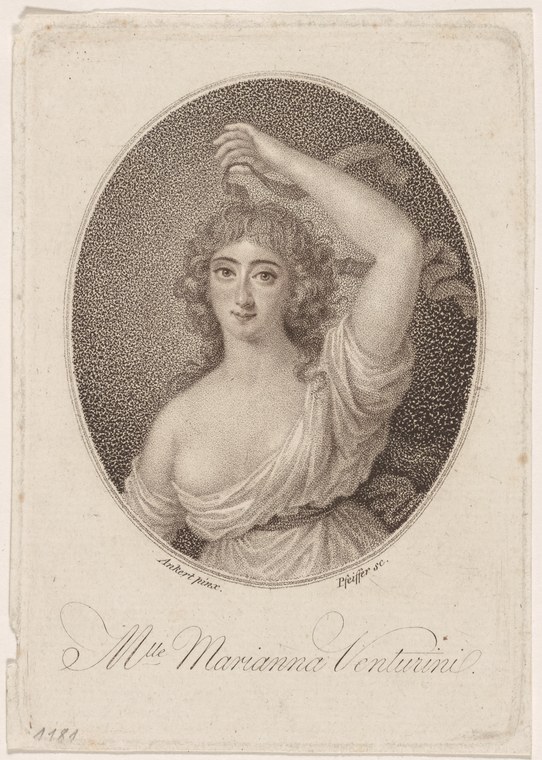
Mlle Marianna Venturini
Unknown artist
- Collection:
- Prints depicting dance
- Source:
- New York Public Library
- Rights:
- Public domain — free to use, share and adapt.
- Recorded as:
- Public Domain
This image documents both a specific historical performer and the aesthetic ideals of late 18th-century theatrical dance. Marianna Venturini was a working professional dancer whose career spanned the transition from the Baroque to the Romantic era, and this portrait captures the conventions of how dancers were presented to and remembered by the public. The engraving is evidence of the commercial apparatus around dance performance: the celebrity of individual dancers, the market for their images, and the role of reproductive prints in creating and sustaining that celebrity.
What you are looking at
A bust-length portrait of a young woman, presented within an oval frame that dominates the composition. She is shown from roughly the waist up, bare-shouldered, with her torso angled slightly to the left. Her right arm is raised and bent, her hand lifting her voluminous curled hair from the nape of her neck in a pose that displays both the musculature of her raised arm and the fashionable arrangement of her hair. Her left shoulder and arm are draped in a gauzy, translucent fabric that falls loosely across her body. The woman gazes slightly away from the viewer with a composed, refined expression. The background is rendered in fine parallel lines that create texture and depth, typical of engraving technique. The oval frame is clear and precise, and beneath it, a handwritten inscription reads "à Mlle Marianna Venturini."
The dancing
The single figure demonstrates a studied, elegant arm position: the raised right arm is bent at the elbow with the hand brought up to the hair, creating an open, extended frame through the upper body. This pose requires control and a lifted carriage through the torso and shoulder. The angle of the head and the gentle turn of the shoulders suggest training in deportment. The gesture is deliberate and theatrical rather than naturalistic—it is the kind of pose a performer would hold for an audience, emphasizing line and graceful extension.
The dance depicted
The inscription identifies this as a portrait of Marianna Venturini, likely the Italian dancer and pantomimist active in European theaters during the late 18th century. The pose—with its emphasis on the arm line, the lifted port de bras, and the refined carriage—is consistent with the aesthetics of theatrical dance of the period, particularly the conventions of ballet and dance pantomime. The raised-arm gesture and the careful attention to the line of the body suggest a performer trained in the balletic vocabulary of the era. However, this is a portrait, not a depiction of a choreographed dance; it presents the dancer in an idealized, statuesque pose that demonstrates her training and refinement rather than a specific moment of performance.
How it was made
This is an engraving, established by the fine parallel line-work that models the figure and the background. The technique is finely controlled: the artist has used varying densities of line to suggest the soft texture of the hair, the translucency of the draped fabric, and the modeled form of the shoulder and neck. The precision and delicacy of the engraving, combined with the handwritten inscription below, indicates this was a commercial reproductive print, likely produced for circulation among the theater-going public or as a memento of a celebrated performer. Engravings of this type were affordable and widely distributed, making them a primary medium for the dissemination of images of celebrated dancers and actors.
About this work
This is a late 18th-century engraved portrait of the dancer and pantomimist Marianna Venturini, presented as a bust-length figure within an oval frame. The image shows Venturini in a pose that demonstrates both her physical training and the aesthetic conventions of late-Baroque and early Romantic theatrical practice. The raised arm, the refined carriage, and the studied elegance of the pose are all markers of the balletic vocabulary of the period; this is a portrait of a dancer by her bearing and her art, not merely by inscription. The work belongs to a tradition of theatrical portraiture that celebrated individual performers and preserved their memory for posterity.
How to look at it
Attend to the pose and the arm position: this is not a snapshot of movement but a carefully composed display of balletic bearing and refinement. The raised arm, the turned shoulder, the lifted spine—all of these are markers of training in a specific theatrical vocabulary. The artist has chosen a pose that is elegant but not in motion; it is a demonstration of the dancer's art through her control of her own body at rest. The fine engraving technique allows the viewer to read subtle details: the musculature of the raised arm, the texture of the hair, the delicacy of the draped fabric. This is a portrait that teaches the viewer how to see a dancer's refinement.
The artist
The artist's name is not recorded in the catalogue. The inscription "Hébert. Sculp" (or similar—the signature is faint) at the lower left suggests the engraver was named Hébert, but this cannot be confirmed. The work appears to be a professional commercial engraving, possibly after a portrait painting or drawing by another artist. The high quality of the work and the refined handling of the medium indicate a skilled practitioner working within the conventions of late 18th-century reproductive engraving.
The period
This portrait dates to the late 18th century, a period of significant change in European dance. The Baroque court ballet tradition was giving way to theatrical ballet d'action and the early aesthetics of Romanticism. Dancers were becoming increasingly celebrated as public figures and theatrical stars, and the market for prints of celebrated performers was robust. The refined, elongated poses and the emphasis on the arm line visible in this portrait reflect the transitional moment between the ornamental grace of the Baroque and the ethereal aspiration of the Romantic ballet that would emerge in the 1820s and 1830s. Pantomime was a major form of theatrical entertainment during this period, and dancers who excelled in both ballet and pantomime, as Venturini apparently did, occupied a central position in European theater.
Where it lives
The work is held by the New York Public Library as part of a collection of prints depicting dance. It is catalogued as a commercial reproductive engraving from an unknown date and artist, though the inscription and style suggest late 18th-century production. Such prints were typically sold as individual sheets or in bound collections, circulating among the theater-going public and collectors of theatrical ephemera.
Dance in this work
Questions about this work
Who was Marianna Venturini?
Marianna Venturini was an Italian dancer and pantomimist who performed in European theaters during the late 18th century. She was celebrated for her skill in both ballet and pantomime, forms that were closely allied in theater of the period. Her career coincided with the transition from Baroque court ballet to theatrical ballet d'action and the early Romantic era. Beyond this portrait and references in contemporary theater records, little is known of her life and work.
What does the pose tell us about how she danced?
The pose demonstrates training in the refined, elongated aesthetics of late 18th-century balletic practice. The raised arm with the hand brought to the hair shows control of the port de bras and a lifted, extended carriage through the upper body. The turned shoulder and the careful angle of the head suggest training in deportment and an understanding of how to present the body to an audience. This is not a pose of movement but of refined stillness—a display of the dancer's technical training through her control of line and alignment.
Why was this image made?
This is a commercial theatrical portrait, made for circulation among the theater-going public. Prints of celebrated dancers and actors were popular and profitable in the late 18th century. This engraving would have been sold as a souvenir or memento of Venturini's performance, and it served to promote her image and celebrity. It is evidence of the commercialization of dance and the celebrity of individual performers during this period.
More dance artwork





