49 works in this view — arrow keys or swipe to move between them.
Dance in Art
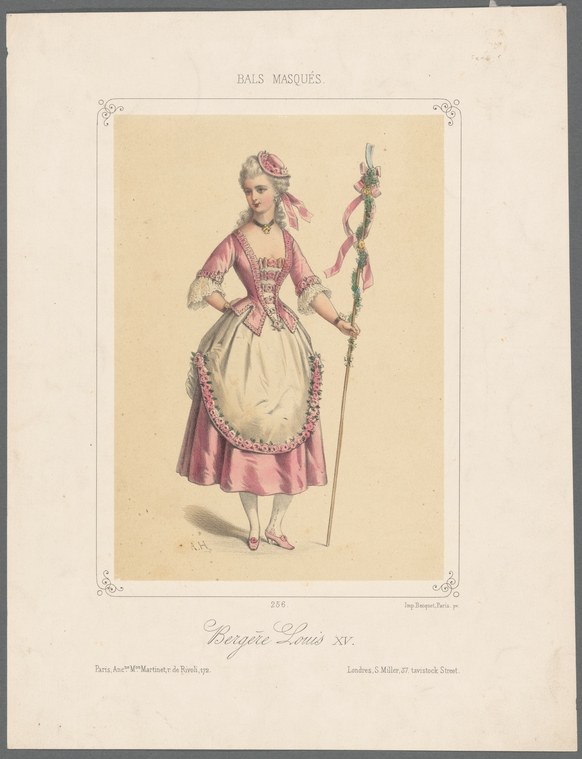
Bergère Louis XV
Unknown artist
- Collection:
- Prints depicting dance
- Source:
- New York Public Library
- Rights:
- Public domain — free to use, share and adapt.
- Recorded as:
- Public Domain
This print is a primary record of how the pastoral shepherdess character was costumed and presented in eighteenth-century French theatrical and social dance. It shows that the *Bergère* was a standardized, recognizable type whose visual identity was fixed enough to warrant publication as a costume reference, indicating the importance of this character in court entertainment and masquerade culture.
What you are looking at
A single female figure stands against a pale cream background, dressed in eighteenth-century pastoral costume. She wears a deep rose-pink brocaded bodice with a cream linen apron decorated with a floral swag or garland, and a full skirt of matching rose silk. Her hair is styled up with a pink ribbon, in the fashion of the period. In her right hand she holds a tall wooden staff wound with pink and green ribbons in a spiral pattern—a type of May pole or pastoral dance staff. Her left arm rests easily at her side. The figure is shown in three-quarter view, standing with weight evenly distributed, in a pose of gentle repose rather than active movement. The composition is formal, centered, and framed by decorative corner ornaments suggesting this is a theatrical or costume design print.
The dancing
The single dancer is shown in a relaxed, presentational stance with no active footwork or dynamic pose visible. Her upright frame and frontal address suggest she is displaying a costume or character type rather than being caught mid-movement. The staff she holds is a principal prop, held vertically with one hand, and appears to be the focus of the image—a marker of the *Bergère* (shepherdess) character type. There is no partner, no spatial depth created through interaction, and no suggestion of momentum or weight transfer.
The dance depicted
This is a costume or character print for the *Bergère Louis XV*, the shepherdess figure of the eighteenth-century *Rococo* court entertainment tradition. The work does not depict an active dance scene but rather documents the costume and visual identity of a theatrical character type associated with pastoral court dances and balls of the Louis XV period. The ribboned staff and rustic-elegant dress are the visual markers of this stock character, who appeared in court ballets, masquerades, and social dancing contexts in mid-eighteenth-century France. The image functions as a reference guide for costume and character rather than as a record of choreography or movement.
How it was made
This is a hand-colored engraving or lithograph, executed in the style typical of French costume and character prints of the eighteenth and nineteenth centuries. The plate shows fine line work for the figure and fabric detail, with watercolor or hand tinting applied to establish the color scheme (cream paper, rose and pink tones, green accents). The technique suggests commercial production—a print made for distribution among theater practitioners, dancers, or wealthy patrons interested in theatrical fashion and character types. The decorative corner elements and centered composition indicate professional publication, likely from a series documenting theatrical costumes.
About this work
This is a French costume print documenting the *Bergère Louis XV*, a stock shepherdess character from the Rococo court dance tradition of the mid-eighteenth century. The image is not a dance scene but a theatrical wardrobe reference: it shows the costume elements and visual identity of a character type central to courtly entertainment, masquerade balls, and pastoral-themed dances of the period. The print belongs to a tradition of theatrical character documentation that was essential to the circulation of fashion, costume, and performance types across European courts and professional dance companies.
The work matters because it provides direct evidence of how the theatrical pastoral tradition was visualized and marketed in the eighteenth century. The image shows that the *Bergère* was understood as a distinct and recognizable character—visually marked by her ribboned staff, rustic-elegant dress, and feminine pose—and that these visual markers were standardized enough to merit publication as a reference guide. For historians of court dance, social dance, and theatrical fashion, the print documents how the aesthetic of the pastoral was constructed and disseminated.
How to look at it
Notice the staff: it is not a prop held casually but the main focus, spiraled with colored ribbons in a way that suggests active handling, perhaps twirling, in actual performance. The costume is elegant but marked as pastoral through the apron and ribbon styling. The figure's pose is formal and still—this is a presentation of a character type, not a freeze-frame of movement. The print format and decorative frame suggest this was one of a series, part of a standardized visual language for communicating theatrical characters to a professional and amateur audience.
The period
The *Bergère Louis XV* (also *Bergère à la française*) was a standard character type in the Rococo theatrical and social dance world of the mid-eighteenth century. Court ballets, masquerades, and balls incorporated pastoral themes and stock characters drawn from French aristocratic fantasy about rural life. The shepherdess was a feminine ideal combining elegance with a romanticized simplicity: educated, dancing, refined, yet nominally rustic. Such costume prints were produced in large numbers for distribution to performers, ballet masters, tailors, and wealthy patrons who needed to learn or recreate current theatrical fashions. The print tradition itself—standardized costume documentation—reflects the professionalization and commercial circulation of court dance and theater in the period.
Where it lives
This hand-colored print comes from the New York Public Library's collection of prints depicting dance. The catalogue record provides minimal information; the title, French publication, and style suggest it is one of a series of French theatrical costume prints, likely from the late eighteenth or early nineteenth century.
Dance in this work
Questions about this work
What is a Bergère in eighteenth-century dance?
A *Bergère* (shepherdess) was a stock theatrical character type in French court ballets, masquerades, and social dances. She represented an idealized, elegant version of pastoral femininity—not a real country figure, but an aristocratic fantasy of rural simplicity combined with refinement, dancing, and courtly grace. The character appeared in elaborate entertainments and was also adopted in social dances and fancy-dress balls.
Why does she hold that ribboned staff?
The ribboned staff, or *bâton de bergère*, was the visual marker of the shepherdess character. In performance, it was used in dance as a prop—likely twirled, held, and manipulated as part of the choreography. The spiraled ribbons made it visually striking and identifiable from a distance, helping audiences recognize the character type.
Is this a dance scene or a costume reference?
This is a costume and character reference, not an active dance scene. The figure is posed still and formally, as if standing for a portrait. The print was made to document how the character should be dressed and visually presented—it is a guide for performers, tailors, and theater practitioners, not a record of choreography or movement.
Who made this print and when?
The artist is not recorded in the catalogue. The style and technique suggest a French production from the late eighteenth or early nineteenth century, when such costume prints were widely circulated. The hand coloring, engraving technique, and decorative framing are consistent with commercial theatrical print publishing of that period.
More dance artwork





