49 works in this view — arrow keys or swipe to move between them.
Dance in Art
Guillot Corju
Unknown artist
- Collection:
- Prints depicting dance
- Source:
- New York Public Library
- Rights:
- Public domain — free to use, share and adapt.
- Recorded as:
- Public Domain
This work documents the theatrical movement vocabulary and costume conventions of 19th-century stage comedy at a moment when dance, mime, and dramatic acting were not yet fully separated as disciplines. For historians of theater and embodied performance, it preserves a specific moment—a character's emotional or rhetorical gesture—in a now-lost or poorly documented repertoire of stage action.
What you are looking at
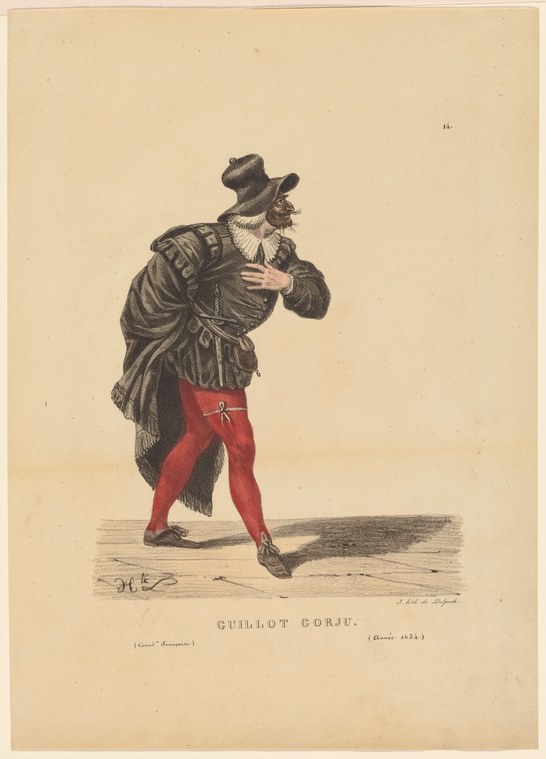
A single male dancer in theatrical costume occupies the center of the composition, captured mid-performance against a plain cream background. He wears a dark, richly patterned jacket or tunic with horizontal striping, a white collar or chemise visible at the neck, and striking red tights that dominate the lower half of the figure. His pose is dynamic and somewhat exaggerated: he leans forward with his upper body, one arm raised and bent across his chest in an expressive gesture, the other at his side. His head is tilted upward beneath a dark feathered or plumed hat, and his posture suggests both theatricality and a moment of emotional intensity—perhaps indignation, appeal, or dramatic address. The figure stands on a simple baseline that grounds him in the composition; no other figures, scenery, or architectural elements are present.
The dancing
The dancer's weight appears concentrated in his lower body and legs, which are straight and firmly planted, while his torso twists and leans forward with considerable torsion. His raised arm is bent at the elbow in a gesture that reads as rhetorical or emphatic—neither a balletic port de bras nor a folk gesture, but something closer to dramatic pantomime or character acting. The posture shows understanding of how a body can express emotion through unequal distribution of tension: grounded below, agitated above. The pose is a single frozen moment, not a step or position in a choreographic sequence.
The dance depicted
This appears to be a theatrical character from a pantomime, opera, or comedic stage performance rather than a codified dance form. The costume—particularly the plumed hat, striped jacket, and red tights—suggests a stock character type from 19th-century European theatre, possibly a valet, rogue, or comic servant (the name 'Guillot Corju' may identify the character or performer). The gesture and posture are consistent with theatrical mime or the dramatic acting vocabulary of stage comedy, where large expressive gestures communicated character and emotion to distant audiences. If this is a dance, it would be vernacular theatrical dance or character dance integrated into a comic or dramatic narrative, rather than ballet proper.
How it was made
This is a hand-colored engraving or etching, datable to the 19th century on stylistic grounds. The primary image is rendered in black line-work with fine cross-hatching for shadow and volume, while the red tights and flesh tones have been applied by hand in watercolor or gouache. The technique allowed for mass production and distribution of theatrical imagery; prints like this were sold cheaply to audiences as souvenirs of performances, advertisements for actors, or reference materials for theatrical costume makers. The combination of precision engraving and hand-finishing suggests a commercial workshop product made for a theater-going public.
About this work
This is a theatrical character portrait in engraved form, documenting either a specific performer or a stock character type from 19th-century European stage comedy. The work belongs in a gallery of dance in art not because it depicts dancing in the formal sense, but because it captures the physical vocabulary of a theatrical performer whose work blended mime, gesture, and embodied character acting—forms of movement that occupied the same stages and audiences as dance proper, and that shared dance's reliance on the expressive moving body. The image is valuable as documentation of how acting, costume, and character were conceived in theater when dance and dramatic performance were closely linked.
For historians of performance and dance's relationship to theater, this print offers evidence of how bodies moved and were perceived in 19th-century comic and dramatic roles, and how that movement vocabulary was circulated to the public through the medium of the printed and colored image.
How to look at it
Observe the unequal distribution of energy in the body: the planted, rigid legs contrasted with the twisted, expressive torso and raised arm. This is not a step or a dance position, but a moment of character acting frozen for the print. Notice how the costume—especially the bright red tights and the hat—was as much a tool of performance as the body itself; the engraver and colorist have given as much care to rendering fabric and color as to anatomy. The pose captures theatrical convention: a readable, exaggerated gesture meant to communicate emotion or character to an audience at a distance.
The period
The style and costume suggest a date in the mid-to-late 19th century, during the height of European vaudeville, pantomime, and comic opera. In this period, theatrical prints were a major form of popular culture and celebrity documentation; actors and character types were widely marketed through hand-colored engravings and lithographs sold to theater audiences. The costume—the plumed hat, striped jacket, and particolored tights—is consistent with French or Italian comic theater or pantomime of this era. The figure's theatrical exaggeration and expressive pose reflect the aesthetic conventions of stage acting before the rise of naturalism and cinema, when large, readable gestures were required to communicate across a theater house.
Where it lives
This work is catalogued as a print in the New York Public Library's collection of 'Prints depicting dance.' The title 'Guillot Corju' likely refers either to a character name or the name of the performer who played this role; the date and artist are not recorded in the available metadata.
Dance in this work
Questions about this work
Is this a dancer or an actor?
The distinction would have been fuzzy in 19th-century theater. This figure is a theatrical performer—a character actor whose medium was the moving body, gesture, and costumed appearance. In the context of stage performance, acting and dancing were closely allied, and many performers worked in both registers. The pose here is mime or dramatic gesture rather than codified dance steps, but it belongs to the same performative universe.
What is the red tights tradition in theater?
Red tights became a convention of comic and pantomime characters in European theater, particularly in commedia dell'arte and its successors. They were eye-catching, read clearly to distant audiences, and became associated with specific character types—often valets, servants, or comic rogues. The color itself was a form of shorthand: a way of signaling the character's nature and role to an audience that might not hear all the dialogue clearly.
Why is this in a collection of dance prints?
The line between dance and theatrical movement was historically porous, particularly in pantomime, comic opera, and vaudeville. Performers trained in both disciplines, and audiences experienced them as part of the same evening's entertainment. This print documents how bodies moved and were costumed in theatrical performance—knowledge essential to understanding how dance was embedded in theater.
More dance artwork





