49 works in this view — arrow keys or swipe to move between them.
Dance in Art
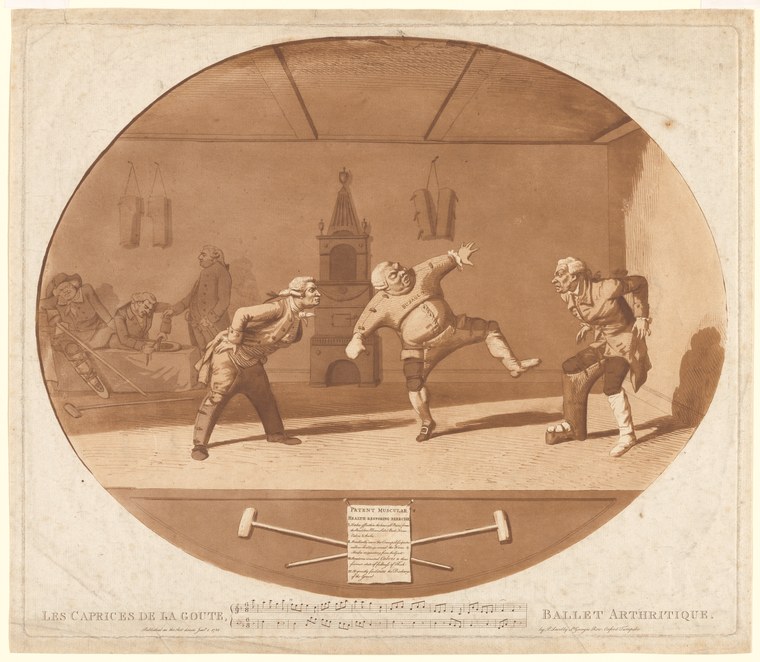
Les caprices de la goute, ballet arthritique
Unknown artist
- Collection:
- Prints depicting dance
- Source:
- New York Public Library
- Rights:
- Public domain — free to use, share and adapt.
- Recorded as:
- Public Domain
This work documents a pivotal moment in dance history: the point at which ballet vocabulary had become so standardized and visible that it could be used as a tool of social satire, recognizable to a broad print-consuming public. It also reveals attitudes toward bodily disability and disease in the period, and the role of burlesque and grotesque movement as entertainment. For dance historians, it is evidence of how deeply formalized ballet had become, and how fully it had permeated visual culture outside the theater.
What you are looking at
A satirical theatrical scene set indoors with a vaulted ceiling and castle tower visible through the backdrop. Three male figures in 18th-century dress enact an exaggerated dance or physical comedy routine on a wooden stage. The central figure, portly and animated, leaps with one leg extended high, his body contorted in an extreme attitude. On the left, a thin man in a coat bends forward in an elaborate bow or curtsy; on the right, a gaunt figure in aristocratic dress leans backward with arms akimbo. A fourth figure reclines on a bench at the left margin, apparently watching or recuperating. The composition is an oval, characteristic of print framing from this period. Below the scene is a title in French, musical notation, and a block of explanatory text—typical of an illustrated song or satire broadside.
The dancing
All three active dancers display exaggerated, contorted postures with little resemblance to formal dance vocabulary. The central figure achieves an extreme arabesque-like extension but executed with theatrical grotesquerie—legs splayed, torso twisted, suggesting physical strain rather than grace. The left figure performs a deep, servant-like genuflection or curtsy with one leg extended behind. The right figure assumes a precarious backward lean. The spacing is loose and the energy chaotic, bodies not in formation but scattered across the stage floor in attitudes of struggle or comedy.
The dance depicted
This is not a depiction of any actual dance form, but rather a satirical engraving mocking physical infirmity, probably gout. The title *Les caprices de la goute* (The Caprices of Gout) and subtitle *ballet arthritique* (arthritic ballet) indicate this is a humorous commentary on the painful, contorted movements of gout sufferers, staged as a grotesque parody of ballet. The performers mimic balletic poses—arabesques, attitudes, deep reverences—but strain and distort them into images of agony. This is visual satire using the language of theatrical dance to ridicule a disease.
How it was made
This is an engraving, identifiable by its fine cross-hatching, uniform tone, and the oval framing characteristic of 18th-century prints. The technique allows for precise linear detail in costume and facial expression, and the small format suggests it was produced for circulation as a sheet print or possibly as an illustration in a periodical or song broadside. The inclusion of musical notation below confirms this was intended as a published entertainment—likely a comic song or ballad. Engravings of this type were inexpensive to produce and distribute, making them a medium for popular satire and social commentary.
About this work
This engraving is a satirical performance print from the 18th century that uses the visual language of theatrical ballet to mock the physical symptoms of gout. Rather than depicting actual dancers or a recognizable dance style, it stages the disease itself as a grotesque, involuntary ballet, with male figures contorting themselves into balletic poses that read as painful and ridiculous. The work belongs in a dance gallery precisely because it appropriates ballet as its language of satire—the audience would have recognized the arabesque, the attitude, and the courtly reverence, and found humor in their transformation into signs of bodily malfunction. It tells us how completely ballet had entered popular culture by this period: it could be parodied without explanation.
How to look at it
Attend to the specific balletic poses the artist has chosen: the arabesque of the central figure, the deep reverence of the left-hand man, the attitude of the right-hand figure. These are recognizable to anyone familiar with ballet, and their distortion into attitudes of strain and discomfort is the entire point of the satire. Notice also the musculature and facial expressions—these are anatomically precise renderings of bodies in pain and effort, not the ethereal or triumphant bodies of serious ballet imagery. The oval frame and theatrical setting signal this as a theatrical print meant for entertainment and commentary rather than documentation.
The period
This engraving dates to the 18th century, an era of extraordinary expansion in theatrical dance and its representation. Ballet de cour had given way to theatrical ballet; the positions and steps had been codified; and the art form had become a major public entertainment in Paris and beyond. Simultaneously, print culture was democratizing visual representation, making theatrical and satirical images available to a broad audience. Gout was endemic among the wealthy and leisured classes—a disease of affluence—and became a recurring subject of humor and visual satire in 18th-century popular prints. By pairing gout with ballet, this engraver was operating at the intersection of three popular obsessions: theater, bodily spectacle, and aristocratic ailment.
Where it lives
This engraving is held in the New York Public Library's collection of prints depicting dance. It survives as a loose print, part of a broad collection of theatrical and satirical imagery from the early modern period.
Dance in this work
Questions about this work
Is this actually a dance or just a joke about gout?
It is both. The artist has staged gout as a mock ballet, borrowing the visual language and poses of theatrical ballet to represent the contorted movements of a gout sufferer. The humor depends entirely on the viewer recognizing balletic forms and understanding how absurd they become when applied to bodily pain. In a sense, the engraver is using dance—or the idea of dance—as his satirical instrument.
What was gout and why was it funny?
Gout is an intensely painful form of arthritis caused by uric acid buildup, historically associated with rich food and alcohol consumption—a disease of affluence. In 18th-century satire, it became a symbol of aristocratic excess and bodily decay. Prints and texts mocked sufferers for their gluttony and self-indulgence while simultaneously treating the grotesque physical contortions of the disease as spectacle and entertainment.
Does this tell us anything about how ballet was actually performed?
Yes, indirectly. The specific poses the artist chose to parody—the arabesque, the attitude, the deep courtly reverence—were clearly recognizable and standardized balletic forms by this date. The exaggeration and distortion only works if the original forms were well known to the intended audience. The image confirms that by the 18th century, ballet technique had become codified enough to parody in a popular print.
More dance artwork





