49 works in this view — arrow keys or swipe to move between them.
Dance in Art
Folk dancers
Unknown artist
- Collection:
- Prints depicting dance
- Source:
- New York Public Library
- Rights:
- Public domain — free to use, share and adapt.
- Recorded as:
- Public Domain
This image documents how trained, aristocratic dance was performed and understood in the 18th century: the integration of music and movement, the importance of elegant dress and deportment, and the role of dance in rituals of courtship and social display. For dance historians, such prints are primary sources for understanding historical technique, posture, and the social context of dance before the modern era.
What you are looking at
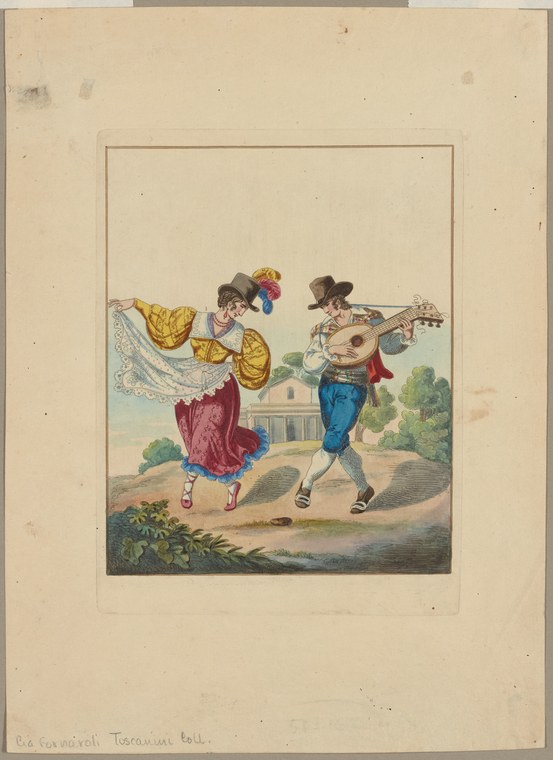
Two figures in 18th-century dress perform on an open stage or garden terrace. The male dancer on the right, wearing blue breeches, a decorative coat with gold trim, and a tricorn hat with a red plume, plays a stringed instrument—likely a guitar or similar lute-family instrument—while dancing. The female dancer on the left wears a yellow silk gown with blue underskirt and carries a shawl or scarf in gold and blue tones; her red shoes are visible beneath her skirts. She faces the male figure in an engaged, flirtatious posture. The setting includes stylized green foliage and shrubs in the lower corners and a building or fortification sketched lightly in the background, suggesting a pastoral or theatrical space. The composition captures a moment of social interaction and courtship through dance, rendered in hand-colored engraving with delicate washes of color.
The dancing
The male dancer stands in a turned-out position, instrument raised, his body angled toward his partner in a posture of performance and attentiveness. The female dancer's weight is shifted, her torso leaning slightly forward, hips and legs animated in what appears to be a stepping or turning movement; her arms are engaged with the shawl or drapery, creating a dynamic line. The figures are separated by a short distance, relating to each other across the stage floor rather than in direct contact. Both maintain an upright carriage and turned-out legs typical of aristocratic dance of the period.
The dance depicted
This appears to depict a social dance, most likely a minuet or one of the contredanses that dominated 18th-century European ballrooms and theatrical performances. The presence of a musician playing while dancing, the elaborate dress, the outdoor or theatrical setting, and the flirtatious engagement between partners all point to the aristocratic dance culture of the 1700s. The male dancer's role as both musician and dancer is characteristic of theatrical courtship dances or entertainment dances of the period, where musical accompaniment and dance were integrated into a single performance. The female dancer's animated posture and engagement suggest a responsive, reciprocal movement vocabulary rather than a formal processional line.
How it was made
This is a hand-colored engraving, identifiable by the fine lines and tonal modeling characteristic of copper-plate engraving, with watercolor or gouache applied to highlight the figures' dress in yellows, reds, blues, and gold. The technique allows for both precise linear detail—visible in the musicians's instrument, the tricorn hat, and the gown's embellishments—and soft atmospheric effects in the background. The delicate coloring and refinement of line suggest this was a commercially produced print, likely issued as a single sheet for collectors or as part of a series of dance or entertainment subjects. The hand-coloring indicates a higher-value product than plain engravings, suggesting circulation among educated or affluent audiences.
About this work
This is a hand-colored engraving of two aristocratic dancers in 18th-century dress, the male figure holding a stringed instrument, positioned in a theatrical or garden setting that suggests both performance and social courtship. The work belongs to a widespread European tradition of dance prints—particularly German and French—that documented and celebrated the fashionable dances and courtship rituals of the ancien régime. Such prints served as both documentation of dance practice and as fashionable domestic images for the educated classes. The work sits at the intersection of music, dance, and courtship display, capturing a moment of theatrical social interaction that would have been recognizable and desirable to its contemporary audience.
How to look at it
Observe the precise moment the artist chose: the male dancer's weight appears to shift as he plays, suggesting movement-in-progress rather than a static pose, while the female dancer's shawl and skirt are caught mid-gesture. Notice the turned-out positions of both dancers' legs and their upright carriage—hallmarks of the period's dance vocabulary. The coloring emphasizes the richness of 18th-century court dress, with the male's gold trim and the female's yellow silk dominating the composition. The background is deliberately sketchy, keeping focus on the figures and their interaction, a compositional choice common in dance prints that prioritize the bodies and their relationship over architectural or landscape detail.
The period
The 18th century saw dance as a central courtly accomplishment and public entertainment throughout Europe. The minuet and contredanses were the dominant social dances, performed in ballrooms, gardens, and on stage. Dance prints, particularly German and French engravings, circulated widely among the educated classes as fashionable collectibles and as instructional or aspirational images. The integration of music and dance visible here reflects the period's understanding of dance as a musically driven, highly refined social art form. The theatrical setting and the figure of the musician-dancer suggest this may depict either a staged entertainment or an idealized vision of aristocratic leisure.
Where it lives
This work is held in the New York Public Library's collection of prints depicting dance. It is catalogued as a folk dance but is more accurately a document of 18th-century aristocratic social or theatrical dance.
Dance in this work
Questions about this work
What kind of dance is this?
Most likely a minuet or contredanse, the dominant social dances of 18th-century European ballrooms and stages. The male dancer's dual role as musician and dancer, the elegant dress, and the flirtatious posture between partners are all consistent with these aristocratic dance forms. The theatrical setting suggests this may depict a staged version of such a dance rather than a ballroom performance.
Why is the man playing an instrument while dancing?
In 18th-century theatrical entertainment and some social dances, musicians and dancers were sometimes integrated; a skilled performer might provide musical accompaniment while also dancing. This was also a convention in French theatrical dances and in some courtship dances depicted in prints and paintings of the period. It served to demonstrate virtuosity and refined accomplishment.
What do the clothes tell us?
Both figures wear high-quality, fashionable 18th-century dress: the woman in a yellow silk gown with full skirts and the man in a coat with gold trim, breeches, and a plumed tricorn hat. This level of dress indicates these are aristocratic or affluent dancers, and the clothing was essential to the visual spectacle of the dance. The gown and the shawl's movement were integral to the aesthetic of women's dance in this period.
More dance artwork





