49 works in this view — arrow keys or swipe to move between them.
Dance in Art
European folk dancing in prints
Unknown artist
- Collection:
- Prints depicting dance
- Source:
- New York Public Library
- Rights:
- Public domain — free to use, share and adapt.
- Recorded as:
- Public Domain
For dancers and historians of Spanish and Latin American dance, this image is a rare direct visual record of bolero performance in its vernacular context, made by an artist who clearly understood the dance's aesthetic and physicality. It documents the tavern tradition in which bolero survived and developed, independent of theatrical or concert institutions.
What you are looking at
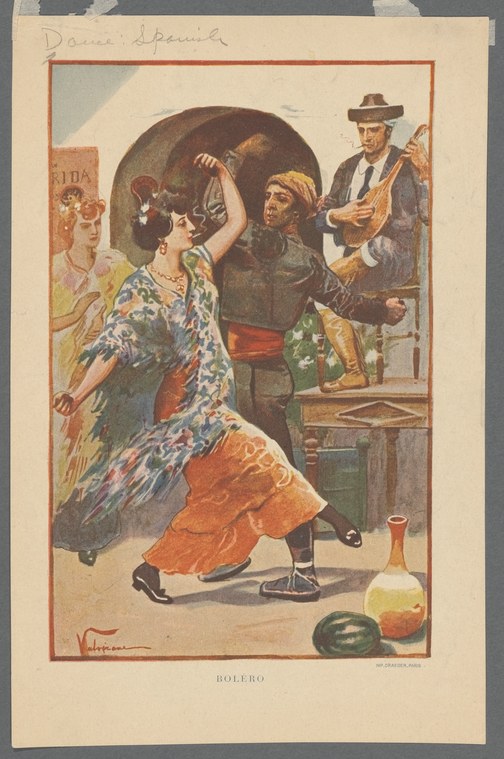
A Spanish woman in a jewel-toned dress with bold geometric patterning dances the bolero in a tavern or café setting. She pivots with one arm raised, her body captured mid-turn, weight on the ball of one foot; her orange underskirt catches the motion and flares outward. A male guitarist in a dark suit and hat sits at right, playing; behind them a second figure, barely sketched, watches or plays a second instrument. Wine bottles and a glass sit on the floor. The warm interior is suggested by ochre walls and dramatic shadow; the artist has used a limited palette of reds, ochres, blues, and flesh tones to convey both the heat of the moment and the modest circumstances of the space.
The dancing
The lead dancer's weight is poised on her right foot in a classic bolero pivot; her left leg extends behind, and her raised right arm frames the turn. The torso is upright but mobile, following the hip action. Her posture and the snap of the skirt show an artist who understood the bolero's essential character—a dance of contained intensity, where the drama lives in the subtle rotation and hip action rather than large spatial movement. The guitarist sits with his instrument angled across his body, his role as accompanimental anchor clear; the secondary figure is too indistinct to assess in detail.
The dance depicted
This is a bolero, the Spanish urban dance that emerged in the late 18th century and remained central to Spanish and Latin American dance culture through the 19th and into the 20th. The bolero is danced in place or with minimal traveling, built on a slow 3/4 rhythm with characteristic hip and torso articulation, typically performed by one or two dancers to live guitar accompaniment. The image captures the essence of bolero as a tavern and street dance rather than concert or court form—intimate, immediate, and rooted in the culture of working people. The title confirms this reading.
How it was made
This is a color lithograph or hand-colored lithographic print, evident from the soft edges, the way the color sits on the surface in flat areas with minimal gradation, and the characteristic texture of stone-printed work. The style and execution suggest early-to-mid 20th century production, though the catalogue record does not provide medium or date. Lithography was the dominant mass-production technique for popular prints in this era, making such images affordable and widely distributed to illustrate European folk dance and regional culture for middle-class audiences.
About this work
This is a color print depicting a bolero dancer in a Spanish tavern, painted or drawn with sympathy for both the dance's technical character and the social context in which it was performed. The work belongs to a substantial tradition of European folk-dance imagery aimed at collectors and educators in the 19th and early 20th centuries. It represents the bolero not as a concert or theatrical form but as a living social dance, danced in the presence of musicians and witnessed in intimate spaces. The artistic skill evident in the rendering of movement, dress, and atmosphere distinguishes it from mere documentary; this is a considered composition that captures a specific moment and mood.
How to look at it
Attend first to the dancer's posture and the exact moment of the pivot: the artist has frozen the movement in a way that conveys both the rotation and the grounded, inward focus of the bolero aesthetic. Notice the restraint—there is no wild extension of the limbs, no grand jeté or leap, only the coiling and turning that defines the dance. Observe how the skirt's flare and the play of light on the dress convey the motion without exaggeration. The inclusion of the guitarist and the humble setting grounds the dance in its actual social context; this is not a spectacle staged for an audience but a moment of living tradition.
The artist
The signature on the print is not clearly legible in the image, and the catalogue record does not identify the artist. The style and execution are consistent with late 19th or early 20th-century European popular illustration, likely German or Austrian in origin, which would align with the print's presence in a European collection.
The period
In the 19th and early 20th centuries, European fascination with regional and 'folk' dances reflected broader currents in Romanticism, nationalism, and the idealization of rural and working-class culture. Publishers and printmakers across Europe produced illustrated books and individual prints documenting the dances of Spain, Eastern Europe, and other regions, often sold as educational or decorative series. This impulse was both genuine ethnographic interest and commercial exploitation of the exotic. The bolero, specifically, had captured European imagination since the 18th century; it appeared in ballets, concert programs, and popular literature throughout the 1800s. By the time this print was made, the bolero was firmly established in the European imagination as quintessentially Spanish, though the image here insists on its street and tavern reality rather than its theatrical or exotic performance forms.
Where it lives
This print is held in the New York Public Library's collection of European folk-dance prints, a body of material assembled to document regional dance traditions. The collection typically spans the 19th and 20th centuries and includes prints, drawings, and photographs from multiple European sources.
Dance in this work
Questions about this work
What is a bolero?
The bolero is a Spanish dance in 3/4 time, characterized by slow, controlled movement with pronounced hip and torso action. Unlike many European dances, it is typically danced in place or with minimal spatial traveling, emphasizing subtle articulation of the body. It emerged as a popular urban and tavern dance in Spain in the late 18th century and became central to Spanish and Latin American dance culture. This print depicts it in its vernacular tavern context, accompanied by guitar.
When was this print made?
The catalogue record does not provide a date. The style, technique, and fashion evident in the image suggest late 19th or early 20th century production, likely between 1880 and 1920. The color lithographic technique and the subject matter are consistent with the period of greatest European interest in documenting folk and regional dances.
Who made this print?
The artist's name is not recorded in the catalogue, and while a signature is visible on the print, it is not clearly legible in this reproduction. The style suggests a trained illustrator, likely based in Austria or Germany, where such folk-dance prints were commercially produced and distributed.
Why does the setting matter?
The tavern or café setting is crucial. It shows the bolero as a social dance of working people, performed in taverns and streets for entertainment and courtship, not as a concert or theatrical form. This grounds the dance in its actual cultural reality and reminds viewers that many of the world's most vital dances were never 'high art'—they were danced by ordinary people in ordinary spaces.
More dance artwork





