49 works in this view — arrow keys or swipe to move between them.
Dance in Art
European folk dancing in prints
Unknown artist
- Collection:
- Prints depicting dance
- Source:
- New York Public Library
- Rights:
- Public domain — free to use, share and adapt.
- Recorded as:
- Public Domain
For historians of dress and social practice, this work is invaluable documentary evidence of how Regency women actually moved and stood. For dance historians, it records the carriage, posture, and gestural norms that framed the ballroom dancing of the period—the upright, controlled deportment that was the foundation of Regency dance etiquette. The image shows us the pedestrian movement and social bearing that gave ballroom dances like the quadrille and cotillion their distinctive character.
What you are looking at
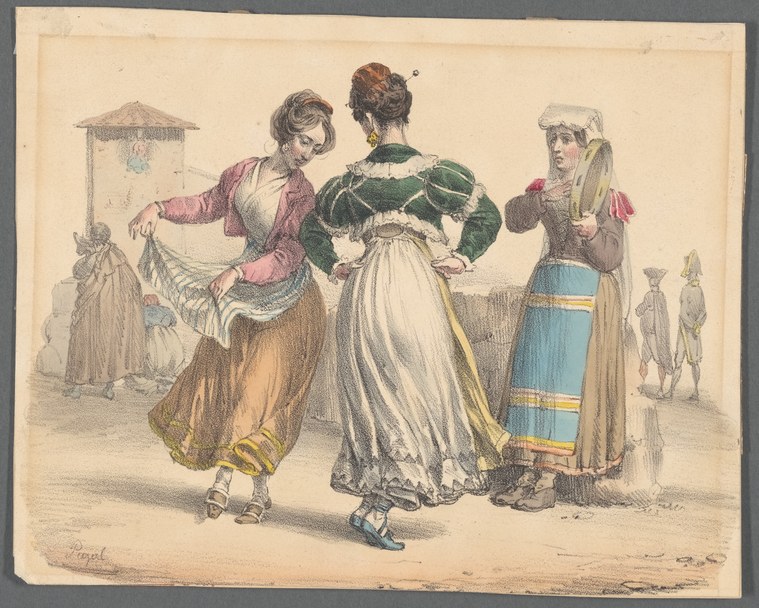
Three women in early 19th-century dress stand in conversation at the center of a street scene, their bodies angled toward one another in animated social exchange. The woman at left wears a rose-colored spencer jacket over a pale skirt; the woman at center, seen from behind, wears a high-waisted white gown with puffed sleeves in dark green silk and a white shawl; the woman at right wears a long dress with a striking blue sash or belt and a yellow-gold shawl. Behind them, a parasol is held aloft by another figure, and in the middle distance, further figures stand conversing or walking. The setting is a public street or promenade, rendered in muted earth tones with careful attention to the play of light on fabric. The composition captures a moment of leisure and sociability rather than formal dance, though the figures' postures and the careful arrangement of bodies suggest an observational study of movement and fashion contemporary with the Regency or early Georgian period.
The dancing
The three principal figures stand in a relaxed, upright frame, their weight distributed evenly, their arms and hands deployed naturally in conversation rather than in any formal dance hold. The woman at center leans slightly toward her companions; the woman at left gestures with an open hand. None of the figures shows the rigid posture, turned-out legs, or lifted carriage that would signal a formal dance lesson or performance. The bodies occupy the picture plane at varying depths, creating a sense of spatial intimacy and ease.
The dance depicted
This is not a depiction of formal dance, but rather of social promenade or street fashion during the Regency or early 19th century. The careful study of fabric, posture, and social interaction suggests the artist was documenting the movement and comportment of fashionable women in everyday public life—how women of the period walked, stood, and gestured in conversation. If dancing is occurring elsewhere in the scene, it is not the primary subject. The work belongs to a tradition of fashion and society illustration rather than theatrical or ballroom dance documentation.
How it was made
This appears to be a hand-colored engraving or aquatint, a technique widely used for fashion and society prints in the early 19th century. The delicate line work in the figures contrasts with the softer, more atmospheric handling of the background and sky. Hand coloring—visible in the careful application of watercolor to the women's clothing, the parasol, and the landscape—was a standard method for circulating fashion information among the wealthy and aspirational urban readership. The technique allowed for rapid production and distribution of images that recorded and promoted fashionable dress and deportment.
About this work
This is a fashion and society print from the early 19th century, likely from a series documenting Regency-era street life and women's fashion. It records not a staged dance but the everyday movement and dress of fashionable women in public spaces—the careful study of how bodies occupied and moved through social space. The work belongs in a gallery of dance and movement because it documents the embodied practices and gestural vocabularies of a specific time and place: the way women of the Regency period were taught to carry themselves, to gesture, to stand in conversation. It is a record of social movement as distinct from theatrical movement, yet no less revealing of the period's understanding of the female body in space.
How to look at it
Attend to the posture of the three women: the slight forward lean, the easy placement of the arms, the apparent ease of standing and conversing. Notice how different this is from the rigid, turned-out stance of formal dance instruction, yet how controlled and composed it remains. The artist has frozen a moment of social movement that was neither danced nor formally choreographed, but which was nonetheless governed by strict codes of deportment. Look at the fabric—the way the high waistlines, narrow skirts, and carefully arranged shawls required and enabled a particular kind of movement. This is a record of how fashion and social convention shaped the body in motion.
The artist
The artist is not recorded. The work bears a signature that appears to read 'Prud'hon' or similar, but without further documentation, attribution cannot be confirmed. The style and technique are consistent with early 19th-century French or English fashion print production, a commercial practice that employed both named artists and anonymous illustrators.
The period
This print dates to the height of the Regency era (c. 1811–1820) or the broader early 19th century, a moment of intense interest in fashion, manners, and the visual documentation of social life. The period saw the rise of illustrated fashion magazines and satirical prints that recorded both fashionable dress and the social interactions it framed. In dance, the Regency was dominated by formal, geometric dances—the quadrille, cotillion, and country dances—danced in ballrooms by the gentry and aristocracy. This print sits at the intersection of street life and ballroom culture, showing the deportment and dress codes that structured both.
Where it lives
This work is held in the New York Public Library's print collection, which specializes in fashion plates, society prints, and documentary illustrations of urban life. It is one of a large body of such works produced in the early 19th century for circulation among the urban and aspiring merchant classes.
Dance in this work
Questions about this work
Is this a dance?
Not a formal dance, but a record of the movement and posture of fashionable women in public life during the Regency period. However, the careful attention to the body's carriage and deportment reflects the dance training and social codes that governed women's movement in this era. For dancers, it provides crucial evidence of the embodied norms that framed the ballroom dances of the period.
What dances would these women have done?
Women of this class in this period danced cotillions, quadrilles, country dances, and waltzes in ballrooms. The upright posture, controlled carriage, and careful hand placement visible in this print were the foundation of that ballroom technique. The deportment shown here—how they stand, gesture, and move in conversation—was inseparable from their training as dancers.
Why is this in a dance collection?
Because it documents the embodied culture and gestural vocabulary of a historical moment in which dancing was a central social practice for the class depicted. It shows us how these women carried their bodies, how they were trained to move and stand—knowledge essential to understanding the ballroom dances they performed.
More dance artwork





