49 works in this view — arrow keys or swipe to move between them.
Dance in Art
Child dancers
Unknown artist
- Collection:
- Prints depicting dance
- Source:
- New York Public Library
- Rights:
- Public domain — free to use, share and adapt.
- Recorded as:
- Public Domain
This work documents the visual and musical apparatus through which children learned and performed social dancing in the mid-19th century. It shows that ballroom dancing was a formal, coached practice for the young, mediated through published music and instructional imagery, and it captures how the dancing body was visualized for a mass audience at that moment.
What you are looking at
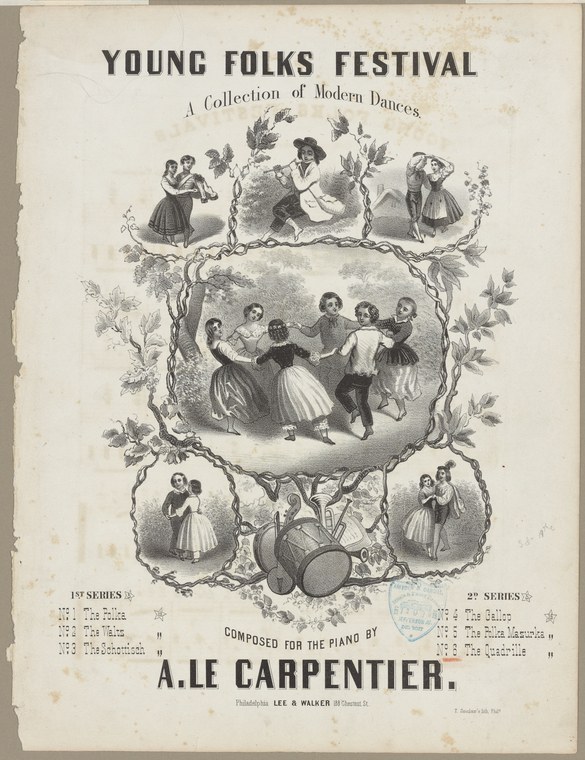
This is a sheet-music cover for a collection of modern dances for young people, composed for piano by A. Le Carpentier. The cover is densely decorated with wood-engraved vignettes arranged within a leafy border frame that resembles branches and foliage. The central circular composition shows a group of young dancers—boys and girls in period dress—arranged in a circle or round dance, their bodies leaning inward toward the center. Above and below this main scene are smaller vignettes depicting pairs and groups in various dance poses: couples in close embrace, children in flowing skirts executing turns or leaps, and figures in attitudes of social interaction. The entire composition radiates outward from the centre, creating a sense of movement and liveliness. The dress is clearly 19th century: girls wear full skirts with fitted bodices, boys are in jackets and trousers. The engraving technique allows fine detail in the rendering of fabric and gesture, with strong contrasts of black and white that give the dancing figures a graphic clarity. The title appears at the top in heavy serif capitals; below it reads 'A Collection of Modern Dances'; the composer's name is prominent at the bottom. Publication details and two series listings (1st Series and 2nd Series) appear in small print.
The dancing
The dancers occupy varied spatial relationships within the vignettes. In the central scene, they form a circle with bodies inclined toward the middle, suggesting a joined-hands or ring formation. In the surrounding smaller scenes, dancers are shown in closed-hold couples (at least one pair clearly in ballroom position), and in solo or paired attitudes of movement—arms raised, bodies twisted, skirts flared by motion. The engraver has captured the weight and line of the body in motion: arched backs, lifted arms, the thrust of the torso during a turn. The young dancers' proportions and the detail of their postures suggest these are not professional performers but social or recreational dancers, consistent with the title's reference to 'Young Folks.'
The dance depicted
This is a printed collection of ballroom and social dances intended for young people in the mid-to-late 19th century, arranged for home performance on the piano. The imagery suggests a mix of couple dances (visible in the paired figures in closed hold) and group dances or round dances (the central circle formation). The specific dances are not identifiable from the cover alone, but the title 'Young Folks Festival' and the reference to 'modern dances' on a cover dated to the Le Carpentier era (likely 1850s–1870s) suggests fashionable ballroom forms such as the waltz, polka, or quadrille—the standard repertoire of social dancing for children of the period. The composer Le Carpentier was active in Paris and known for dance music publications, so this is almost certainly a French or French-influenced collection.
How it was made
This is a wood engraving, a relief printing technique that produces crisp, finely detailed black-and-white images suitable for mass reproduction. Wood engraving allowed for the intricate rendering of figures and ornamental detail visible here—the individual skirt pleats, the expressions and poses of the dancers, and the delicate foliage of the decorative border. The technique and finish suggest this is a printed commercial publication, not a one-off artwork; the cover would have been engraved from a drawing and printed in substantial numbers. The publisher Lee & Walker is noted; the date marking at the foot ('T. Balderston 1854' or similar) indicates this is from the mid-19th century.
About this work
This is a cover design for a mid-19th-century collection of ballroom dances for young people, composed and published for home music-making. It is a primary visual document of how social dancing—and the instruction of children in social dancing—was visualized and promoted in the Victorian era. The cover's decorative programme, with its multiple vignettes of children in varied dance poses, serves both aesthetic and instructional purposes: it conveys the liveliness and social pleasure of dancing, while also showing the range of figures and formations that appear in the dances inside.
As an artifact of dance pedagogy and commercial publishing, it belongs to a large print culture devoted to social dancing in the 19th century. Unlike stage or theatrical imagery, which records the practice of professionals, this work shows dancing as a domestic, recreational pursuit for the young—a window into ballroom culture at the level of home and family.
How to look at it
Examine the central circle of dancers and note the posture and proximity of the figures: this is likely a round dance or cotillion figure, a formation associated with group social dances. Then look at the smaller vignettes: the pairs in the side panels show the closed hold characteristic of the waltz or polka, while the solo figures show the skirt and arm positions of a turning movement. The engraver has chosen moments of apparent activity—turns, lifts of the arm, the swing of the skirt—to convey motion and energy even in a static medium. Notice how the ornamental border of leaves and branches frames and, visually, contains the dancers: this was a conventional way of presenting musical or dance subjects in Victorian print design, suggesting both nature and cultivation.
The artist
The composer A. Le Carpentier was a 19th-century French musician known for dance music and instructional works. The engraver is not identified on the surviving copy, but the work was published by Lee & Walker, a London firm active in music publishing. The cover design is typical of Victorian-era music publishing: ornate, decorative, and heavy on imagery designed to appeal to middle-class families purchasing music for home performance.
The period
This work dates to the mid-19th century, a period of rapid growth in both ballroom dancing and in commercial music publishing aimed at the middle class. The waltz and polka had recently become fashionable across Europe; quadrilles and cotillions remained standard. Social dancing was understood as an essential accomplishment for young people, especially girls, and was taught both in the home and in dancing schools. Publications like this—affordable, attractively illustrated sheet music—proliferated in response to demand. The engraved vignettes on the cover served a dual purpose: they were decorative advertisements for the music inside, and they provided visual reference for the positions and movements of the dances.
Where it lives
This work is held in the New York Public Library's collection of prints depicting dance. It is a commercial music publication, part of the large body of 19th-century printed sheet music that serves as a documentary record of ballroom dancing, pedagogy, and musical taste.
Dance in this work
Questions about this work
What dances are in this collection?
The cover does not list the individual dances. The series organization (1st Series, 2nd Series) is visible, but the specific titles require consulting the full publication. Given the date and the title's reference to 'modern dances' for young people, the collection almost certainly includes popular ballroom forms such as the waltz, polka, quadrille, or galop.
Who was A. Le Carpentier?
A. Le Carpentier was a 19th-century composer known for dance music and instructional works, likely based in Paris. Beyond his publications, little biographical detail survives, but his prolific output suggests he was a working musician catering to the middle-class market for social-dance music.
Why are there so many small pictures on the cover?
The vignettes serve as a visual advertisement for the music inside, showing the reader the kinds of movements and formations they will encounter. This was a common practice in Victorian music publishing: ornate, densely illustrated covers appealed to buyers and gave a sense of the music's character and use.
Were these dances for professional performers or amateurs?
The title 'Young Folks Festival' and the domestic context (piano arrangements for home use) indicate these were dances for amateur, recreational dancers—children of the middle class learning ballroom dancing as a social accomplishment. The imagery emphasizes pleasure and light-heartedness rather than virtuosity.
More dance artwork





