49 works in this view — arrow keys or swipe to move between them.
Dance in Art
Das Blumenfest
Unknown artist
- Collection:
- Prints depicting dance
- Source:
- New York Public Library
- Rights:
- Public domain — free to use, share and adapt.
- Recorded as:
- Public Domain
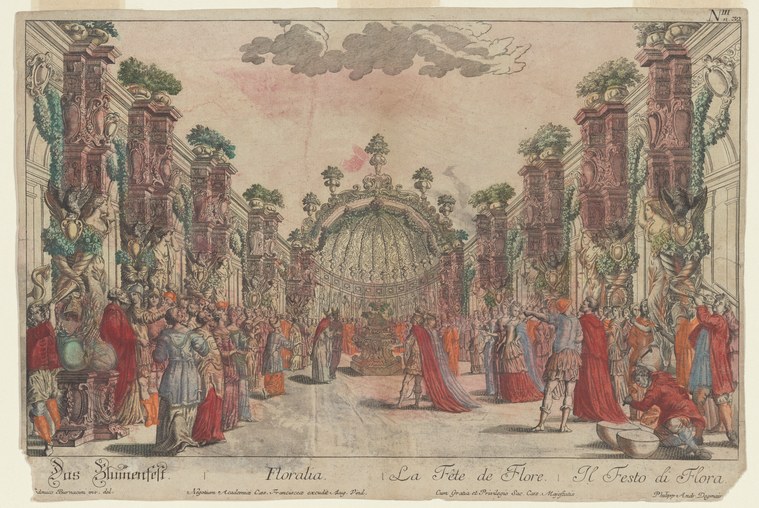
This image is vital evidence of how Renaissance and Baroque courts understood festivity, spectacle, and the relationship between dance, architecture, and social hierarchy. It shows that court dances of this era were embedded in larger theatrical and ceremonial contexts, often outdoors and observed by large, mixed-status crowds rather than performed in closed ballrooms. For scholars of Renaissance festival culture and the history of court dance patronage, this engraving is a rare surviving record of an actual event's spatial arrangement and dress codes.
What you are looking at
A grand outdoor festival in a formal European garden or courtyard, rendered in the hand-colored engraving style typical of 17th-century print culture. Massive rusticated stone columns support decorative architectural elements and climbing vines on either side, framing a perspectival view down a central axis toward an ornate domed pavilion or garden structure in the distance. Hundreds of figures in early modern dress—nobles, courtiers, and attendants in silks and brocades, many wearing the vibrant reds characteristic of formal court wear—occupy the space in loose groupings. Some process or parade along the central axis; others stand in clusters conversing or observing. The sky above is rendered in pale wash with clouds. The overall effect is of a state occasion or ceremonial celebration, with the architecture and crowd size conveying grandeur and formality. The title inscription refers this as a festival of Flora (goddess of flowers), suggesting a springtime or May Day celebration, a popular court entertainment of the period.
The dancing
The figures are depicted in profile and three-quarter view, dressed in the stiff, voluminous silhouettes of late Renaissance or early Baroque court dress—doublets, hose, long skirts, and elaborate hats. Few clear pairs or groups stand in close formation; instead, people are scattered and viewing-oriented, suggesting this is not a participatory dance but a spectacle to be watched. Some figures appear to stand at rest; others gesture or turn. The crowd density and lack of coordinated movement suggest this documents a social or ceremonial assembly rather than a choreographed ensemble dance.
The dance depicted
The inscription identifies this as a festival of Flora (Floralia, La Fête de Flore, Il Festo di Flora), which were festive court entertainments popular in 16th and 17th-century Europe, especially in Italy. These often included processions, theatrical displays, and allegorical performances celebrating spring and fertility. While a choreographed or participatory social dance may be taking place within this gathering, the image does not clearly depict a specific recognizable dance form or hold. It documents instead the ceremonial and festive context in which court dances would have occurred, showing the architecture, costumes, and hierarchical arrangement of bodies typical of such occasions.
How it was made
This is a hand-colored engraving, a reproductive print medium that allowed wide circulation in the 16th–17th centuries. The artist used line engraving to establish structure and perspective, then applied watercolor or gouache by hand to add local color—evident in the reds, greens, and flesh tones. This was an expensive, labor-intensive technique compared to woodcut but more refined; the fine parallel lines visible in the stonework and architectural details are characteristic of the burined line. The coloring is somewhat flat and applied in broad areas rather than blended, typical of contemporary hand-coloring practice. This method of production indicates the print was made for circulation among educated collectors, courtiers, or scholars interested in festival imagery and classical references.
About this work
Das Blumenfest documents a Renaissance or early Baroque court festival, likely Italian, celebrating Flora with a formal procession and gathering of elegantly dressed courtiers. The engraving serves as both a record of a historical occasion and a visual artifact of court culture and artistic patronage. It belongs in a gallery of dance in art not because it depicts choreographed dancing—the figures are too diffuse and uncoordinated for that—but because it shows the ceremonial, architectural, and social context in which court dances took place. Such festivals were intrinsic to courtly life; the dances that occurred within them would have been observed among crowds arranged much as the engraver shows here.
How to look at it
Observe the architectural framing and the careful perspectival recession, which emphasizes the scale and formality of the occasion. Notice how the crowd is arranged not in neat rows but in loose, naturalistic clusters, suggesting observation and conversation rather than participation in a unified action. Look at the dress codes: the prevalence of bright reds and silks among the central figures likely indicates rank, while plainer dress appears at the periphery. The pavilion at the center distance is the focal point; this was likely a stage or viewing platform for performances or speeches. The engraver's choice to show the festival in plan-like overview rather than from ground level places the viewer as an elevated observer—a position of privilege similar to that of the patrons and collectors who owned such prints.
The artist
The artist is not recorded in the catalogue. The style and technique suggest a professional court printmaker or engraver working in Italy (or possibly southern Germany or the Low Countries) during the late 16th or 17th century. The inscription text is in German (Das Blumenfest), Italian (La Fête de Flore, Il Festo di Flora), and possibly Latin, suggesting the print was designed for circulation across multiple educated European markets. The quality of the engraving and the labor investment in hand-coloring indicate a work of some status, likely commissioned to commemorate a significant court occasion and distributed among the nobility and collectors.
The period
The Renaissance court festival tradition peaked in the 16th and early 17th centuries, particularly in Italy, France, and the German principalities. These elaborate events combined architecture, music, dance, poetry, and theatrical performance in displays of princely power and classical learning. By the early Baroque period, court dance had become formalized into distinct types—pavanes, galliards, courtly minuets—and these dances were performed within such festivals, often as interludes in larger dramatic or allegorical spectacles. The engraving medium itself was at its height of sophistication and circulation in this period, before etching and lithography displaced it. Hand-colored prints like this one represent the cutting edge of reproductive visual technology and served as portable records of prestigious events, allowing courts to publicize their magnificence across Europe.
Where it lives
The work is held in the New York Public Library's collection of prints depicting dance. It enters the collection as a historical record of Renaissance court festivity and courtly behavior, though the exact provenance and acquisition history are not documented in the available record.
Dance in this work
Questions about this work
Is anyone actually dancing in this image?
Not in any structured or identifiable way. The image documents a courtly festival gathering—a ceremonial occasion at which dances would have occurred—but the figures shown are too dispersed and static to demonstrate choreographed movement. This is a record of context and setting rather than a depiction of the dance itself.
What is a Blumenfest and why is it important?
A Blumenfest or Floralia was a court celebration dedicated to the goddess Flora, typically held in spring, combining processions, theatrical performance, music, and dancing. These events were central to Renaissance and early Baroque court culture as displays of princely magnificence and classical learning. They served both social and political functions—uniting the court hierarchy and projecting power and refinement.
How do we know this engraving records a real event?
We cannot be certain from the image alone whether this documents an actual historical festival or is an idealized representation designed for circulation. However, the specificity of the title, the named location (implied by the architectural detail), and the surviving convention of commemorative court prints suggest this represents a real occasion, though artistic license and allegorical embellishment may have been employed.
What does hand-coloring tell us about this print's audience?
Hand-coloring was expensive and labor-intensive, indicating this print was made for a wealthy, elite audience—courtiers, nobles, and educated collectors. The multiple language inscriptions suggest it was marketed across different German-speaking and Italian regions, advertising the court's prestige and encouraging emulation of its festivals and fashions.
More dance artwork





