49 works in this view — arrow keys or swipe to move between them.
Dance in Art
La mazourka. Selections
Unknown artist
- Collection:
- Prints depicting dance
- Source:
- New York Public Library
- Rights:
- Public domain — free to use, share and adapt.
- Recorded as:
- Public Domain
The print is a primary historical document of the mazurka in its heyday as a ballroom dance, capturing not the technical instruction but the lived social performance. For dance historians, it provides visual evidence of how partners held one another, how the dance moved through space, and how it functioned as a spectacle of courtship and status in formal European society. For researchers of 19th-century social life, it records the material detail of evening dress, ballroom architecture, and the rituals of mixed-gender dancing at a specific moment in cultural history.
What you are looking at
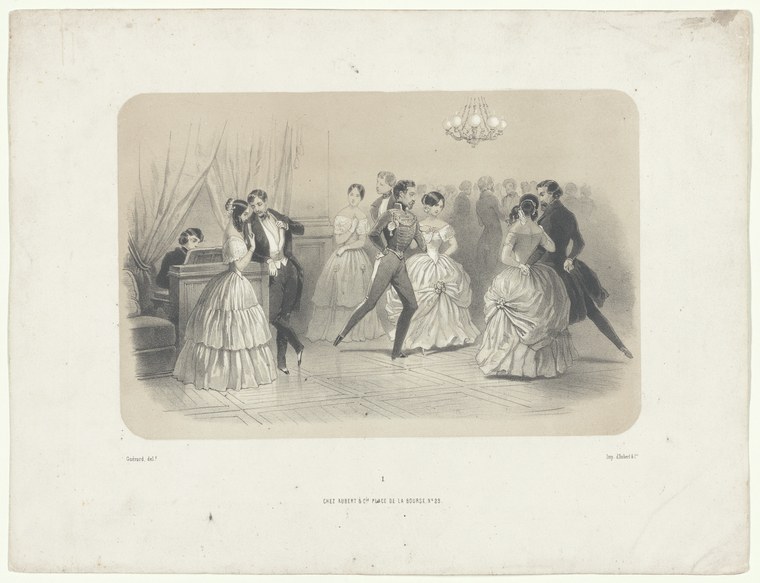
A ballroom or dance hall scene from the 19th century, viewed from above as if from a gallery or mezzanine. In the foreground, a woman in a voluminous white ball gown dances with a man in dark formal dress; her skirt billows dramatically around her. To the left, another couple is visible near a piano, where a pianist works. The center of the floor hosts a group of at least four more couples in various stages of a group dance, their white gowns creating bright focal points against the darker clothing of their male partners. A chandelier hangs above, and the back wall shows tall draped curtains. The composition emphasizes the social spectacle of ballroom dance: multiple couples in motion simultaneously, formal evening dress, and the presence of musicians and onlookers (several standing figures in darker dress line the walls). The engraving captures a moment of collective pleasure and courtship ritual.
The dancing
All the dancers hold the standard closed ballroom frame of the era: partners face one another with the man's right hand on the woman's back and her left on his shoulder, their other hands clasped at chest height. The women's posture is upright, their weight carried over their feet despite the momentum suggested by the skirts, indicating trained carriage. The men stand taller and lead. The visible footwork and the forward momentum of the skirts suggest a traveling step, not a stationary pivot. No pointe shoes or elevated positions are present; this is a social dance, not theatrical ballet.
The dance depicted
The title and the visual evidence point clearly to the mazurka, a Polish social dance that was fashionable in European ballrooms throughout the 19th century. The mazurka is characterized by a traveling step, an accent on the third beat, and a proud, sometimes aggressive posture—all suggested here by the forward movement and formal bearing of the dancers. The presence of a piano and multiple simultaneous couples dancing in a formal ballroom confirms this as a social dance of the middle to upper classes, not a theatrical performance. The print captures the mazurka as a participatory ballroom spectacle rather than a staged entertainment.
How it was made
This is an engraving or etching on paper, identified from the linear hatching, the delicate line work defining form and shadow, and the characteristic monochrome gray tones. The technique allows fine detail in the dress and setting and suggests this was a reproduction made for circulation—likely a print for sale or for inclusion in a periodical or book of social customs and fashions. The soft gray tone typical of engraved reproductive prints was suited to wide distribution and modest cost, making such images accessible to educated middle-class readers interested in fashionable society.
About this work
This is an engraved or etched print documenting the mazurka as it was danced in European ballrooms of the 19th century, probably mid-century. The work is part of a series titled 'Selections' (as indicated by the catalogue record), which suggests it was one of several prints issued together to illustrate varieties of fashionable dance and social life. The image sits at the intersection of dance history, social history, and popular prints: it records both a specific dance form and the visual conventions by which that dance was communicated to a broad audience. For historians of dance and fashion, it offers rare direct evidence of how the mazurka was actually performed—the frame, the posture, the scale of movement—rather than prescriptive instruction from a manual.
How to look at it
Observe the forward momentum of the dancers and the momentum of the skirts, which suggests a traveling step rather than a pivoting motion. Notice the formal, upright carriage of the couples and the way the men lead the women through space. The multiple couples dancing simultaneously—not in a single line or set formation—shows this is a free-flowing ballroom dance, not a choreographed group figure. The framing from above emphasizes the ballroom as a social theater, and the presence of seated musicians, standing observers, and the architectural detail of walls and chandelier establish the formal evening setting in which mazurka was danced.
The period
The mazurka entered European ballrooms in the 1830s and remained fashionable throughout the 19th century, reaching its peak of popularity in the 1850s–1870s. It was danced at balls by the aristocracy and aspiring middle classes, and it inspired countless printed representations aimed at readers who wanted to keep abreast of fashionable society. In the visual arts, engraved and lithographed prints of social dances were a popular genre; they served as both entertainment and as a form of social aspiration and instruction. The image reflects the 19th-century taste for documenting and circulating images of fashionable leisure, particularly those involving women in elaborate dress.
Where it lives
The print is held in the New York Public Library's collection of prints depicting dance. It is numbered as part of a series titled 'Selections,' suggesting it was issued with other similar prints as a suite or portfolio.
Dance in this work
Questions about this work
How do I know this is a mazurka and not some other 19th-century ballroom dance?
The title explicitly identifies it as 'La mazourka' (the French spelling of mazurka). Visually, the traveling movement, the formal closed frame, and the three-beat structure suggested by the composition are consistent with mazurka. The painting style and dress date to the mid-to-late 19th century, when the mazurka was at the height of its ballroom popularity.
Why are all the women wearing white gowns?
White or pale silk and satin evening gowns were the height of formal ballroom fashion for women in the 19th century, especially for younger unmarried women. The color and luminosity also served an aesthetic purpose in engravings: the pale gowns create visual contrast and focus against the men's dark dress, and the fabric's movement is easier to render and to read in print.
Is there a specific moment in the dance being shown?
The print captures a general state of the mazurka in motion rather than a single technical moment. The skirts in mid-billow and the forward posture of the dancers suggest traveling steps and the pride and momentum characteristic of the dance, but the image is more documentary than narrative.
Who would have owned or seen this print?
Such prints were sold to the educated middle and upper classes—people who attended balls, aspired to fashionable life, or simply wanted to see and own images of contemporary social customs. They were inexpensive compared to paintings and could be framed, collected, or bound into books. They circulated through print shops, periodicals, and publishers specializing in fashionable subjects.
More dance artwork





