49 works in this view — arrow keys or swipe to move between them.
Dance in Art
La mazourka. Selections
Unknown artist
- Collection:
- Prints depicting dance
- Source:
- New York Public Library
- Rights:
- Public domain — free to use, share and adapt.
- Recorded as:
- Public Domain
The mazurka was the supreme social dance of mid-nineteenth-century Europe, and this print preserves how it was actually performed—the hold, the frame, the costume, and the ballroom context—in the decades before photography. For anyone studying the history of ballroom dance, social dance pedagogy, or the visual culture of courtship and elite society in this period, the print is documentary evidence of the highest order.
What you are looking at
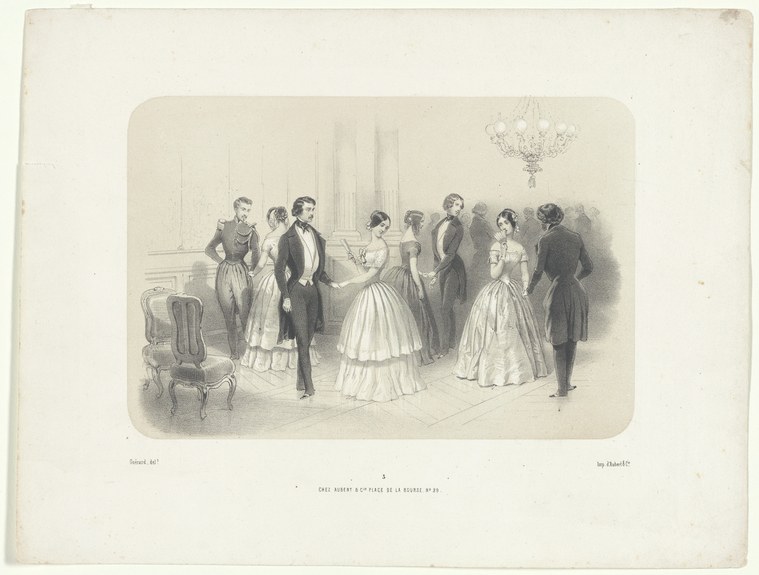
A formal interior with a crystal chandelier captures the moment of a mazurka, the Polish court dance that dominated ballroom society across Europe in the nineteenth century. Eight figures occupy the space: three women in white ball gowns with layered skirts and fitted bodies stand at the center and right, while five men in black evening dress with swallow-tails frame the composition. The central woman, caught mid-turn with her skirt flared around her, is partnered by a man in profile; two other couples stand nearby in conversation or observation, while additional figures occupy the background. The print is rendered in lithographic tones that suggest the gaslit elegance of a grand ballroom—the setting is shallow, the figures' shadows delicate, the space itself suggested rather than fully defined. This is a moment of social ritual captured with the affection for ballroom precision that marked the 1840s and 1850s, when the mazurka had become the signature dance of fashionable Europe.
The dancing
The principal dancers hold the closed position typical of the mazurka—the man's right hand at the woman's waist, her left on his shoulder, their free hands joined at shoulder height. The woman's weight is poised on a turning step, her white skirt described in crisp lithographic lines that catch the silhouette of rapid motion. Her body leans into the pivot with the slight backward tilt characteristic of the era's ballroom frame. The other figures—some dancing, some conversing—are rendered with the refined stillness of social observation rather than athletic energy; this is ballroom choreography, not theatrical spectacle. The composition distributes attention across the room, showing the mazurka as a social event rather than a performance, with multiple interactions unfolding simultaneously.
The dance depicted
The title identifies this as a mazurka, a Polish court dance in triple meter that swept through European ballrooms from the 1820s onward and remained a symbol of aristocratic elegance through the nineteenth century. The mazurka was typically danced by one or more couples while others watched from the perimeter—exactly what this print shows. The characteristic features visible here are the closed ballroom position, the woman's turned-out movement, and the formal white-gown-and-evening-dress costume that marked the mazurka as a dance for the elite. By mid-century the mazurka had become as much a convention of ballroom propriety as the waltz or quadrille, and its appearance in fashionable prints signals its entrenchment in the visual culture of courtship and social performance.
How it was made
This is a lithograph, identifiable by the soft tonal washes, the way the black pigment sits on the paper surface with a slightly grainy quality, and the characteristic ease of rendering that lithography permitted compared to hand-engraving. The technique allowed the artist to suggest light and shadow with subtle gradations—note the way the chandelier casts diffuse illumination across the scene. Lithography's speed and reproducibility made it the standard medium for fashion and ballroom prints in the 1840s–1850s, suitable for periodical illustration and for sale as individual sheets. The print was likely produced in Paris or London, the twin centers of ballroom fashion and lithographic publishing.
About this work
This is a mid-nineteenth-century lithographic print depicting a mazurka in a ballroom interior, likely from a series of ballroom scenes circulated as fashion and etiquette plates. The mazurka was the reigning emblem of refined European society in this period—a Polish national dance transformed into a marker of gentility and romantic courtship. The print documents not just the dance itself but the entire social apparatus surrounding it: the setting, the dress codes, the gender roles, the performance of elegance before an audience of peers. As a visual record of how the mazurka was actually danced, held, and framed in its moment of greatest prestige, it is invaluable evidence of ballroom practice and social choreography in the mid-nineteenth century.
How to look at it
Attend to the central woman's posture and the angle of her torso as she turns. The artist has chosen to capture the mazurka mid-pivot, with her weight committed to the turn and her skirt in full flare—this is the moment of greatest visual drama and elegance. Note how the man's frame remains upright and stable even as his partner rotates, a convention of the closed ballroom hold that maintained male authority through stillness. The other figures—the bystanders in conversation, the couples waiting their turn—establish the social context: the mazurka was danced in the presence of an audience, and social observation was part of the dance's meaning. This is not a performance dance for a paying audience but a social dance for the approval of peers.
The period
The mazurka entered European ballrooms in the 1820s and reached the height of its fashion between 1840 and 1860. It arrived from Poland as a national dance marked by pride and military bearing—quite unlike the swooning sentimentality of the waltz—and its very foreignness and exoticism made it irresistible to aristocratic Europe. The mazurka was danced in triple time with characteristic rhythmic figures: stamping, heel clicks, and turns executed with precise control. In the ballroom, it remained a vehicle for social distinction; to dance the mazurka well was to demonstrate breeding, coordination, and knowledge of the latest Continental fashions. The 1840s–1850s were the peak years of its prestige. Lithographic prints of mazurka scenes circulated widely as fashion plates and as records of elite social life, part of a broader visual literature of ballroom propriety and romantic courtship. The dance survived the decline of the quadrille and waltz into the twentieth century, but its golden age was this mid-Victorian moment.
Where it lives
The New York Public Library holds this as part of its Prints depicting dance collection, a assemblage of visual documentation of dance across media and centuries. The print's provenance beyond the NYPL is not recorded here.
Dance in this work
Questions about this work
Why are the women wearing white ball gowns and the men in black?
This was the strict ballroom dress code of the mid-nineteenth century. White (or pale pastel) full skirts with fitted bodices were the mark of unmarried women at formal balls; men wore black swallow-tail coats with white shirt fronts. This costume immediately signaled the social status and eligibility of the dancers. The contrast also made the dancing figures visually legible in a crowded ballroom.
How did the mazurka differ from the waltz?
The mazurka was in triple meter like the waltz, but with a very different character. It emphasized military bearing, precise footwork with characteristic stamps and heel clicks, and was danced with the dancers' bodies held more upright and less 'romantic.' The waltz, by contrast, featured continuous rotation and a dreamy, swooning quality. The mazurka advertised control and national pride; the waltz advertised surrender to music and emotion.
Who danced the mazurka?
In its European ballroom context, the mazurka was danced by the aristocracy and wealthy gentry—those with access to formal balls and the leisure to master its technique. It was primarily a dance for young unmarried people under the watchful eyes of chaperones and society, making it a central ritual of courtship among the elite.
Why are some couples dancing while others stand and watch?
The mazurka was not a group dance but a solo-couple dance performed before an audience of peers. Typically one or two couples at a time would dance while others observed from the edges of the ballroom, waiting their turn. This spectatorial dimension was central to the dance's social function: dancing well in front of witnesses established your credentials and desirability.
More dance artwork





