49 works in this view — arrow keys or swipe to move between them.
Dance in Art
Venus
Unknown artist
- Collection:
- Prints depicting dance
- Source:
- New York Public Library
- Rights:
- Public domain — free to use, share and adapt.
- Recorded as:
- Public Domain
This image reveals the inseparability of dance, fashion, and courtly display in eighteenth-century theatrical culture. For historians of dance costume, court spectacle, and the body in performance, it documents not only how a theatrical role was visualized but also how the dancer's body was meant to be read—as a vehicle for luxury, refinement, and allegorical meaning rather than virtuosity. The survival of such prints in collections like that of the New York Public Library shows how widely theatrical imagery circulated in the period and how seriously the visual presentation of the dancing body was treated.
What you are looking at
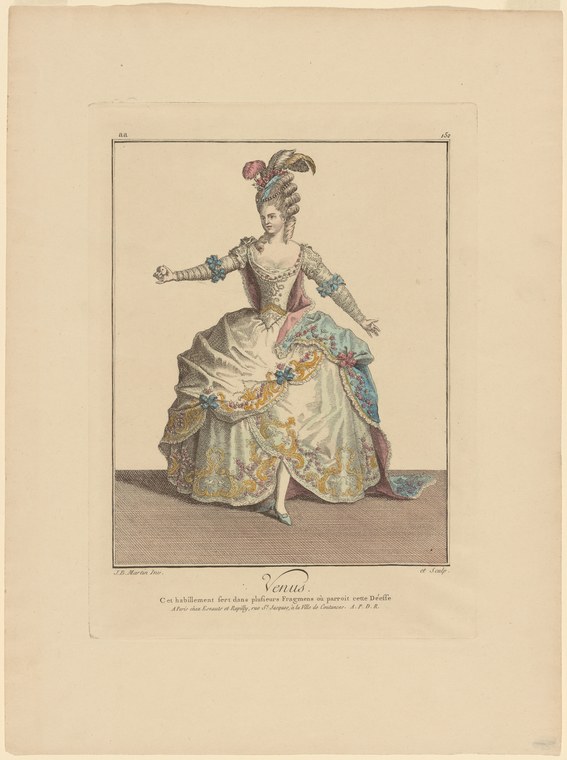
A single female figure stands alone against a plain background, posed as if mid-performance. She wears an elaborate court dress of the 1780s—a heavily decorated gown with a tight bodice in pale blue or grey, trimmed with gold embroidery and jeweled ornaments, and a voluminous skirt of cream silk with substantial panniers creating dramatic width at the hips. The skirt is caught up with swags of darker fabric and further adorned with gold brocade, ribbon, and what appears to be jeweled ornaments. Her left arm extends outward in a graceful gesture; her right arm rests near her body. Her headdress is tall and elaborate, topped with plumes and ornamental details. She wears heeled shoes and stands in a refined, composed attitude. The figure is rendered in colored engraving with careful attention to the texture and sheen of the fabrics, gold leaf or gilt work enhancing the richness of the dress.
The dancing
The dancer is shown in a vertical stance with minimal weight shift—both feet appear planted, the pose symmetrical and formally composed rather than captured mid-movement. The left arm is raised and extended to the side at roughly shoulder height, palm down and fingers relaxed in a gesture of presentation or greeting. The right arm hangs more naturally. The body is held upright with an elongated spine, shoulders back, no indication of flexed legs or the dynamic weight redistribution that characterizes any period of ballroom or theatrical dance. This is a portrait pose rather than a moment of action.
The dance depicted
This appears to be a costume study or character portrait rather than documentation of actual dance in motion. The figure is labeled 'Venus' and represents the goddess of love and beauty in allegorical or theatrical guise. While the elaborate dress is contemporary with the era of Baroque court dance (Louis XV period, roughly 1740s–1770s, though the dress itself shows elements of 1780s fashion), the figure makes no dance movement. The pose suggests a theatrical presentation—possibly a moment from a court ballet, opera-ballet, or masque in which the dancer would embody the classical deity—but we are not shown the dance itself. The image functions more as a fashion and character plate than as dance documentation.
How it was made
This is a hand-colored engraving, a commercial print technique used throughout the eighteenth century for fashion plates, theatrical costume studies, and allegorical figures. The fineness of the line work and the careful modeling of the silks and satins suggest professional engraving; the hand-coloring (possibly watercolor or gouache) has been applied over the print, giving the gold embroidery and jeweled details their luminosity. This was a standard format for disseminating fashionable dress and theatrical costume to a broad audience—cheaper than an oil painting, widely reproducible, and portable. The technique allowed precise detail in textiles and ornament, which is clearly the primary subject of interest here alongside the figure's graceful bearing.
About this work
This is a hand-colored engraving depicting a young woman in the role of Venus, dressed in the height of French court fashion and theatrical luxury of the 1780s. Though labeled as a dance figure and likely connected to court ballet or opera-ballet performance, the image itself shows no movement—it is a posed costume study, designed to celebrate the beauty of the dress and the elegance of the figure wearing it. The work belongs to a long tradition of theatrical costume plates and allegorical fashion prints that were collected and circulated among those interested in theater, fashion, and courtly elegance. It is a document of how the goddess would have appeared on stage, and of what the fashionable body was understood to be: tall, narrow-waisted, gracefully composed, adorned with gold and jewels.
How to look at it
Attend first to the dress: every element of its construction is visible and was meant to be admired—the cut of the bodice, the arrangement of the panniers, the placement of the gold embroidery and jeweled ornaments, the fall of the silk. This is a fashion plate as much as a dance image. Then observe the figure's posture and gesture: the raised arm is neither a dance movement nor a ballroom position, but a theatrical presentation of the body as object of beauty. The painter or engraver is showing us what Venus would have looked like standing at rest in her costume—composed, vertical, ornamental. There is no sense of weight, momentum, or the kinetic energy of actual dancing. The moment chosen is not a step but a pause, a display.
The artist
The artist is not recorded. The print appears to be a mid-to-late eighteenth-century French production, likely from a series of theatrical or allegorical costume studies. The precision of the engraving and the sophistication of the hand-coloring suggest a commercial print shop of some standing, possibly Parisian. Such prints were often produced without attribution to individual artists; they were the work of studios and served a commercial market for theatrical and fashion imagery.
The period
This work dates to the era of the Rococo and the declining years of the ancien régime, when court ballet and opera-ballet were central to aristocratic cultural life. The 1780s saw the height of ornamental fashion and theatrical display, even as the social world that sustained them was entering crisis. Baroque court dances—minuets, rigaudons, bourées—were still performed, and allegorical ballets in which dancers embodied classical deities remained a staple of court entertainment and public opera houses. The extreme ornamentation and narrowed silhouette of the dress shown here is characteristic of the 1780s and early 1790s, the last moment of pre-Revolutionary French luxury. By the time this print may have circulated widely, the world it depicted was already under threat.
Where it lives
The work is held in the Prints collection of the New York Public Library, catalogued as part of their holdings of dance imagery. No date, artist, or original source is recorded in the catalogue. It appears to be a single print rather than part of an identified series, though such costume studies were often produced in sets.
Dance in this work
Questions about this work
Is this a portrait of a specific dancer?
There is no indication in the image or catalogue that this represents a named performer. The label 'Venus' identifies the allegorical character, not the dancer. These costume studies were typically generic character plates rather than portraits of individual artists, though copies would have been used in theaters to guide costume and presentation.
What dance would have been performed in this costume?
We cannot determine from the image which dance, if any, was actually performed in this dress. The costume is consistent with court ballet and opera-ballet of the Rococo period, and such roles would typically have involved minuet-like movements, ornamental gestures, and courtly bearing—more about display and grace than virtuosity. The figure herself shows no movement.
What does the notation at the bottom of the print say?
The inscription is partially legible as identifying the figure as Venus and crediting the work to printmakers or publishers—a standard format for commercial prints of the period. The exact text would require closer examination of a high-resolution copy, but such inscriptions typically named the character, the occasion (if known), and the maker of the print.
How rare is this print?
Eighteenth-century hand-colored theatrical prints of this quality were expensive objects, but thousands survive in institutional collections. This particular print's current rarity or availability cannot be determined from the catalogue record alone. The NYPL holding suggests it is part of a deliberate collecting effort in dance imagery.
More dance artwork





