49 works in this view — arrow keys or swipe to move between them.
Dance in Art
Bal de l'Opéra
Unknown artist
- Collection:
- Prints depicting dance
- Source:
- New York Public Library
- Rights:
- Public domain — free to use, share and adapt.
- Recorded as:
- Public Domain
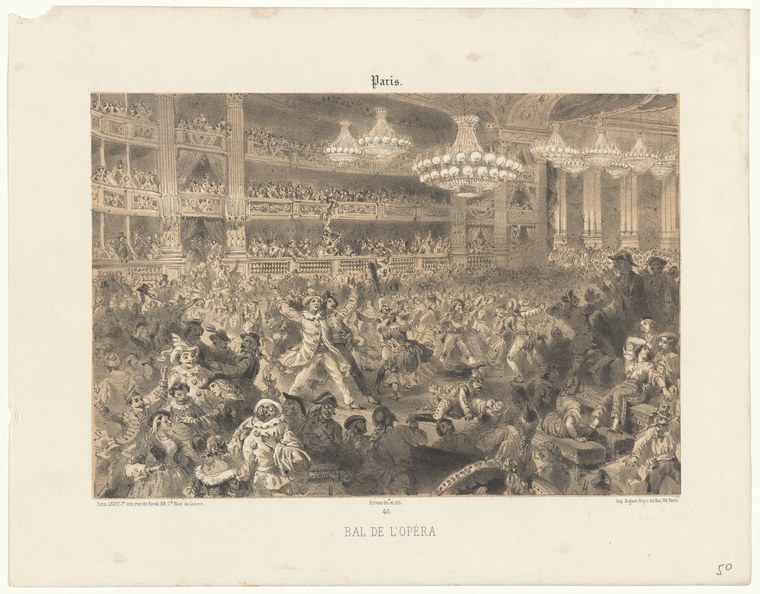
For dance historians, this image provides rare visual documentation of how 19th-century social ballroom dancing actually looked—the posture, the frame, the relationship between partners, the role of architecture in structuring the dance. It shows the scale and formality of the Opéra ball as a social institution, not simply as an event but as a stage for the enactment of class and gender relations through dance.
What you are looking at
This engraving depicts a grand ball in the Paris Opéra, likely from the mid-19th century. The composition is dense with figures filling the entire space—from the foreground where couples dance on the floor to the tiers of balconies above, where spectators crowd the railings. The orchestra sits elevated on the left; massive crystal chandeliers illuminate the scene from above. The architecture frames the scene with Corinthian columns and ornate ceiling decoration. Guests wear formal evening dress: women in full-skirted gowns with bare shoulders, men in dark tailcoats and white shirts. The mood is one of animated celebration—figures gesture, converse, and move in complex patterns across the ballroom floor. The print shows exceptional detail in rendering the crowd; no two figures are identical, and facial expressions and poses convey the social energy of the occasion.
The dancing
Most visible couples are in closed ballroom position—the man's left hand holding the woman's right at shoulder height, right hand on her back, the woman's left arm on his shoulder. The characteristic upright frame of 19th-century ballroom dance is evident throughout: torsos erect, heads held high, movement controlled and formal. The women's full skirts swing with the movement; many figures are caught mid-turn, their skirts flared. The dancers' weight appears forward and grounded rather than lifted. Arms are held with the formality of the period—not relaxed but not dramatically raised either. The composition captures multiple moments simultaneously: some couples are in direct frontal contact, others are passing or turning away from the viewer.
The dance depicted
The work depicts the social ballroom dancing of 19th-century Paris high society, likely waltzes, quadrilles, or polkas—the fashionable dances of Opéra balls. The dress and setting place this firmly in the Gilded Age or Second Empire period. The Opéra ball itself was a major social event; these balls were public spectacles where members of society performed their status through dance. The image shows not competitive or theatrical dance but social dance in a ceremonial space—the dance of courtship, alliance, and display. The formality of the setting and the number of spectators indicates this was a formal, organized event rather than a social club; the Opéra hosted regular balls of considerable grandeur.
How it was made
This is an engraving or possibly a steel engraving, evidenced by the fine line work, the use of cross-hatching for tone, and the ability to render both delicate fabric texture and deep shadow. The technique allows the artist to achieve remarkable clarity and detail across a crowded composition—individual faces are legible even in the background. The print shows signs of high-quality reproduction and likely wide circulation; the inscription at bottom confirms it documents a known Parisian venue and event. The medium made it possible to create an affordable, distributable image of a spectacular moment in high society.
About this work
This engraving documents the social ballroom culture of 19th-century Paris at its most prestigious venue. The Opéra ball represented the apex of social dance—not performance for an audience but performance of oneself for society. The image captures the formal, partner-based ballroom dancing of the era: closed-hold couples moving through prescribed patterns in an architectural frame designed to display both the dancers and the institution. The work sits at the intersection of social history, dance history, and visual culture; it shows us how the body was positioned, how space was organized, and what dancing meant in the context of Parisian high society.
How to look at it
Attend to the posture and frame of the dancing couples: the consistent upright carriage, the closed hold, the formal spacing between partners. Note how the artist has frozen multiple moments of the same dances simultaneously—some couples are turning, others moving forward, allowing us to read the spatial and temporal flow of the ballroom. Observe the role of the architecture: the columns, balconies, and chandeliers do not frame the dancers as performers but as part of the social fabric of the institution. The density of the crowd and the animation of the spectators show that watching others dance was as important as dancing oneself.
The period
The image dates from the era of the Romantic ballet, but it documents not the theatrical dance on the Opéra stage but the social dancing that took place in its public ballrooms. The 19th century saw the codification of ballroom dance—the rise of the waltz, the quadrille, and later the polka as standardized social forms. The Opéra ball was a major social event, particularly during the Second Empire (1852–1870), when such public spectacles reinforced social hierarchies through ritual and display. The image reflects the era's fascination with capturing contemporary social life through prints and engravings, a visual culture that documented both theater and society.
Where it lives
The work comes from the New York Public Library's collection of prints depicting dance. The inscription 'Bal de l'Opéra' with credit line confirms it is a documented engraving of a known Parisian event.
Dance in this work
Questions about this work
What dance are they doing?
The specific dance cannot be determined from the image alone—the couples could be waltzing, doing a quadrille, or dancing a polka, all fashionable at Opéra balls. The closed hold and upright frame are consistent with the ballroom dances of the period. The engraving shows social dancing at a formal public event rather than any single choreographed form.
Who could attend an Opéra ball?
The Opéra ball was a public or semi-public event, though attendance was restricted to subscribers and members of high society. The crowd shown here—formally dressed, predominantly white, arranged in hierarchical tiers of balconies—reflects the social order of 19th-century Paris. These were not events for ordinary citizens but for the aristocracy, wealthy bourgeoisie, and their associates.
Why is the building so ornate?
The architecture is meant to display wealth and institutional power. The Palais Garnier, the Paris Opéra, was built during the Second Empire as a monument to French cultural achievement. The ballroom's grandeur—the columns, chandeliers, multiple levels—was integral to the social meaning of the event. The building itself was part of the spectacle.
How do I know this is from the 19th century?
The women's dress—the full skirts, bare shoulders, and fitted bodices—places this in the mid-to-late 19th century. The men's tailcoats and the architectural style of the Opéra support this dating. The engraving technique and printing quality are consistent with 19th-century reproduction methods.
More dance artwork





