49 works in this view — arrow keys or swipe to move between them.
Dance in Art
Masquerades and fancy-dress balls in prints
Unknown artist
- Collection:
- Prints depicting dance
- Source:
- New York Public Library
- Rights:
- Public domain — free to use, share and adapt.
- Recorded as:
- Public Domain
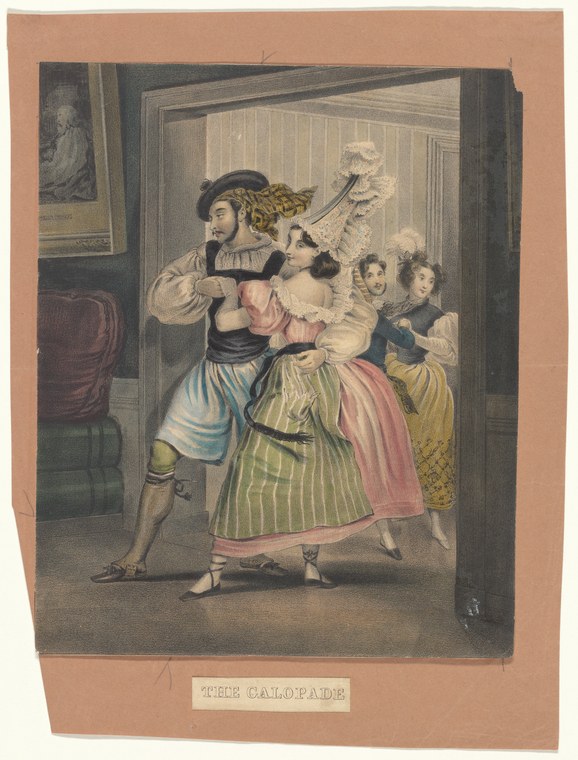
This print is evidence of how masquerade balls functioned as dance events and how they were marketed and remembered through circulating images. For a historian of ballroom culture, it documents both the actual social practices and the aesthetic codes by which such events were represented to a watching public.
What you are looking at
A crowded indoor masquerade or fancy-dress ball, captured mid-celebration. In the foreground, a woman in a striped green skirt with pink drapery dances with raised arms, her body animated and turned, while a man in classical costume—short tunic, leg wrappings, and feathered headdress—attends to her movement. Behind them, at least two other costumed figures cluster in the doorway: a woman in pale dress with feathered ornament and another in darker fabric. The setting is an elegant interior with paneled walls and a framed picture visible on the left wall, suggesting a ballroom or salon. The composition uses strong linear perspective to draw the eye from the crowded foreground through an open doorway to further rooms beyond. The print employs hand-coloring over an engraved base, with soft yellows and creams in the architectural elements contrasting against the deeper tones of costume and shadow.
The dancing
The principal dancers occupy an open frame with little closed-position contact. The woman's posture is upright and energetic, her arms raised and separated, her weight shifted as if mid-turn or stepping; the man beside her maintains a more static classical pose, his arm raised but his body squared. The secondary figures in the doorway are less developed, appearing more as decoration than dance partners. The artist shows understanding of ballroom space—the dancers occupy the floor with room around them—but the emphasis is on costume and spectacle rather than footwork or hold.
The dance depicted
This is a fancy-dress or masquerade ball, a fashionable social entertainment of the 18th and early 19th centuries where guests wore historical, mythological, or fantastical costumes and danced in character. The man wears a classical or Greco-Roman costume, the woman a contemporary dress adapted for the occasion. The dance itself is not clearly identifiable as a specific form—it appears to be a social or ballroom dance of the period, possibly a cotillion or quadrille adapted to the playful setting. Such balls were common in aristocratic and upper-middle-class circles across Europe, particularly in London and Paris, and were documented in prints and satirical illustrations.
How it was made
This is a hand-colored engraving or aquatint, a reproductive print technique that allowed wide circulation of fashionable imagery. The fine lines of the engraved base (visible in the architectural detail and fine contours) are overlaid with watercolor or tinted ink in warm pastels—yellows, pinks, greens, and grays. This combination was standard for commercial fashion and social illustration in the late 18th and early 19th centuries, making the work accessible to a middle-class audience interested in current entertainments and styles. The print medium enabled rapid production and distribution of costume references.
About this work
This print documents a masquerade ball, a fashionable form of aristocratic and upper-middle-class entertainment where guests danced in costume. The work captures the social theatre of the occasion—the elaborate dress, the mixture of historical and contemporary costume, the intermingling of dancers—rather than documenting any specific choreography. As a hand-colored engraving, it served as a record of fashionable behavior and costume for readers who might attend such events themselves or enjoy the satirical or celebratory documentation of high society at play.
The image belongs in a dance archive because fancy-dress balls were a significant form of social dancing and because the print reveals how dance was understood and promoted in commercial visual culture—as spectacle, costume, and social display rather than technical accomplishment. It records a moment when dance and dress were inseparable, and when the ballroom was a stage for the performance of identity.
How to look at it
Attend to the contrast between the still, classical pose of the man and the animated, contemporary movement of the woman—this captures the playful collision of costume and actual movement that defined the masquerade ball. Notice how the artist stages the action in deep space, using the open doorway and receding rooms to suggest the scale of the event and the flow of dancers through the rooms. The hand-coloring, though delicate, emphasizes the costumes over anatomical detail, indicating that dress, not footwork, was the point.
The artist
The artist is not recorded. The print is part of a series or collection titled *Masquerades and Fancy-Dress Balls*, suggesting it was produced as part of a commercial suite documenting fashionable social entertainments. Such series were common products of London and Paris print publishers in the late 18th and early 19th centuries, usually created by teams of engravers and colorists rather than individual artists, and intended for a broad middle-class market.
The period
Masquerade balls reached their peak of fashionability in the 18th century and remained popular into the Romantic era. They were associated with aristocratic leisure, flirtation, and the theatrical exploration of identity—guests adopted costume and often adopted altered behavior to match. In art and literature, they were frequent subjects of satire and celebration. The late 18th and early 19th centuries saw an explosion of commercial prints documenting fashionable behavior, social entertainments, and costume, reflecting growing middle-class interest in—and consumption of—visual culture about upper-class life. This print sits at the intersection of dance documentation, fashion illustration, and social satire.
Where it lives
This print is held by the New York Public Library as part of a collection of prints depicting dance. It is catalogued as part of a series on masquerades and fancy-dress balls, though individual cataloguing details (artist, date, publisher, engraver) are not currently recorded.
Dance in this work
Questions about this work
What was a masquerade ball and how was it danced?
A masquerade ball was a fashionable social entertainment where guests wore masks and elaborate costumes and danced in character. The actual dancing followed the ballroom dances of the period—minuets, cotillions, country dances, and later quadrilles and waltzes—but the costume and masked identity added an element of play and theatrical transformation. These events were particularly popular in aristocratic circles in the 18th century and were often sites of flirtation and social transgression.
How do we know what people wore and how they danced at these events?
Prints like this one, along with written accounts, fashion journals, and portrait paintings, document the costumes and general behavior of masquerade attendees. While individual footwork is rarely visible in prints (the technique is not precise enough), the overall posture, hold, and energy of the dancers, along with the stated identities of the dances being performed, allow historians to reconstruct the experience.
Why did artists make so many prints about fancy dress and masquerades?
Masquerades and fancy-dress balls were among the most conspicuous and discussed entertainments of fashionable society, and prints about them sold to a broad audience interested in high-society behavior, costume, and gossip. Commercial print publishers produced series on fashionable life, and these images circulated as both documentation and aspiration—people who attended such events, or dreamed of attending, purchased prints to remember or imagine them.
More dance artwork





