49 works in this view — arrow keys or swipe to move between them.
Dance in Art
Mademoiselle Auretti
Unknown artist
- Collection:
- Prints depicting dance
- Source:
- New York Public Library
- Rights:
- Public domain — free to use, share and adapt.
- Recorded as:
- Public Domain
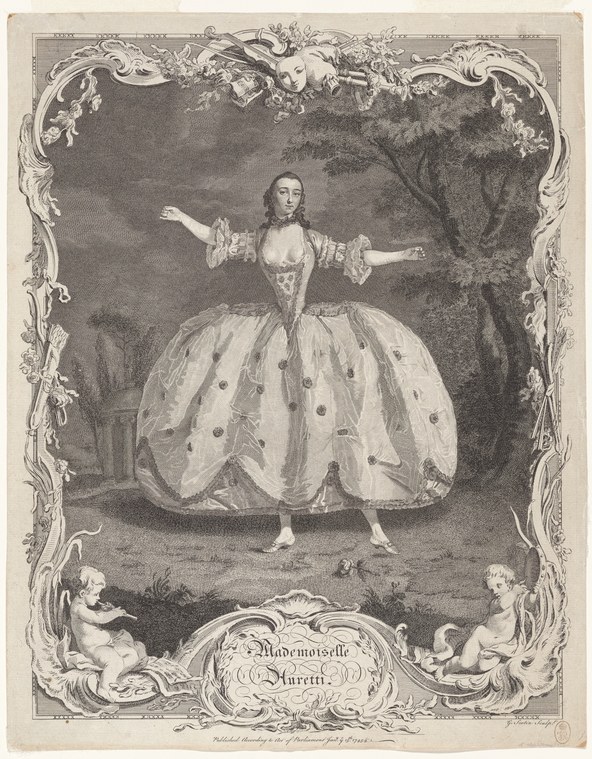
This print documents a named female professional dancer of the 18th century and preserves the specificity of her costume in high visual detail—information crucial to understanding what theatrical dance dress actually looked like and how dancers were publicly represented and commodified. The extraordinary costume, which may reference multiple dance traditions or theatrical genres simultaneously, offers insight into the fantastical and spectacular dimension of 18th-century theatrical dance and costume design.
What you are looking at
A young female dancer stands alone in a wooded landscape, posed with arms outstretched to either side at shoulder height and palms facing downward, in a gesture of expansive presentation or appeal. She wears an elaborate pale muslin or silk dress with a dramatically voluminous skirt composed of multiple tiers of layered, curved panels that extend far beyond the body—the silhouette suggests petals or the form of a flower, with darker spots or embellishments scattered across the fabric. Her bodice is fitted and corseted, cut low and square, with the sleeves ending at the elbow. The background is a Romantic-era landscape with dark trees and atmospheric shading that creates depth. The entire composition is enclosed within an ornate Rococo-style border of scrollwork and decorative flourishes. At the base, two putti (cherubs) flank a cartouche bearing the inscription "Mademoiselle Auretti" in script. The engraving technique produces fine details in the drapery and creates a theatrical, gallery-presentation quality typical of 18th-century dance portraiture.
The dancing
The dancer stands in an open, frontal pose with both arms raised and extended laterally, creating a balanced, symmetrical silhouette. Her weight appears evenly distributed, her posture upright and dignified. The gesture suggests either a moment of stillness between movements or a formal presentation stance—the kind a performer would hold to acknowledge applause or to be admired. The arms are neither in a classical ballet frame nor held in a balletic port de bras; instead, they project outward with palms down in a gesture of offering or display. The body shows no visible twist or contrapposto; she faces forward directly toward the viewer.
The dance depicted
This is most likely a portrait of a professional theatrical dancer of the mid-to-late 18th century, captured in a moment of performance or formal presentation. The dress—especially the extraordinary architectural skirt—does not correspond to any recognizable stage genre of the period in its precise form. The voluminous, petal-like skirt may reference or exaggerate the panniers and layered skirts worn in court dances and early theatrical ballet, but the extreme and fantastical shape suggests either a specialized costume for a particular role, a poetic transformation specific to a ballet d'action or pantomime, or an idealized theatrical image designed more for the print market than direct documentation of actual performance. The name Auretti indicates she was likely a known performer—possibly Italian, given the name—working in the European theatrical or ballroom circuits.
How it was made
This is an engraving, produced by fine line work and cross-hatching to create tone and shadow. The technique allows for sharp detail in the costume and facial features, and the ornate border—a hallmark of 18th-century print presentation—suggests this was created for circulation as a stand-alone portrait print, a format highly popular for dancers and performers of the period. Engravings of dancers were often distributed to audiences as souvenirs or promotional material, making them key documents of theatrical practice and celebrity. The inclusion of the cartouche with the dancer's name confirms this was an identified public figure worthy of formal portraiture.
About this work
This is an 18th-century engraved portrait of a named dancer, Mademoiselle Auretti, shown in full theatrical dress in a formal presentation pose. The extraordinary skirt—constructed in layers that radiate outward like flower petals—is the dominant visual element and signals a highly specialized, possibly fantastical role in theatrical ballet, court dance, or dance pantomime of the period. The print format, ornamental border, and inclusion of the performer's name indicate she was a professional of sufficient renown to merit this kind of portrait circulation. The image belongs to a significant genre of 18th-century dance documentation: the performer portrait print, which served both as a record of celebrated dancers and as a theatrical merchandise connecting stage personalities to their audiences.
How to look at it
Look first at the silhouette of the skirt: its radical, petal-like structure is not naturalistic dress but a theatrical fantasy, likely constructed from multiple layers of thin fabric held out by wire, buckram, or other supports. This costume design tells you the role was meant to be visually striking and otherworldly. Notice the formal, static nature of the pose—the dancer is presented facing the viewer, arms extended in a gesture of offering, rather than caught mid-movement. This was the convention for performer portraits of the period: a moment of display and presentation rather than kinetic action. The ornate Rococo frame and the formal cartouche at the base situate this as a high-value theatrical merchandise, a print made to be collected and displayed.
The period
The 18th century saw the professionalization of theatrical dance and the rise of the ballerina as public celebrity. The engraved performer portrait was a standard medium for publicizing dancers, particularly in London, Paris, and other major cultural centers. This period coincided with the development of the ballet d'action—narrative ballets that replaced pure courtly gesture with theatrical spectacle and pantomime. The dress shown here—with its architectural manipulation of fabric—reflects the Rococo taste for ornament, illusion, and the spectacular staging of the female body. Female dancers in particular were marketed as objects of beauty and fascination; prints like this one circulated widely to audiences who might never see a live performance.
Where it lives
This print is held in the New York Public Library's collection of prints depicting dance. It is an engraving from the 18th century whose specific date, artist, and publication details are not recorded in the available catalogue data. It exists as part of a broader archival tradition of theatrical performer portraiture.
Dance in this work
Questions about this work
Who was Mademoiselle Auretti?
The catalogue provides only her stage name. She was clearly a professional performer of sufficient fame to warrant a formal engraved portrait, which suggests she was a working dancer in European theatrical circuits during the 18th century. The Italian form of her name suggests she may have been trained in or associated with Italian dance traditions, which were highly prestigious in the period. Beyond this, her biographical details are not preserved in the available record.
Is that costume historically accurate, or is it fantastical?
It is likely both. Theatrical dress of the 18th century did employ panniers, hooped petticoats, and layered skirts that created full silhouettes. However, the extreme petal-like shape shown here appears to be a specialized or exaggerated costume for a particular role—possibly in a ballet depicting a supernatural being, a personified flower or element, or a character from a pantomime. The print medium may also have idealized or poetically heightened the costume's form. Without a text or other sources naming the specific ballet, we cannot be certain.
What kind of dance did Auretti perform?
The pose, costume, and presentation style all suggest theatrical ballet or theatrical dance pantomime rather than social ballroom dancing. The dress and setting indicate a professional stage performer working in the European tradition of the 18th century. The static, formal pose and the fantastical costume suggest she may have specialized in roles requiring spectacle, character, or narrative pantomime rather than purely virtuosic technical display.
Why was this print made and who would have owned it?
Engraved portraits of dancers were produced primarily as theatrical merchandise and souvenirs for paying audiences. They served as publicity for the performer and as collectible items for fans. Such prints were affordable enough for middle-class and genteel audiences to purchase, making the dancer a kind of public celebrity. They were displayed in homes and collections, functioning as both art objects and records of theatrical performance.
More dance artwork





