49 works in this view — arrow keys or swipe to move between them.
Dance in Art
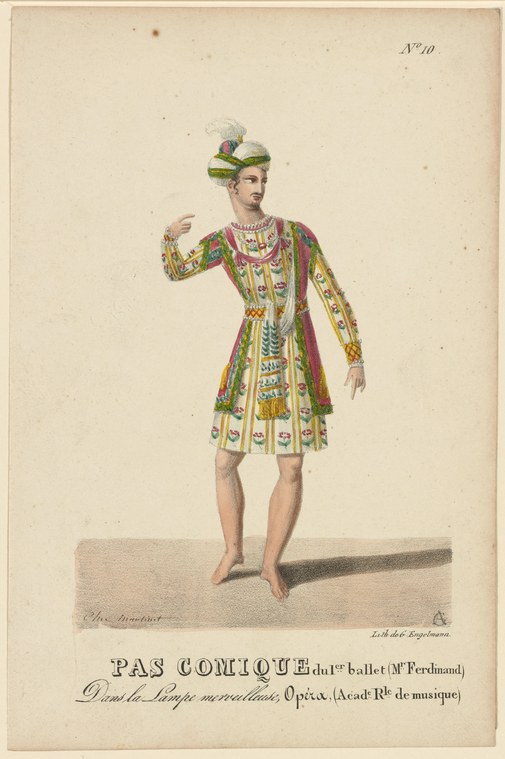
Pas comique du 1er ballet (Mr. Ferdinand). Dans La lampe merveilleuse, opera, (Acade. Rle. de Musique)
Unknown artist
- Collection:
- Prints depicting dance
- Source:
- New York Public Library
- Rights:
- Public domain — free to use, share and adapt.
- Recorded as:
- Public Domain
This print is a rare surviving record of a named performance at the Paris Opéra and shows how dance was understood and communicated to the public through costume, gesture, and theatrical presentation. It demonstrates that comic or character dance, though subordinate to noble ballet in the hierarchy of the period, was still documented and valued as a distinct theatrical category. For historians of 18th-century dance, it is evidence of the integration of dance, music, and visual spectacle in operatic performance and of how roles and techniques were differentiated by costume and genre.
What you are looking at
A single male dancer stands barefoot in a three-quarter pose against a pale neutral ground, with his shadow cast to the right. He wears an ornate tunic-like garment in cream or pale yellow, densely decorated with embroidered or printed patterns in red, blue, green, and gold—geometric designs, floral motifs, and what appear to be jeweled ornaments arranged symmetrically down the front and sleeves. A wrapped turban or decorative headdress in green and gold sits on his head. His left arm is raised with the hand positioned at roughly shoulder height in a gesture that appears gestural or expressive rather than decorative; his right arm hangs loosely at his side. His weight appears evenly distributed on both feet. The figure is rendered with delicate hand-coloring in this print, and the composition presents him as a figure study or costume documentation rather than as part of a narrative scene.
The dancing
The dancer's pose is upright and frontal, with the body held in an open, self-presenting manner. The raised left arm and hand position suggest a gestural or theatrical convention rather than a technical hold—the hand is open and the arm gently flexed, as if indicating something or making a narrative point. The stance is wide and stable, with weight evenly placed. There is no partner, and the gesture reads as a moment of address or expression rather than technical execution.
The dance depicted
The catalogue identifies this as the comic dance ('pas comique') from the first ballet in 'La lampe merveilleuse' ('The Wonderful Lamp'), an opera at the Académie Royale de Musique (the Paris Opéra). The costume and setting identify this as French theatrical dance of the 18th century, most likely the 1730s–1760s. 'Pas comique' indicates a character dance, a subordinate role or entertainment interlude distinct from the principal noble or serious dances; the ornate, exotic costume suggests a comedic or 'character' role—possibly a Chinese, Turkish, or other orientalised figure, which was common comic or exotic casting in period opera-ballet. The lightness of the pose, the theatrical gesture, and the frontal presentation all support the conventions of comic theater dance rather than serious ballet.
How it was made
This is a hand-colored engraving or etching, as established by the fine linear work, the planar background, and the evidence of watercolor application over a printed line. The delicate cross-hatching and the precision of the costume detail are characteristic of 18th-century dance documentation prints, which served as records of roles, costumes, and performers for the theatrical public and for archives. Such prints were widely distributed and affordable, making them primary sources for performance history. The hand-coloring adds specificity and appeal but also introduces variation between impressions.
About this work
This is a documentation print of a comic character dance from an 18th-century French opera-ballet, showing a single dancer in full theatrical costume. It belongs to a tradition of printed records of operatic and balletic roles that served audiences, historians, and the theatrical profession itself. The work demonstrates how comic or character dances were differentiated by costume, gesture, and presentation from the 'noble' ballet technique that was being codified in the same period. It is both a performance document and a record of how dance was culturized and categorized in institutional French theater.
How to look at it
Attend to the costume as a primary document: the symmetry, density, and ornamental quality of the embroidery or printing indicate a high-status, theatrical role, not a simple or servant character. The raised arm and open hand gesture are conventions of 18th-century theater acting and dance, not technical ballet vocabulary; they communicate character, emotion, or narrative. The barefoot stance and the neutral, frontal pose are typical of theatrical dance documentation prints of the period, which aimed to show the figure clearly and completely, in the manner of a fashion plate or a costume study. The ornate headdress and the pale, formal ground emphasize the role and the spectacle, not the movement itself.
The artist
The print is attributed to 'Chas. Bennatier' (or similar) as the draftsman and 'E.Desmadryl' [uncertain] as engraver, but neither figure is reliably documented. The work belongs to the French theater print tradition of the 18th century, in which performers and roles were recorded and distributed to audiences. Such prints were often sold in theater lobbies or by print sellers near the Opéra, making them commercial products as well as archives.
The period
In the early–mid 18th century, the Paris Opéra was the center of European theatrical dance, and ballet was being rapidly professionalized and systematized under the influence of teachers and choreographers like Michel Fokine's predecessors. At the same time, opera-ballet remained the primary vehicle for public dance performance; pure ballet as a independent art form was still developing. Comic or character dances, pantomime, and exotic roles were stock elements of operatic spectacle, often used for variety and comic relief. The costume and presentation conventions visible in this print—the orientalised dress, the frontal pose, the gestural arm—reflect both the exoticism and the comedic traditions of period theater.
Where it lives
The print is held in the New York Public Library's collection of prints depicting dance. It is part of a larger archive of 18th-century theater and dance documentation, which includes similar records of roles, performers, and costumes from European opera houses.
Dance in this work
Questions about this work
What does 'pas comique' mean?
'Pas comique' refers to a comic dance or character role in French theater of the 17th–18th centuries. It was subordinate to the 'pas noble' (noble or serious dance), which was the principal technical and dramatic form. Comic dances were often shorter, featured exaggerated or gestural movement, and were used for variety and entertainment. They were frequently performed by character actors or dancers in secondary roles.
How do we know this is from a specific opera?
The inscription at the bottom of the print reads 'Pas comique du 1er ballet (Mr. Ferdinand). Dans la Lampe merveilleuse, Opéra. (Acad. Rle. de musique).' 'Acad. Rle. de musique' refers to the Académie Royale de Musique, the official title of the Paris Opéra. The reference to 'Mr. Ferdinand' is likely the dancer's stage name or a pseudonym. The opera 'La Lampe merveilleuse' (The Wonderful Lamp) was performed at the Paris Opéra, though the date is not certain from this print alone.
What does the exotic costume tell us?
The ornate, richly patterned tunic and turban suggest an orientalised or exotic character role—possibly Turkish, Chinese, or from another imagined non-European setting. This was a common convention in 18th-century theater for comic and character roles, which often drew on orientalist fantasy and satire. The exotic costume would have signaled to audiences that this was a comic or character figure, distinct from the 'noble' ballet performers.
Why is the dancer barefoot?
Barefoot dancing was the standard in all theatrical dance of this period, including ballet. Shoes were not used for serious ballet until the 19th century (and only then for women, with the invention of the pointe shoe). The bare foot allowed for greater articulation, speed, and ease of movement, and it was also a convention of costume and spectacle that made the dancer's body visible and accessible to the audience.
More dance artwork





