49 works in this view — arrow keys or swipe to move between them.
Dance in Art
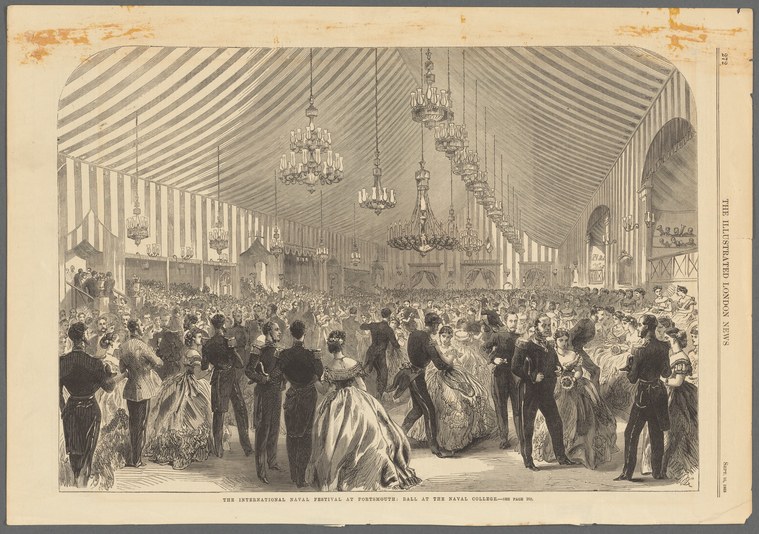
The international naval festival at Portsmouth: ball at the naval college
Unknown artist
- Collection:
- Prints depicting dance
- Source:
- New York Public Library
- Rights:
- Public domain — free to use, share and adapt.
- Recorded as:
- Public Domain
This print documents what a major state ball actually looked like—not a artist's fantasy but a news image intended to inform readers about a real event. It shows the relationship between dance, architecture, dress, and political occasion that defined Victorian elite social life, and it demonstrates the role of the illustrated press in distributing images of dance and courtship to a mass audience.
What you are looking at
A grand ballroom filled with formally dressed couples dancing under an ornate striped ceiling. The space is vast and elegantly appointed, with multiple crystal chandeliers suspended from the coffered ceiling and classical arches visible in the distance. The floor is crowded with dancers in evening wear—men in dark tailcoats, women in full-skirted light-colored ball gowns—moving across the polished floor. The composition draws the viewer's eye toward the distant end of the hall, suggesting the scale and formality of the event. The engraving style, with its careful cross-hatching and attention to architectural detail, creates a sense of occasion and grandeur appropriate to a state naval ball.
The dancing
Couples are distributed throughout the space in closed position, with men's right hands placed on women's backs and their left hands joined. The women's full skirts are caught mid-motion, creating volume and movement. Most dancers face toward the right or away from the viewer, suggesting forward motion and a unified direction of travel across the floor. The dancers' posture is upright and formal, consistent with Victorian-era ballroom propriety. While footwork is not visible in detail, the body weight and frame suggest a measured, processional movement rather than rapid steps.
The dance depicted
This is a formal Victorian-era ball, almost certainly featuring cotillion, quadrille, or waltz—the dominant social dances of the 1860s naval and court world. The closed position and forward-facing couples are consistent with either waltz or cotillion in a formal procession. The presence of numerous couples moving simultaneously across a large floor suggests a set dance such as a cotillion or grand march, rather than individual waltzes. The formal dress and institutional setting (a naval college ball during an international festival) indicates a state occasion where strict choreographic convention would be observed.
How it was made
This is a wood or steel engraving, identifiable by the fine parallel lines (hatching and cross-hatching) used to create tone and texture throughout the image. The technique allowed for mass reproduction in printed periodicals, and the composition and subject matter suggest this was made as a news illustration for a illustrated weekly or newspaper. The careful rendering of architecture, dress, and crowd detail indicates this was either drawn from life by an artist present at the event, or composed from sketches and descriptions by someone familiar with such occasions. The quality and detail suggest publication in a major British illustrated periodical of the 1860s.
About this work
This is a news engraving documenting a formal ball held during the International Naval Festival at Portsmouth. The work captures not a single dancing couple but the social spectacle of a state occasion—the architecture, the crowd, the formal propriety of Victorian ballroom culture. It belongs in a history of dance because it shows how dance functioned in the 19th century not as performance or competition but as the central social technology of elite gatherings. The image reveals the scale, formality, and gendered choreography of ballroom culture in an era when such occasions were among the most important public rituals of the state.
How to look at it
Observe the careful attention to the architecture and setting rather than to individual dancers' technique—the artist's purpose was to convey the grandeur and formality of the occasion, not to analyze the dance itself. Notice how all the couples face the same direction, suggesting they are part of a formal set dance rather than improvising their own paths. The full skirts and the slight forward lean of the male dancers suggest movement, but the overall composition emphasizes stasis and formation rather than a single moment of action. The artist has chosen a viewpoint that includes both the near figures and the receding architecture, creating a sense of belonging to an institution and occasion larger than any individual dancer.
The period
The International Naval Festival at Portsmouth was held in 1865, marking an important moment of Anglo-French naval cooperation and international diplomacy. In this period, the ballroom waltz and cotillion were at the height of their social and cultural authority, taught to every person of rank and performed at every state occasion. The illustrated press—publications like the Illustrated London News—had by the 1860s developed the technique of sending artists to major events to record them through wood engraving, a technology that allowed mass circulation of topical images within days of the event. This engraving is part of that media ecosystem: it brought news of the ball to readers across Britain and the empire.
Where it lives
This print is held in the New York Public Library's collection of prints depicting dance. It appears to be a contemporary news engraving from an illustrated periodical or bound collection of such prints.
Dance in this work
Questions about this work
What was the International Naval Festival?
The International Naval Festival at Portsmouth in 1865 was a major diplomatic and social occasion celebrating Anglo-French naval cooperation. It included naval displays, civic ceremonies, and formal balls such as the one shown here. Major state occasions were documented in the illustrated press for circulation to the reading public.
What dance is being performed?
The closed position and forward-facing couples suggest either a waltz or a formal cotillion. The presence of many couples moving together across the floor indicates this is likely a set dance such as a cotillion or grand march rather than individual waltzes. Without closer detail of footwork or a musical score, the specific dance cannot be determined with certainty.
Who is dancing?
The dancers are members of the naval and civil elite attending a state ball—officers, their wives, dignitaries, and their families. The formality of dress and the institutional setting indicate these are people of rank and education, for whom ballroom dancing was a required social skill.
How was this image made?
This is a wood or steel engraving, a relief printing technique that allowed mass reproduction in newspapers and periodicals. An artist attended the event (or worked from descriptions and sketches) to create a detailed image that could be carved into a printing block and reproduced for publication. The technique allowed illustrations of topical events to reach thousands of readers within days.
More dance artwork





