49 works in this view — arrow keys or swipe to move between them.
Dance in Art
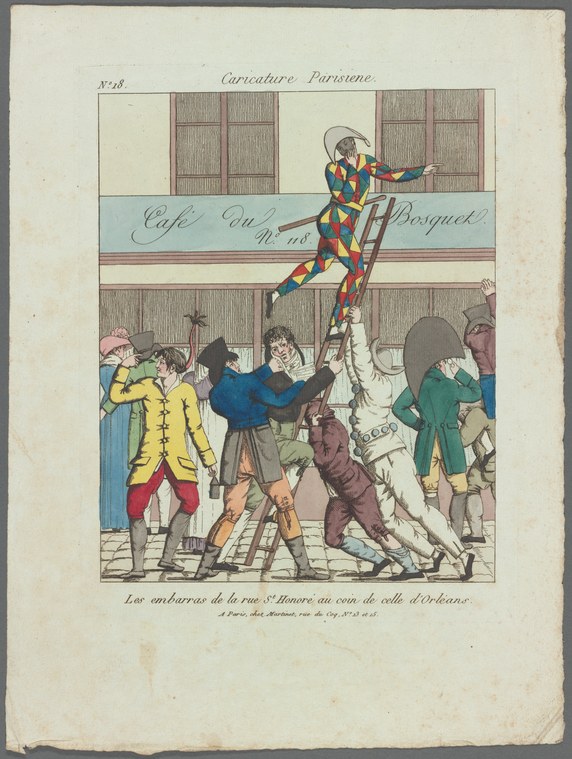
Les embarras de la rue St. Honoré au coin de celle d'Orléans
Unknown artist
- Collection:
- Prints depicting dance
- Source:
- New York Public Library
- Rights:
- Public domain — free to use, share and adapt.
- Recorded as:
- Public Domain
The print documents a form of acrobatic street performance that is rarely preserved or studied, yet represents a significant thread in the genealogy of acro-dance and theatrical spectacle. It shows the performer's body, costume, and the public reception in vivid detail, capturing both the physical technique and the cultural moment in which such performances were entertainment for urban crowds. For historians of circus, street performance, and the body in early 19th-century France, this is a primary source.
What you are looking at
A street scene outside the Café du Bois d'Orléans in Paris captures an acrobatic performer suspended mid-leap above a crowded sidewalk. The building façade rises four stories with tall shuttered windows; the café occupies the ground floor with its name painted across the storefront. Below, roughly a dozen Parisians of mixed status—women in bonnets and shawls, men in coats and breeches—stand or gesture upward in astonishment and alarm at the figure above them. The acrobat, dressed in a tight-fitting multicolored diamond-patterned costume, hangs nearly horizontal against the building's face, one arm extended upward as if clinging to the wall, the other outstretched in balance. The print is colored by hand in pastels—blues, greens, yellows, reds—and the crowd's poses suggest a moment of genuine danger: some onlookers recoil, others reach up, a woman shields her face. The street furniture is minimal; the focus is entirely on the collision between the performer's impossible suspension and the orderly urban world beneath him.
The dancing
The acrobat's body is stretched nearly horizontal, with legs extended, one arm reaching upward toward the building, the other extended outward for balance. The weight appears to be supported against the facade itself—this is wall-climbing or facade acrobatics, not mid-air suspension. The crowd below displays reactive gestures: several figures look upward with hands raised, mouths open; one woman turns away; another appears to be reaching or pointing. The costumer's form shows trained muscular control and the kind of hyper-extension typical of professional acrobats. The crowd's varying postures—some standing rigid, others leaning in—suggest both fascination and fear, which is the emotional core of the print.
The dance depicted
This is street acrobatics or facade performance, a branch of acro-dance that sits at the boundary between theatrical display and street entertainment. The scene depicts an improvised or semi-formal street performance, likely early 19th-century Paris, where such performers would entertain crowds in public spaces and outside commercial establishments. The acrobat's costume—the tight diamond-patterned suit—was standard dress for traveling acrobats and street performers of the period. The title specifies the Rue Saint-Honoré at the corner of Rue d'Orléans, a named location, suggesting either a documented event or a popular performance spot. The performance mode is neither dance nor circus in the formal sense, but rather one of the acrobatic street arts that fed into later theatrical acro-dance forms.
How it was made
This is a hand-colored engraving or etching, a medium typical of French popular prints of the late 18th and early 19th centuries. The fineness of the line work and the precision of the architectural detail suggest engraving; the hand coloring in opaque watercolor or gouache is uneven and creates a folk-art quality despite the print's commercial manufacture. This technique allowed for mass production and distribution—such prints sold cheaply in Paris and were collected in series on contemporary events and curiosities. The colored engraving format was the dominant medium for capturing topical scenes, street life, and spectacular performances before lithography supplanted it. The print's presence in institutional collections (here, the New York Public Library) confirms its status as a commercial popular print rather than a unique work.
About this work
This hand-colored engraving captures a moment of street acrobatics in early 19th-century Paris, showing a performer in a diamond-patterned suit suspended against the facade of a building while a crowd of Parisians gathers below in wonder and alarm. The work is a documentary of urban entertainment culture and a record of acrobatic technique as practiced in public space. It belongs in a dance gallery not because the acrobat is dancing—he is not—but because acro-dance encompasses the controlled suspension and hyper-extension of the human body in space, and street acrobatics represent a vernacular lineage that runs through vaudeville into contemporary performance. The specificity of the location (Rue Saint-Honoré, corner of Rue d'Orléans) and the commercial quality of the print suggest this was either a documented event or a celebrated performance spot, making it a historical record of where and how this form was practiced.
How to look at it
Look first at the acrobat's posture and the point of contact: he is not flying, but clinging and climbing. The performer's body is taut and extended, showing the core strength and training required. Then study the crowd's reactions—the upward gazes, the raised hands, the woman turning away—which tell you both the rarity and the danger of the act. Notice the precision of the architectural drawing: this is a real building, a real street, which suggests the print-maker was documenting a documented event. The hand coloring adds urgency and immediacy; the diamond pattern of the acrobat's suit makes him the visual focal point against the muted building. Finally, note the social composition of the crowd: these are not aristocrats at a theatre, but ordinary Parisians, which is the point—this is street entertainment, not court spectacle.
The artist
The artist is not recorded. The work is attributed to the tradition of Parisian popular engravings produced for street sale, a commercial practice rather than fine art. Such prints were made by engravers and colorists working in workshops; attribution is often impossible unless signed. The style and technique place it within the tradition of *Caricature Parisienne* and topical prints that captured contemporary events, scandals, and curiosities for a broad urban audience. The series number (No. 48) suggests this was part of a larger collection of contemporary scenes.
The period
The early 19th century saw a boom in street acrobatics and carnival performance in Paris, fueled by returning soldiers, itinerant performers, and the growth of public leisure space in the expanding city. At the same time, popular engraving was at its height as a medium for capturing and disseminating images of contemporary life. The Rue Saint-Honoré was a major commercial street, making it a natural gathering place for street performers. The hand-colored engraving format was dominant for such documentary imagery before the rise of lithography and photography later in the century. The crowd's dress and the architectural style suggest the 1810s–1820s, a period when Parisian street life and urban spectacle were frequent subjects for popular prints.
Where it lives
The work is held by the New York Public Library in its collection of prints depicting dance. It is a commercial popular engraving, likely produced in Paris and distributed for sale to collectors of contemporary scenes. The series number (No. 48) indicates it was marketed as part of a numbered sequence, a standard practice for such prints.
Dance in this work
Questions about this work
Is the performer actually dancing?
No. This is acrobatics—specifically, facade climbing or wall acrobatics. The performer is suspended and supported by the building itself, not moving through choreographed steps. However, acro-dance as a category includes all trained, virtuosic uses of the acrobatic body in performance space, and street acrobatics are a historical precursor to modern acro-dance forms.
Where was this performance?
The title specifies the Rue Saint-Honoré at the corner of the Rue d'Orléans in Paris. This was a major commercial street, and the Café du Bois d'Orléans appears to have been a real establishment. The specificity suggests either that this was a documented or notorious performance, or that the café was a known venue for street entertainers.
What does the performer's costume tell us?
The tight-fitting, diamond-patterned suit was standard dress for traveling acrobats and street performers in the early 19th century. It allowed for unrestricted movement and made the performer highly visible. The bold pattern also served as a costume that marked him as a professional entertainer, distinguishing him from ordinary citizens.
Why are the crowd's reactions so varied?
The print captures a genuinely dangerous or startling moment. The crowd is experiencing real fear and astonishment at an acrobatic feat that violates ordinary expectations of how the body can move through space. Some onlookers recoil, others are transfixed—this mixed response is what made such street performances compelling and gave them their value as entertainment.
More dance artwork





