49 works in this view — arrow keys or swipe to move between them.
Dance in Art
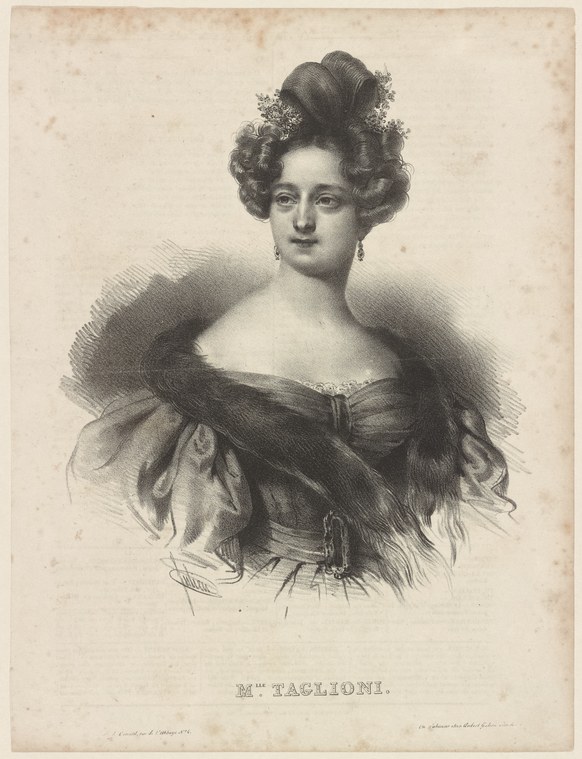
Mlle. Taglioni
Unknown artist
- Collection:
- Prints depicting dance
- Source:
- New York Public Library
- Rights:
- Public domain — free to use, share and adapt.
- Recorded as:
- Public Domain
Taglioni is to Romantic ballet what Nijinsky is to Modernism—the dancer who defined an era and changed what was possible in the art form. This portrait preserves her image during the period when she created and performed the roles that remain in the repertoire today. For historians of dance, fashion, and 19th-century celebrity, this print documents how the most famous dancer of her time was publicly presented and consumed.
What you are looking at
A bust-length portrait of a woman in early 19th-century dress, rendered in fine engraving or steel-plate technique. She is shown from the shoulders up, turned slightly to one side with her gaze directed toward the viewer. Her dark hair is arranged in the fashionable style of the 1830s–1840s, piled high on the crown with curls framing the face. She wears a low-cut evening dress of sheer fabric—likely silk or gauze—that falls off the shoulders in the Romantic period style, with a delicate shawl or wrap of gossamer material draped loosely across her back and shoulders. The lighting is soft and modeled, creating volume in her face and shoulders while the background remains neutral and pale. The inscription beneath reads "M.lle TAGLIONI," identifying the subject. The print appears to be a commercial portrait, likely a theatrical publicity image or commemorative print.
The dancing
The figure is stationary and posed for the portrait, not captured mid-movement. Her posture is upright and dignified, shoulders relaxed and slightly back. The soft, bare-shoulder positioning of her dress and the elegant angle of her head suggest the refined bearing expected of a prima ballerina, but no active dance gesture is visible. The draping of the gossamer wrap and the turn of her shoulders convey ease and grace rather than exertion.
The dance depicted
This is Marie Taglioni (1804–1884), the Swedish-Italian prima ballerina and founder of Romantic ballet, one of the most celebrated dancers of the 19th century. The portrait does not depict her dancing but rather presents her in the formal dress of a prominent theatrical performer of her era. Taglioni was famous for her ethereal technique, her role in *La Sylphide* (1832), and her elevation of the pointe shoe as a central element of classical ballet vocabulary. The modest elegance and restraint of her dress in this image reflects the refined aesthetic she embodied on stage.
How it was made
This is a steel-plate or copper-plate engraving, a reproductive print technique that allowed for fine linear detail and tonal subtlety through cross-hatching. The delicate modeling of her face, the soft gradations in the fabric, and the fine rendering of curls and drapery are characteristic of engraving at the highest level of finish. Such prints were produced in commercial quantities and distributed widely among theater-goers, fans, and collectors as promotional or commemorative merchandise. The technique and finish suggest a professionally executed work, likely produced by a specialized printmaker rather than the artist of the original design.
About this work
This is a portrait engraving of Marie Taglioni, the defining prima ballerina of the Romantic era and creator of the role of the Sylphide. Although not a depiction of dance itself, it is a precious record of how the most celebrated dancer of her time was represented to the public—not in performance costume but in the refined, off-stage dress of an artist of the highest social standing. The image belongs in a dance collection because Taglioni's career and aesthetic transformed ballet into its modern form, and because such prints shaped how her contemporaries imagined her artistry and her person.
The print dates from the height of her fame, likely the 1830s–1840s when she was at the center of European ballet. It reveals how Romantic-era dancers were marketed and commemorated: as refined, ethereal beings whose off-stage appearance was as carefully curated as their stage persona. The portrait circulated among the growing middle-class theater audience that made Taglioni an international celebrity.
How to look at it
Notice the complete absence of any dance costume or pointe shoe. This is Taglioni in formal dress, not performance attire—yet the portrait conveys a sense of lightness and grace that reflects her stage identity. The artist's choice of the low-shouldered, high-waisted dress of the period, combined with the soft draping and the turn of the head, suggests the refined, almost weightless carriage for which she was famous. The engraver has rendered her face with fine modeling and clarity, emphasizing her features as a recognizable portrait rather than an idealized type. The inscription anchors the image as a specific person, a celebrity to be identified and collected.
The artist
The artist of this engraving is not recorded in the catalogue. The style and finish suggest a professional reproductive printmaker working in London or Paris in the 1830s–1840s, producing portraits of celebrated theatrical performers for a paying public. Such prints were often after paintings or drawings by better-known portrait artists, but the engraver's name was sometimes omitted from the plate.
The period
The 1830s–1840s were the height of the Romantic movement in ballet and the visual arts. In dance, this was the era of *La Sylphide*, *Giselle*, and the cult of the ballerina—when women dancers in ethereal roles and pointe shoes replaced male dancers in prominence. In printmaking, steel-plate engraving was the dominant technology for reproducing portraits and theatrical imagery, circulating widely and affordably. Taglioni's fame coincided with the rise of mass-market portraiture and the first modern celebrity culture. The soft, idealized aesthetic of this portrait—the gossamer drapery, the pale complexion, the ethereal bearing—visually embodies the Romantic ideal of feminine grace that her dancing helped to create.
Where it lives
This engraving is held in the Prints collection of the New York Public Library. It is a commercial reproductive print, one of many thousands produced to circulate images of famous performers among theatergoing public of the 19th century.
Dance in this work
Questions about this work
Is this Taglioni dancing?
No. This is a portrait of her in off-stage evening dress, likely produced as a commemorative print or theatrical souvenir. It is not a depiction of her in performance or in the act of dancing. However, the refined bearing and ethereal aesthetic visible even in this static pose convey something of the quality for which she was famous.
When was this made?
The catalogue record does not provide a date. Based on the style of dress, hair arrangement, and the technology of the engraving, it likely dates from the 1830s–1840s, when Taglioni was at the height of her international fame. A more precise date would require consultation of print archives or theater records.
Who was Taglioni and why is she important?
Marie Taglioni (1804–1884) was a Swedish-Italian prima ballerina who created and performed in *La Sylphide* (1832), widely considered the first Romantic ballet. She brought the pointe shoe into regular use and embodied the ethereal, weightless aesthetic that defined Romantic dance. She was the most famous dancer of her era and shaped ballet into its modern form.
What is an engraving and how was it made?
This is a steel-plate or copper-plate engraving, a reproductive print technique in which an image is incised into a metal plate with a burin (engraving tool) and then inked and printed on paper. The fine linear marks visible in the image—particularly in the hair, drapery, and face—are characteristic of this technique. Engravings allowed artists to produce multiple identical copies, making them ideal for distributing portraits of famous performers.
More dance artwork





