49 works in this view — arrow keys or swipe to move between them.
Dance in Art
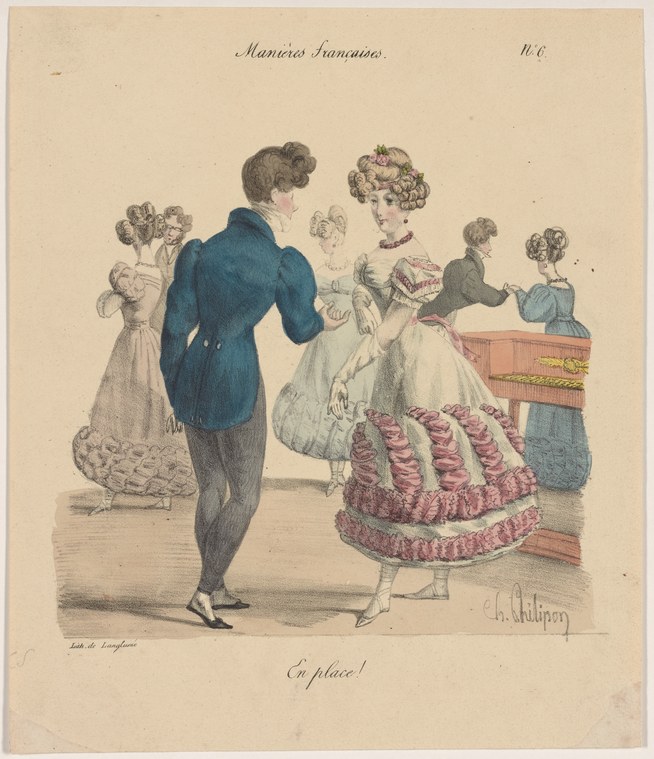
Manières françaises, en place!
Unknown artist
- Collection:
- Prints depicting dance
- Source:
- New York Public Library
- Rights:
- Public domain — free to use, share and adapt.
- Recorded as:
- Public Domain
This print documents the social choreography of Regency-era ballroom culture in precise visual detail: the dress codes, the spatial arrangements, the gendered postures of politeness and deference that governed who danced with whom and how. For dance historians, it captures the threshold moment—the pause between social life and formal dance—that reveals how deeply dance was embedded in class ritual. For costume and social historians, it is an invaluable record of women's fashionable dress at the moment of its greatest complexity and expense.
What you are looking at
A fashionable social dance scene set indoors, with a polished wooden floor and what appears to be a piano or furniture piece visible at right. The composition is crowded with figures arranged in a loosely grouped formation. In the foreground, a man in a dark blue coat with buttons stands facing a woman in an elaborate white dress with a dramatically gathered skirt trimmed in deep rose-colored ruching or pleating that extends from her hips in multiple voluminous rows. The man leans toward her in a deferential posture, one arm extended. Behind this couple, at least four other pairs are visible—some merely sketched as heads and shoulders—suggesting a ballroom full of dancers. The women wear white or pale muslin gowns with minimal trim; the men wear dark coats. The lighting is even and suggests daylight or good artificial illumination. The title 'En place!' (In position!) inscribed below indicates this is the moment before the dance begins, when couples are taking their places.
The dancing
The central couple stands apart, not yet in closed hold—the man bows slightly with arm extended in invitation or acknowledgment, while the woman faces him with her body upright and composed, her weight evenly distributed. Their separation suggests the preliminary moment before contact. The surrounding couples stand at various distances apart, some closer together, others merely suggested as distant spectators or waiting participants. The artist captures the particular stillness and formality of ballroom protocol: bodies are controlled, postures are upright, and there is no sense of movement in progress.
The dance depicted
This depicts the formal opening of a French ball or cotillion, specifically the moment when couples are 'en place'—arranged in formation before dancing begins. The extreme fashionability of the women's dress and the refinement of the setting identify this as upper-class European social dance, most likely from the early 19th century. The composition and social conventions point toward a cotillion, quadrille, or similar formation dance common at Regency-era balls, where the dance was preceded by a formal ritual of positioning and acknowledgment. The title's French language and the elegant engraving style confirm this is documentation of fashionable Parisian or Continental European ballroom custom.
How it was made
This is a hand-colored engraving or lithograph, evident from the fine line work in the figures' faces and clothing and the careful cross-hatching used to model the men's coats and create shadow. The colored washes—the man's dark blue coat, the rose-colored ruching, the pale muslin gowns—are applied over the printed line, a technique common in popular fashion and social satirical prints of the 1820s–1840s. The signature 'A. Philippon' is visible at lower right. This medium allowed wide circulation as an affordable print for middle-class consumption, distributed through print shops as a record of current fashionable behavior and as a gentle satire of ballroom manners.
About this work
This is a colored engraving depicting the formal opening ritual of a French ballroom dance, captured at the precise moment when couples arrange themselves before the music begins. The title 'Manières françaises, en place!' (French Manners, In Position!) and the inscription below establish this as social commentary on contemporary Parisian ballroom protocol. It belongs to a substantial body of early 19th-century satirical and documentary prints that used dance as a lens onto fashionable society, its pretenses, and its carefully codified rituals. The work records not the dance itself but the ceremony that precedes it—a moment of high formality and decorum that the artist treats with gentle humor.
How to look at it
Attend to the spatial arrangement and the body language: notice how the foreground couple stands at a distance, the man in a posture of formal greeting rather than embrace, and how the surrounding pairs are clustered or scattered, some sketched lightly as mere background. The artist is interested in the formality and slight awkwardness of the moment—the pause before dancing begins, when social rules govern every gesture. The woman's extravagant skirt, with its elaborate ruching, dominates the composition visually; it is both fashionable magnificence and gentle satire of excess.
The artist
Achille Devéria (often signed as A. Devéria or Philippon, as here) was a prolific French lithographer and engraver active in the 1820s–1840s, known for satirical and documentary prints of Parisian fashionable life. His work frequently focused on ballroom scenes, fashion, and the absurdities of upper-class social ritual. He worked in a tradition of social satire and observation shared by Honoré Daumier and others, using the intimacy and reproducibility of the print medium to distribute commentary on contemporary manners to a wide audience.
The period
This work dates to the Restoration or July Monarchy period in France (circa 1815–1848), when the return of the aristocracy and the rise of a wealthy bourgeoisie created intense new interest in ballroom dancing and fashion display. The waltz and cotillion were the dominant ballroom dances, and the ritual of formal introduction and placement before dancing was an essential part of courtship and social standing. At the same moment, printed satirical and documentary images of ballroom life were enormously popular, feeding both fascination with and mockery of fashionable society.
Where it lives
This work is held in the NYPL's prints collection depicting dance. It is catalogued as part of their holdings of historical dance imagery but lacks complete cataloging data; the date and medium are not recorded in the current entry.
Dance in this work
Questions about this work
What dance is being performed here?
No dance is being performed—the print captures the moment immediately before dancing begins, when couples are taking their positions. This is likely the opening of a cotillion or quadrille, dances that required formal arrangement before music began. The title 'En place!' makes this ritual moment the subject of the image.
Why is the woman's skirt so elaborate?
This level of decoration—gathered, pleated, and trimmed in expensive ribbon or silk—was the height of fashionable dress for ballroom dancing in the 1820s–1830s. The exaggerated volume visible here is both accurate to the period and a target of gentle satire; the artist is commenting on the extremes of fashion display in ballroom culture.
What do the couple's postures tell us about the dance they are about to perform?
Their upright, formal stance and the distance between them suggest a dance with clear protocols of politeness and restraint. The man's deferential gesture and the woman's composed waiting indicate dances like the cotillion or quadrille, where partners were not in continuous close contact and where social hierarchy and courtesy were expressed through positioning and movement.
Is this an engraving or a lithograph?
Based on the line work and the technique, this appears to be an engraving with hand coloring. The fine detail in the faces and the careful modeling of the fabrics suggest engraving, while the soft washes of color were added by hand after printing. This was a common technique for affordable fashion and social prints in early 19th-century Paris.
More dance artwork





