49 works in this view — arrow keys or swipe to move between them.
Dance in Art
The German dancing master
Unknown artist
- Collection:
- Prints depicting dance
- Source:
- New York Public Library
- Rights:
- Public domain — free to use, share and adapt.
- Recorded as:
- Public Domain
This image is primary evidence for how minuet instruction actually worked: the role of the violin, the postures and extensions expected, and the pedagogy of courtly dance in the 18th century. It documents the dancing master as a professional and a social figure, and shows that dance education was formalized, systematic, and closely tied to aristocratic identity and aspiration.
What you are looking at
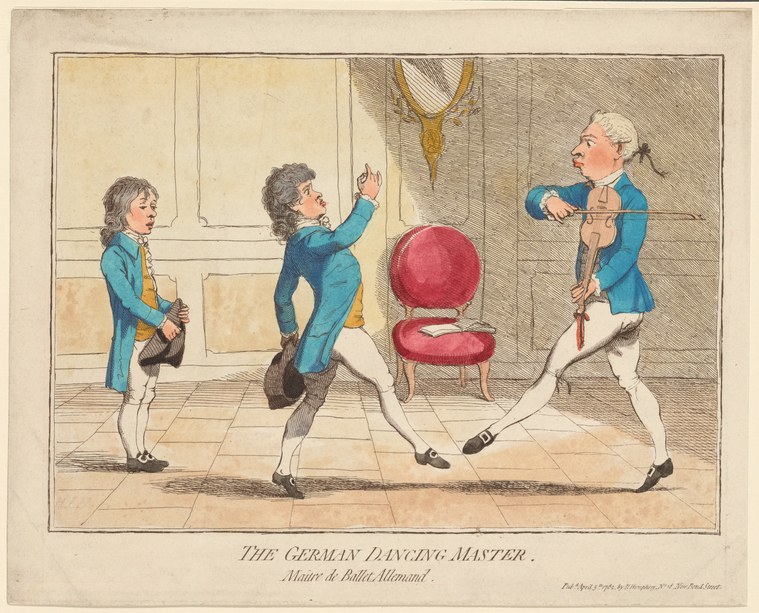
An interior scene of a dance lesson, shown in hand-coloured engraving. A German dance master in a blue coat and white breeches stands at right, violin in hand, instructing three young male pupils. The two pupils in the foreground are actively dancing—one gestures upward with one hand while executing a step, the other leaps with legs extended—while a third boy stands at left watching. A red upholstered chair and a hunting trophy (antlers mounted on the wall) furnish the practice room, whose walls are rendered with classical panelling. The scene is lit evenly across the composition, emphasizing the formal geometry of the lesson: master at right, pupils arranged before him in various stages of execution.
The dancing
The two active dancers display the balletic posture and turnout expected of 18th-century aristocratic male dancers. The dancer in the foreground center stands with one leg extended behind, torso upright, one arm raised; the other executes a high leap with both legs bent, arms in motion. The master holds his violin ready, conducting the lesson with evident authority. All three pupils are dressed in matching blue coats and white breeches—the uniform of a dance class—suggesting this is formal instruction in courtly deportment rather than casual movement. The seated or watching pupil at left maintains an erect, attentive posture.
The dance depicted
This is an image of minuet instruction, the foundational social and courtly dance of the 18th century. The title explicitly identifies the figure as a German dancing master; such professionals were essential to aristocratic education across German-speaking lands. The pupils' posture, the violin accompaniment, and the formal interior setting all confirm this as a teaching scene centred on the minuet and its cognate court dances. The particular moment chosen—with pupils at different stages of execution—captures the pedagogical process: demonstration, imitation, and correction. The engraving documents both the dance form and the social institution of the dancing master's studio.
How it was made
This is a hand-coloured engraving, a technique that allowed fine detail and precise line work ideal for capturing both the subtleties of posture and the architectural setting. The engraving would have been widely distributed and affordable for a middle-class market, making it both a record of courtly practice and a commodity aimed at those aspiring to it. The colour—applied after the engraved line—picks out the blue coats and red upholstery with clarity, while the crosshatching in the background creates spatial depth. This technique placed the work within a European print culture of instructional and satirical images of dance.
About this work
A hand-coloured engraving documenting the teaching of minuet and court dance in an 18th-century German studio. The print preserves not only the postures, steps, and musical accompaniment of aristocratic dance instruction, but also the social structure of the lesson itself—the authority of the master, the graduated learning of the pupils, and the formal dress and deportment required. Such images circulated widely in print culture and served both as records of actual practice and as aspirational guides for those seeking to acquire courtly accomplishment. The work belongs in a gallery of dance imagery because it captures a specific historical moment when dance was integral to elite education and when the dancing master was a recognizable professional figure across European courts and capitals.
How to look at it
Watch the postures of the two active dancers: notice the turned-out legs, the lifted spine, and the lifted arms—the formal, geometric frame that distinguishes the minuet from other dances. Observe that the master stands apart with his violin, neither dancing nor touching the pupils, but controlling the music and time. The moment captured is one of active practice rather than performance; this is the studio, not the ballroom or theatre stage. The artist has chosen to show the labour and instruction behind courtly grace, not its effortless display.
The period
The minuet dominated European aristocratic social and theatrical dance from the early 18th century through the 1780s. It was danced at court, in the theatre, and in the dance studios and assembly rooms where the aspiring middle class sought to acquire gentility. German dancing masters, trained often in France or Italy, commanded respect and fees sufficient to maintain studios like the one depicted here. By the period this print was made, the minuet's reign was challenged by the quadrille and the cotillion, but instruction in its form remained essential to any claim to refinement. Print culture, including satirical and instructional images of dance, flourished in the same period, making images like this both documentation and merchandise.
Where it lives
The work is held in the New York Public Library's Prints collection, which preserves visual culture related to dance, theatre, and social life. It is catalogued simply as a depiction of dance and identified only by its title and subject.
Dance in this work
Questions about this work
What dance is being taught here?
The minuet, the dominant courtly and social dance of the 18th century. The posture, the violin accompaniment, and the formal interior setting all confirm this. Minuet instruction was a standard part of aristocratic and genteel education.
Who was a dancing master and what did he do?
A dancing master was a professional musician and pedagogue, trained in the forms and steps of courtly dance. He maintained a studio, taught aspiring aristocrats and the prosperous middle class, and was paid fees that reflected his status. This print shows him at work: directing the lesson with his violin, correcting posture, and guiding the execution of steps.
Why are there three pupils at different stages?
The artist has shown the progression of learning: one pupil watches from the side, one executes a step, and one attempts a more advanced jump or extension. This narrative composition suggests that dance instruction was sequential and that mastery required sustained practice.
What does the setting tell us?
The panelled walls, the furniture, and the mounted trophy indicate a room in a house or studio maintained for dance instruction. This was not a theatre or a courtyard, but a dedicated, formal space—a sign that dance was valued enough to warrant investment in proper facilities.
More dance artwork





