49 works in this view — arrow keys or swipe to move between them.
Dance in Art
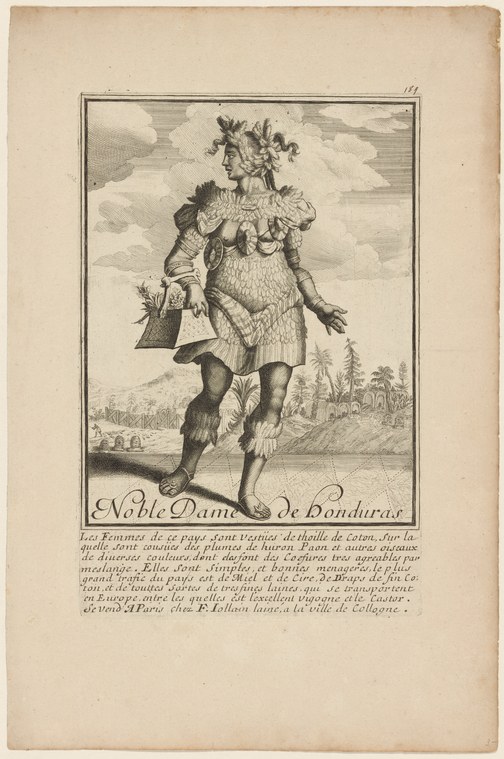
Noble dame de Honduras
Unknown artist
- Collection:
- Prints depicting dance
- Source:
- New York Public Library
- Rights:
- Public domain — free to use, share and adapt.
- Recorded as:
- Public Domain
This work preserves a visual record of how European court culture and theatrical entertainment imagined and performed exoticism and otherness in the early modern period. For dance historians, it documents not a named dance technique but a moment in the history of dance as spectacle and costume—the use of movement, dress, and gesture to embody fantasy and to entertain an elite audience. The work also reveals the role of the engraving as a technology for disseminating knowledge of courtly performance and costume across Europe.
What you are looking at
A single female figure dominates this engraving, posed in a dynamic standing position against a landscape background. She wears an elaborate costume comprising a patterned bodice with white puffed sleeves, a short decorative skirt or overskirt, and what appears to be fur or feathered leg coverings. Her headdress is ornate and feathered, and she holds a large fan or decorative object in her left hand. Her right arm is extended outward in a gesture of presentation or display. The background shows a distant landscape with trees and possibly architectural elements. The figure's pose suggests movement or performance rather than repose—her body is angled, her weight appears shifted, and her overall bearing suggests she is demonstrating or enacting something for an audience. The engraving is finely executed with careful cross-hatching to create shadow and volume.
The dancing
A single dancer or performer stands with her weight shifted to one side, her body twisted in a contrapposto-like stance. Her right arm extends outward at shoulder height in an open, presentational gesture; her left arm holds aloft a large fan or similar object. Her head is turned to face the viewer. Her legs are apart in a wide stance, and she appears to be on or near the balls of her feet, suggesting an elevated or energetic posture. The absence of closed holds and the frontal, display-oriented pose indicate this is a solo performance or parade rather than a partnered dance.
The dance depicted
This image most likely documents a figure from a masquerade, pageant, or theatrical entertainment rather than a vernacular social dance. The costume—particularly the feathered headdress, the patterned bodice, and the fur or feathered leg coverings—suggests either a fantastical or exotic character, possibly drawn from the commedia dell'arte, court spectacle, or early modern theatrical traditions. The title 'Noble dame de Honduras' (a phrase that plays on the exotic and the fictional, given Honduras's 16th-century significance in European imagination) suggests this represents an invented or stylized character type rather than an actual regional dance. The pose and gesture are those of display and presentation to an audience, consistent with theatrical or court performance contexts. The French caption below the image would have explained the figure's significance to contemporary viewers.
How it was made
This is an engraving, executed with fine lines and careful cross-hatching to create modulation of light and shadow across the figure's form and costume. The technique allowed for detailed rendering of textile patterns and ornamental details—the lace of the bodice, the embellishments of the skirt, the feathering of the headdress—and for wide circulation through printing. Engravings of this type, often collected in series, served as documents of costume, character types, and theatrical or courtly entertainments. The precision and the careful composition suggest this was a work of some ambition, likely created for an educated audience familiar with court spectacle or theatrical traditions.
About this work
This engraving documents a single elaborately costumed figure—titled 'Noble dame de Honduras'—posed in an attitude of theatrical presentation. The identity of the artist is not recorded, but the work belongs to a tradition of early modern prints that documented court spectacles, masquerades, and theatrical characters, often organized in series to be collected or circulated among educated viewers. The figure's costume, pose, and the French inscription suggest this is neither a portrait of an actual woman nor a representation of a vernacular dance, but rather a character type from a courtly or theatrical entertainment—an invented 'exotic' persona designed to amuse and impress. Such prints were valuable documents of how dance, costume, and performance intersected in early modern European court culture and popular spectacle.
How to look at it
Attend to the figure's pose: the way her body is twisted, her weight shifted, her arms at different heights and angles. This is not a naturalistic standing position but a composed, theatrical one—a moment frozen that communicates both her character and her readiness to move or perform. Notice how the engraver has used line and shadow to suggest the texture and weight of her costume, especially the patterned bodice and the feathered elements, which would have been visually striking in performance. The fan or object in her hand is a prop of display and aristocratic bearing; her extended arm and turned head address an imagined audience directly.
The period
This engraving belongs to a tradition of early modern European theatrical and courtly documentation, likely from the 16th or 17th century, though the exact date is unknown. Court masquerades, ballets de cour, and theatrical spectacles were major forms of courtly entertainment during this period, particularly in France and Italy. These events often featured elaborate costumes, exotic character types, and choreographed movement. The tradition of printing and collecting images of theatrical characters and costumes was well established, serving both as records and as inspiration for future performances. The title's reference to Honduras reflects the period's fascination with the Americas and the 'exotic,' a fascination that fed into the design and performance of courtly entertainments.
Where it lives
This engraving is held in the New York Public Library's collection of prints depicting dance. The work has minimal accompanying documentation in the catalogue record; the artist is unknown, and the date is unrecorded, though stylistic analysis of the engraving technique and costume design would likely narrow these down.
Dance in this work
Questions about this work
What is the 'dance' in this image?
This is not documentation of a named dance technique or style, but rather a single figure posed for theatrical or courtly display. The 'dance' is performance and spectacle—the embodied presentation of a character type to an audience. The pose and gesture are theatrical rather than balletic or folk-vernacular.
What does 'Noble dame de Honduras' mean?
The title plays on the exotic and the invented. Honduras held significant symbolic weight in early modern European imagination as part of the newly discovered Americas. The title suggests this is a fantastical or stylized character created for courtly entertainment, not a historical or ethnographic representation. The engraving likely came with a longer caption or text explaining the character's role in a specific performance or spectacle.
How would I have encountered this image in the early modern period?
As a print in a bound collection of similar images, likely acquired by a person of education and means interested in court culture, theatrical innovations, or costume design. Such prints were often gathered into albums and circulated among courtiers, artists, and patrons. They served as records of past performances and as inspiration for future ones.
What does her costume tell us?
The patterned bodice, puffed sleeves, ornate headdress, and fur or feathered leg coverings are theatrical costume—elements chosen for visual impact and for the character they evoked. The precision with which the engraver rendered these details suggests their importance to viewers. The costume marks her as neither an ordinary noblewoman nor a historical figure, but a invented character type designed to surprise and delight an elite audience.
More dance artwork





