49 works in this view — arrow keys or swipe to move between them.
Dance in Art
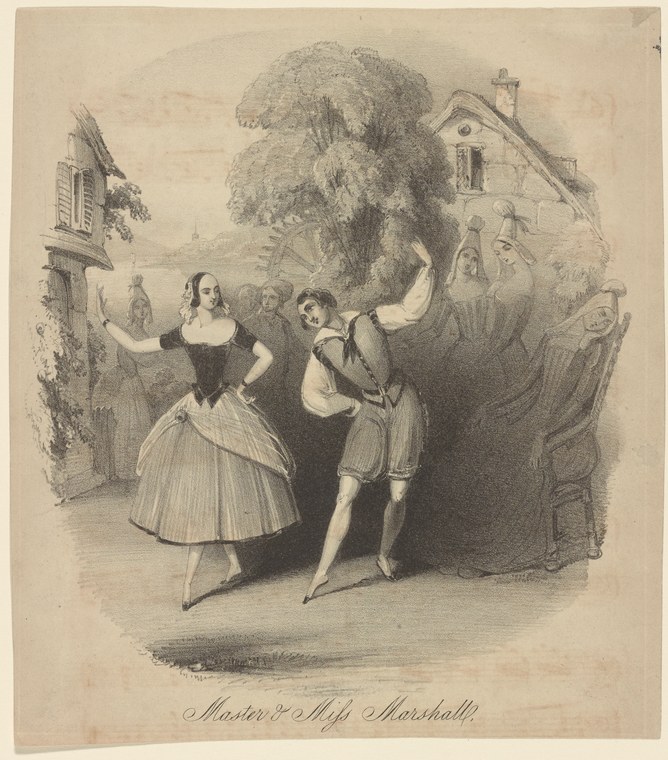
Master & Miss Marshall
Unknown artist
- Collection:
- Prints depicting dance
- Source:
- New York Public Library
- Rights:
- Public domain — free to use, share and adapt.
- Recorded as:
- Public Domain
The engraving documents a named performance lineage and a specific teaching moment in early 19th-century dance, preserving both the formal postures and the intimate, domestic context in which social and theatrical dance instruction took place. For historians, it is evidence of how dance families operated and how performance was integrated into everyday urban life; for dancers, it illustrates the formal frame and uprightness expected in that era's instruction.
What you are looking at
A domestic street scene in which two young dancers—a girl in a dark dress with a full skirt and a boy in lighter clothing—perform together while an adult woman and several onlookers watch from a townhouse doorway. The setting is a narrow street lined with period buildings; a large bare tree dominates the background, and the architecture suggests a European town. The composition captures an informal moment of instruction or display: the woman appears to be demonstrating or correcting the dancers' positions, her posture commanding the scene. The engraver has used fine cross-hatching to create volumetric form and atmospheric depth, the lighter sky contrasting with the darker figures and buildings to draw focus to the central action.
The dancing
The girl stands in a classical upright frame with arms positioned formally at her sides or slightly extended; her full skirt suggests a trained, controlled posture typical of stage dancing. The boy mirrors her bearing with equal formality. Both young dancers face toward the watching woman, whose own posture—one hand raised, body angled toward them—suggests active instruction or demonstration. The woman's gesture is authoritative yet intimate, consistent with a private lesson or family performance.
The dance depicted
The formal dress, the woman's authoritative teaching position, and the children's upright carriage suggest either a private lesson in drawing-room dance or an informal performance of social dance. The title *Master & Miss Marshall* implies these are named performers or members of a performing family; the setting and period dress suggest early-to-mid 19th century social or theatrical dance instruction. The boy's participation and the woman's evident authority point toward a context of professional or semi-professional family performance rather than purely social recreation.
How it was made
The work is an engraving or steel engraving, executed with fine parallel hatching and cross-hatching to create tonal variation and spatial recession. This technique allows precise rendering of fabric texture—the girl's dress folds, the woman's cloak—and fine detail in architectural background. The relatively small scale and commercial engraving technique suggest this was produced for popular print distribution, likely as part of a series documenting theatrical or performance personalities of the period. The publication format implies a wide audience of theatre-goers and print collectors.
About this work
This is a domestic or street-level dance lesson captured as a commercial engraving, likely from the 1830s–1850s. It documents a named performance or teaching moment involving two young dancers and an adult instructor identified as a Marshall—possibly a theatrical family or established dancing master. The work sits at the intersection of theatrical portraiture, family performance documentation, and the broader Victorian fascination with capturing named performers and their practices. It belongs in a gallery of dance art because it preserves a specific historical moment of dance pedagogy and family-based theatrical work, offering visual evidence of how dance was taught, displayed, and circulated in the early modern period.
How to look at it
Attend to the woman's raised hand and angled body—the artist has frozen the moment of correction or demonstration, not the execution of a step. Notice the children's stillness and formal alignment: the engraver emphasizes posture and frame over movement, suggesting that the proper *position* was what mattered in period dance instruction. The setting—a public street, yet intimate—captures the ambiguous status of dance in this era: simultaneously a private family art and a public, displayable skill.
The period
This work dates to the era of theatrical print culture and the rise of named performers as public figures. In the 1830s–1850s, theatrical engravings and lithographs were mass-produced as souvenirs and as records of celebrated performers. Social dance instruction was increasingly formalized and commercialized during the Regency and early Victorian periods, with dancing masters establishing schools and teaching families building dynasties of performance. The scene reflects the reality of how dance was transmitted: through private lessons, family instruction, and the staging of informal performances for friends and patrons.
Where it lives
The work is held in the New York Public Library's collection of prints depicting dance. It is a commercial engraving, likely one of many such theatrical and performance prints produced for popular circulation in the early-to-mid 19th century.
Dance in this work
Questions about this work
Who were the Marshalls?
The catalogue does not identify them further. The title suggests they were known performers or members of a dancing family; their names appear in the work itself, but without additional records, their full context remains unclear. They may have been itinerant performers, established teachers, or members of a theatrical company.
Is this a lesson or a performance?
The image captures an ambiguous moment that was likely both. In the era this depicts, family dance lessons often doubled as small performances for friends and patrons; the woman's authoritative posture and the children's formal alignment suggest instruction, but the deliberate composition and engraved publication suggest the moment was considered worth preserving and circulating as a record of the Marshalls' work.
What dance style is this?
The formal upright posture, the girl's full skirt, and the period setting suggest social dance instruction of the early 19th century—likely cotillion, quadrille, or ballroom forms. The boy's participation indicates it may be couple or group social dance rather than theatrical ballet, though the formality of the frame leaves some ambiguity.
More dance artwork





