49 works in this view — arrow keys or swipe to move between them.
Dance in Art
Masquerades and fancy-dress balls in prints
Unknown artist
- Collection:
- Prints depicting dance
- Source:
- New York Public Library
- Rights:
- Public domain — free to use, share and adapt.
- Recorded as:
- Public Domain
For dancers and historians, this work documents the social context in which ballroom dancing occurred—the costume conventions, the mixed-gender proximity, the theatrical frame that dance inhabited in the 19th century. It shows that masquerade balls were understood as total sensory and social events, not performances of technique alone, and that dance was embedded in a culture of visual spectacle, flirtation, and temporary role-play. The work also reveals what the period valued in ballroom imagery: the variety of dress, the energy of social mingling, and the choreography of courtship and class negotiation.
What you are looking at
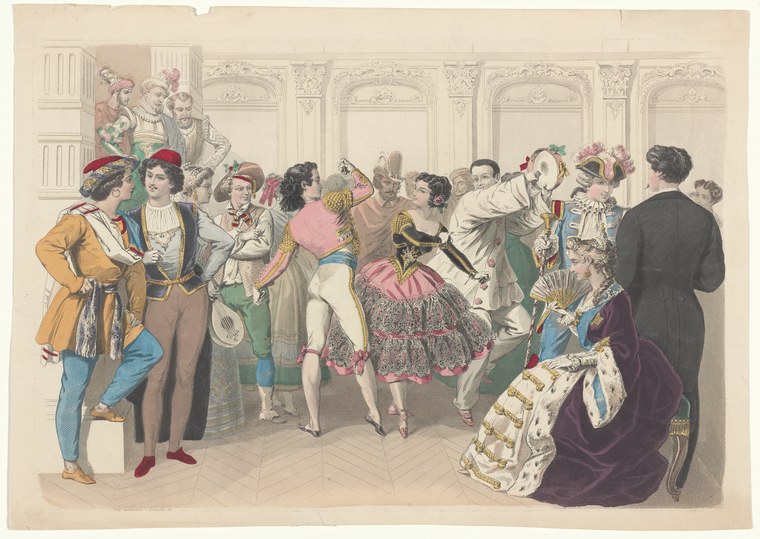
A crowded interior—a grand salon or ballroom with neoclassical architecture—captures a masquerade or fancy-dress ball in full swing. The composition is dense with figures in various costumes and masks, creating a sense of theatrical chaos and social performance. In the foreground, a woman in a striking pink silk dress with ornate embroidery dominates the scene, her pose energetic and confident; nearby stands a man in a vivid yellow-orange coat trimmed with fur, wearing a plumed hat. To the left, figures in military or continental dress lean in conversation; to the right, elaborately dressed women fan themselves or adjust their masks. The architectural setting—tall arched doorways with ornamental details, pilasters, and cornices—frames the revelry and suggests an aristocratic or wealthy merchant venue. The color palette is rich with reds, blues, golds, and flesh tones, applied with particular attention to the sheen and drape of fabrics. The moment chosen is one of social mixture and dance-readiness: some figures stand in potential dance pairs, others gesture animatedly, and the overall effect is of a society gathering where disguise permits a temporary suspension of rank and decorum.
The dancing
The figures occupy space in loose clusters rather than formed couples or lines. Most stand or lean rather than execute steps; the woman in pink appears to be in motion or about to move, her body angled and weight shifted. Arms are raised in conversation, gesture, and social signaling rather than in dance frames—fans are held, hands are extended in greeting. The mix of costumes (military uniforms, elaborate gowns, masks, plumed hats, cloaks) suggests these are not professional dancers but society members in theatrical dress. The composition emphasizes social proximity and flirtation over synchronized or structured dance movement; bodies relate to one another through gaze, gesture, and spatial proximity rather than through contact or frame.
The dance depicted
This is a depiction of a masquerade or fancy-dress ball—a social event of the 18th or early 19th century in which dancing occurred within a broader spectacle of costume, disguise, and conversation. The image records the sociability of such events rather than the execution of a specific dance form. That said, the formal dress, the ballroom setting, and the era suggest that when dancing did occur, it would have been minuet, cotillion, quadrille, or country dances typical of Regency or Gilded Age ballrooms. No clear dance formation or hold is visible; the artist was more interested in the costume, the transgression of disguise, and the social theater of the occasion than in choreographic detail.
How it was made
This is a hand-colored engraving or lithograph, characteristic of 19th-century popular and satirical print culture. The fine linear work, the precision of the architectural detail, and the way color is applied in discrete washes over the printed line all point to a print made for wide circulation—likely a commercial publication or a series of social observation prints. The technique allowed the artist to reach a middle-class audience interested in fashion, social satire, and the spectacle of urban leisure. The hand-coloring gives it a finish and vibrancy that would have made it suitable for framing or inclusion in an album.
About this work
This is a print documenting the spectacle and social performance of a 19th-century masquerade ball. The work captures not a single dance in progress but the broader theater of costume, flirtation, and social transgression that characterized such events. The fancy dress—military uniforms, plumed hats, cloaks, elaborate gowns—permits a temporary inversion of social hierarchy, and the artist has chosen to show the moment of preparation and social mingling rather than formed couples in a structured dance. The work belongs in a dance gallery because masquerades were dance events; the image reveals what spectators and participants understood as the purpose of the gathering: to create a space where disguise, movement, and social mixing could occur together. It is also important evidence for the aesthetics and furnishings of ballroom space in the period, and for the way costume and masks were understood as instruments of social freedom.
How to look at it
Attend first to the costume and disguise: the variety of dress and the play of recognition and concealment are the subject. Notice how the artist has used the architectural setting—the formal neoclassical columns and arches—to contain and frame the social chaos; the architecture is orderly, but the figures within it are playful and mixed. Look at the position of the woman in pink, whose pose and forward energy suggest readiness to move or dance, and at the men nearby who appear to be engaging with her; this spatial relationship—proximity without yet contact—captures the social prelude to dancing. Finally, observe the color and detail of the fabrics: the sheen of silk, the texture of fur trim, the precision of military uniform. The artist spent considerable skill on these surfaces, suggesting that the visual spectacle of dress was as important to the scene as the dancing itself.
The period
This print belongs to the 19th century, an era in which masquerade balls and fancy-dress balls were popular among the urban and aristocratic classes across Europe. Such events had roots in 18th-century Venetian carnival tradition and courtly masquerade, but they flourished in the Regency and Romantic periods as occasions for social satire and transgression. The formal ballroom dances of the era—minuet, quadrille, cotillion, country dances—provided the structural framework for such events, but masquerades were distinguished by costume, disguise, and a relaxation of social etiquette. In visual culture, masquerade balls became a favored subject for satirists and social observers, who used them to comment on fashion, rank confusion, and the artificiality of polite society. The print medium made such images widely accessible and part of popular discourse about urban leisure and morality.
Where it lives
This work is held in the New York Public Library's print collection, classed among prints depicting dance. It is part of a larger genre of satirical and observational prints on social life, fashion, and urban leisure that circulated in the 19th century.
Dance in this work
Questions about this work
What is a fancy-dress ball, and how does it differ from an ordinary ball?
A fancy-dress ball was a social event in which attendees wore elaborate costumes, masks, or theatrical dress, often departing from their everyday appearance and social rank. This costume and disguise created a temporary space for social transgression and playfulness. An ordinary ball followed strict codes of decorum and dress; a fancy-dress ball permitted role-play and visual spectacle. Both featured ballroom dancing, but the masquerade frame made the event as much about costume and social mixing as about the dance itself.
What dances would have been performed at a masquerade ball in this era?
The formal dances of 19th-century ballrooms were the quadrille, cotillion, country dances, and waltz. These were structured, often progressive dances that occupied much of the evening. Masquerade balls also featured informal conversation, flirtation, and movement that was not formally choreographed—which is what this print appears to capture. The print does not show a dance in progress, but rather the social prelude to dancing.
Why are so many different kinds of costume visible in one image?
Masquerade balls encouraged guests to choose their own costumes, often inspired by theatrical, military, historical, or fantastic themes. This diversity of dress was part of the appeal: the visual spectacle and the opportunity to observe others in unfamiliar guise. Military uniforms were popular, as were cloaks, masks, and historical or Oriental dress. The variety visible in this print was intentional and valued.
More dance artwork





